Basis points, pips and percentages: the units traders actually use
Central banks move rates in basis points, charts move in pips and accounts measure in percentages — three units for the same market. Here is what each means and how to convert between them.
Trading runs on three units that measure different things: central banks move rates in basis points, charts move in pips, and accounts measure results in percentages. The units sound interchangeable and are not — a 50-basis-point hike, a 50-pip move and a 5% return are three different scales for three different things. The traders who confuse them make expensive arithmetic errors; the traders who know the conversions move between the news, the chart and the statement without friction.
This guide defines each unit and the conversions between them. The pip arithmetic is in what is a pip and how to calculate pip value; the percentage arithmetic in drawdown and recovery maths.
The three units
The basis point (bp). The unit of interest rates. One basis point is one hundredth of a percentage point: 0.01%. A quarter-point rate hike is 25 basis points; a half-point is 50. The unit exists because rates change in increments too small for whole percentages — a central bank moving "0.25%" sounds awkward, so the market says "25 basis points". The interest rate guide uses the unit throughout.
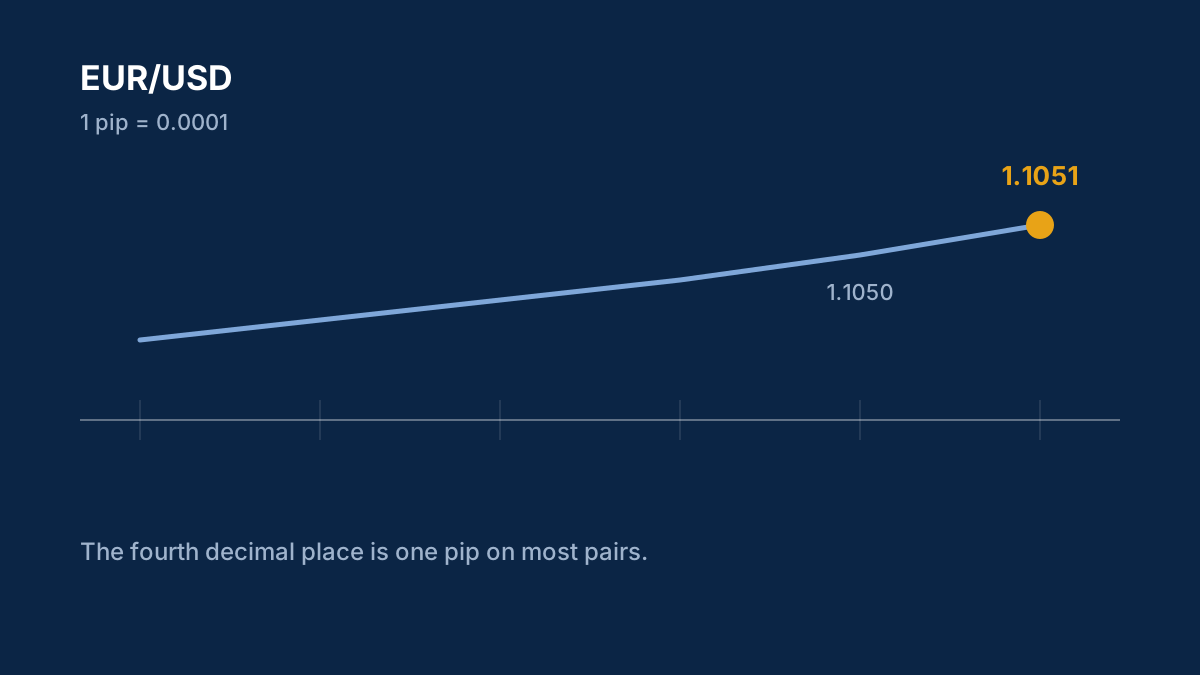
The pip. The unit of price movement on a chart. One pip is the smallest standard price step: the fourth decimal place on most pairs, the second on yen pairs. A move from 1.1000 to 1.1050 is 50 pips — the chart's distance, not the rate's. The pip's value in money depends on the position size and the pair, per the pip guide.
The percentage. The unit of results. Returns, drawdowns and risk per trade are measured as percentages of the account: a 2% monthly return, a 10% drawdown, a 1% risk per trade. The percentage is the trader's home unit — the one that connects the market's moves to the account's condition. The drawdown guide runs the percentage arithmetic.
Why the units confuse
The confusion arises where the units meet:
Basis points and pips are both small — and different. A 25-basis-point hike is a rate change; a 25-pip move is a price change. The same number, different meanings: the hike might move the pair 80 pips, or 10 — the units measure different things, and the market's reaction is the bridge between them.
Percentages and basis points use the same word family. "Rates rose half a percent" means 50 basis points — half of one percentage point, not half of the rate. The phrasing trips traders who hear "percent" and think "percentage of the rate".
Pip values are not percentages. A 50-pip move on EUR/USD is about 0.45% of the price — and the account's change is that percentage times the leverage, not the pip count. The pip is distance; the percentage is the account's result; the two connect only through position size.
The conversions that matter
Three conversions cover most practical needs:
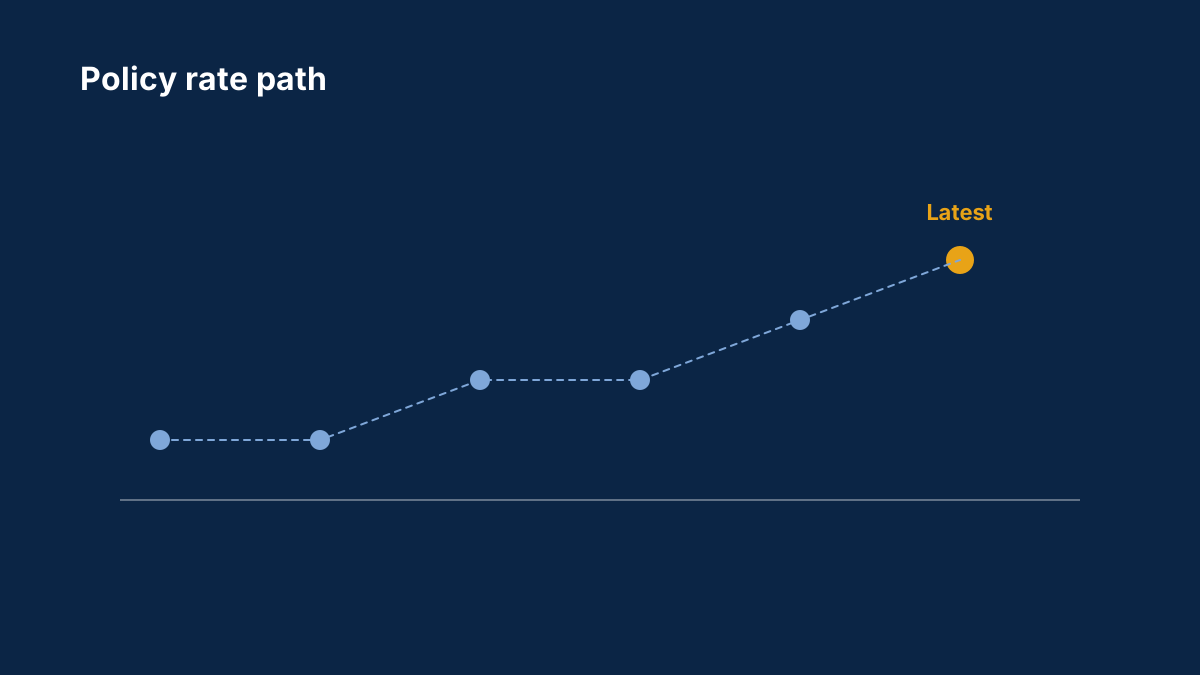
Basis points to percentage points. Divide by 100: 25 bp = 0.25 percentage points. The conversion is the rate headline's translation — "the Fed hiked 25 basis points" means "rates rose 0.25 percentage points", from 3.75% to 4.00% in the September decision (report).
Pips to price percentage. Divide the pip move by the pair's price, times the pip's decimal place: a 100-pip move on EUR/USD at 1.1000 is about 0.91% of the price. The conversion connects the chart's move to the position's exposure — and the position sizing guide uses it to convert stop distances into risk.
Money to percentage. The account's result divided by the balance: a $100 result on a $5,000 account is 2%. The conversion is the statement's translation, and the drawdown guide runs it on every recovery calculation.
The practical habits
The units' practical habits:
Read rates in basis points, not percentages. "25 bp" is the market's language, and the habit keeps the rate story precise. The central bank language explainer shows the market reading rate moves in exactly these units.
Think of pips as distance, not money. The pip's money value depends on size, and the habit of separating distance from money keeps the sizing decisions clean. The position sizing guide builds the separation into the four-step method.
Measure everything in R and percentages. The journal's results in R and the account's results in percentages keep the analysis free of account-size noise. The review guide runs the metrics in exactly these units.
The units in central bank communications
The three units meet most visibly in central bank communications, where precision is the policy. The Fed's September hike was "a quarter point" — 25 basis points — moving the target range from 3.50%–3.75% to 3.75%–4.00% (report); the ECB's hike to 2.50% was the same 25 bp in the European vocabulary (report); and the market's reaction to each was measured in the pairs' pips. The three units describe one event at three levels: the policy's size in basis points, the market's reaction in pips, and the trader's account change in percentages. The central bank language explainer covers how the market reads the communications; the units are the communications' arithmetic.
The practical skill is the simultaneous translation: hearing "25 basis points", expecting the dollar pairs' pip reaction, and knowing what the position's percentage change would be at the current size. The three-level translation is the daily work of trading the news, and the news trading playbook runs it on every release.
The conversion errors that cost money
The units' confusion produces specific, expensive errors, and naming them is the defence:
The basis-point-pip conflation. Treating a 25 bp hike as a 25-pip move — the policy's size mistaken for the market's reaction. The market's reaction is whatever it is: 10 pips or 100, decided by the surprise, not the hike's size. The news trading guide covers why the reaction's size is the surprise's, not the decision's.
The percentage-of-rate error. Hearing "rates rose half a percent" and calculating half of the current rate — 4% becoming 2% — instead of the correct 50 basis points on top. The error is the phrasing's fault and the trader's cost, and the market's habit of saying "50 basis points" exists to prevent exactly it.
The pip-percentage confusion in sizing. Calculating the position's risk as "50 pips" without converting to the account's percentage — the pip count mistaken for the risk. The position sizing guide exists to force the conversion: pips to money to percentage, every trade.
The basis-point-percentage mix in swap. Reading the swap's cost as "3 basis points" without converting to the position's nightly money — the rate's unit mistaken for the account's. The rollover explainer covers the swap's conversion.
Each error is the same pattern: one unit's number dropped into another unit's calculation. The defence is the habit of naming the unit before using the number.
The units in the journal
The journal is where the units earn their keep, and the discipline is unit purity: the results recorded in R and percentages, the market's moves noted in pips, and the policy context noted in basis points — three columns, three units, never mixed. The journal guide supplies the fields; the unit discipline is what makes the fields comparable across time and account sizes. A journal that records "made 40 pips on 2 lots" is a story; one that records "made 1.6R, +1.6%" is a record, because the units are the trader's, not the market's.
The review guide runs the journal's numbers in exactly these units, and the unit purity is what makes the weekly and monthly reviews possible: the win rate in percentages, the expectancy in R, the drawdown in percentages, the policy moves in basis points as the context. The units are the trader's accounting system, and the discipline is the accounting's integrity.
A worked example set
The conversions, practised on one trade: the Fed hikes 25 basis points; EUR/USD falls 60 pips; a trader short one mini lot at $1 per pip makes $60 — on a $6,000 account, exactly 1%. The same event, three units, one chain: 25 bp of policy, 60 pips of market, 1% of account. The Fed hike explainer runs the event's transmission; the numbers above are the units' translation of it.
The example set's lesson is the guide's whole point: the units are not interchangeable, and the trader who translates them correctly — policy in basis points, market in pips, account in percentages — is the trader who knows what any number actually means. The basis points, pips and percentages guide is the reference; the habit is the daily practise.
Basis points, pips and percentages are three languages for the same market — the rate's, the chart's and the account's. Learn the translations, and the market's numbers stop colliding and start cooperating.
Sources
Common questions
What is a basis point?
One hundredth of a percentage point — 0.01%. A quarter-point rate hike is 25 basis points. The unit is how central bank rate moves are quoted.
How do I convert basis points to percentages?
Divide by 100: 25 basis points is 0.25 percentage points. A hike of 25 bp moves a rate from 3.75% to 4.00%.
What is the difference between pips and basis points?
Pips measure price movement on a chart — the fourth decimal place on most pairs. Basis points measure interest rates — hundredths of a percentage point. They are different scales for different things.
How many pips is a 1% move in EUR/USD?
At 1.1000, roughly 110 pips — because one pip is 0.0001, and 1% of 1.1000 is 0.011. The conversion depends on the pair's price level.
Why does 'rates rose half a percent' confuse traders?
Because it means half of one percentage point — 50 basis points — not half of the rate itself. The phrasing collapses two units, and the market's habit is to say 50 basis points instead.
This article is for information only and is not financial advice. Trading forex and CFDs carries a high risk of losing money. Read the risk warning. Spotted an error? Tell the editors.
Comments
Log in to join the discussion. Comments follow the community guidelines.
Log in to commentLoading comments…