What is forward guidance? How central banks steer expectations
Central banks tell markets what they are likely to do next, so the future is priced before it happens. Here is what forward guidance is, how it works, and why the guidance sometimes fails.
Forward guidance is the central bank's most powerful communication tool: telling the market what it is likely to do next, so that the future is priced before it happens. When the Fed signals that rates will stay high for longer, the market reprices immediately — the guidance does the policy's work without a single rate change. The tool shapes every currency's path between decisions, and understanding it explains most of what the market does on the days nothing happens.
This guide explains what forward guidance is, how it works and where it fails. The language mechanics are in the central bank language explainer; the Fed's projections in the dot plot guide.
What forward guidance actually is
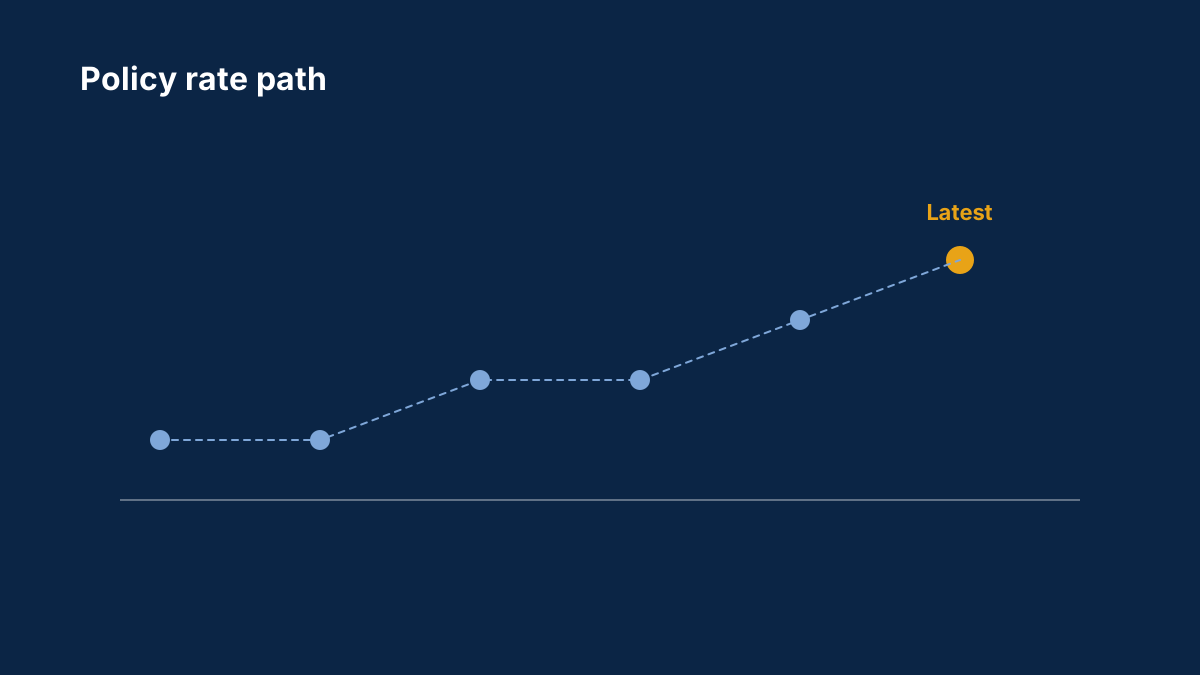
Forward guidance is a central bank's communication about its likely future policy — the intended rate path, the conditions that would change it, and the reasoning behind both. The tool comes in forms ranging from vague ("the committee will act as appropriate") to explicit ("we expect to keep rates at this level for some time") to numerical (the Fed's dot plot, the ECB's inflation projections).
The tool's purpose is steering: the central bank wants the market's expectations to align with its own intentions, because expectations do the policy's work in advance. When the market believes the bank will hike next quarter, long-term rates rise now, financial conditions tighten now, and the eventual hike lands on a market that has already adjusted — the shock is smaller, and the policy works through the guidance alone. The interest rate guide covers why expectations are the market's actual driver.
How the guidance works
The mechanism runs through expectations:
- The bank signals its intent — in the statement, the press conference, the projections or the speeches. The signal is the guidance.
- The market reprices the path — the expected rate trajectory shifts, and bond yields move with it. The bond yields guide covers the yield leg.
- The currency moves — the repriced path changes the currency's attractiveness, through the standard interest-rate channel.
- The policy lands later — and the market has already adjusted, so the actual decision moves prices only to the extent it surprises.
The September 2026 Fed decision is the live example: the hike itself was the quarter point, but the market's attention was on the projections showing rates staying near 4% through 2027 (report) — the guidance, not the decision, carried the market's message. The dot plot explainer covers how the projections steer the dollar.
The forms of guidance
The guidance's forms trade precision against commitment:
The qualitative form. "The committee will act as appropriate" — direction without timing or size. The vaguest form, and the safest for the bank, because it commits nothing.
The conditional form. "Rates will remain at this level until inflation returns sustainably to target" — the guidance ties the policy to a condition, making the path a function of the data. The conditionality is the tool's modern standard: the bank promises a reaction, not an outcome.
The numerical form. The dot plot's rate projections, the ECB's published inflation forecasts — numbers that the market can price directly. The most precise form, and the most exposed: when the data moves, the numbers must move, and the reversal costs credibility.
The central bank language explainer covers how the market reads each form's vocabulary.
Where the guidance fails
The tool has three known failure modes:
The guidance trap. The bank guides the market toward a path, the data changes, and the bank must choose between following the old guidance or admitting the change. The reversal costs credibility — the market discounts the next guidance — and the banks have learned to keep the guidance conditional to escape the trap. The dot plot guide notes the dots' own history of being overtaken by data.
The over-tight steering. Guidance that pins expectations too firmly can make the market more fragile: when everything is priced, any surprise lands harder. The tool steers, but it cannot remove uncertainty — it just moves it.
The misunderstood signal. The market reads the guidance wrong — the classic example being a conditional statement read as a promise. The misunderstanding produces the wrong pricing, and the correction produces the volatility the guidance was meant to prevent.
The trader's read
The practical read of forward guidance:
- Track the guidance's form — qualitative, conditional or numerical — because the form decides how precisely the market can price it.
- Watch the condition, not the promise — the conditional guidance's data trigger is the real signal: the release that satisfies the condition is the release that moves the path.
- Diff the language — the guidance's changes between statements are the message, per the central bank language explainer.
- Read the projections as guidance, not forecast — the dots and the inflation numbers are steering tools, and the dot plot explainer shows how to read them that way.
Forward guidance is why the currency market moves on days nothing happens — the central banks are talking, and the talk is the policy's advance guard. Read the form, watch the condition, and the market's quietest days become its most informative.
Sources
Common questions
What is forward guidance in central banking?
A central bank's communication about its likely future policy — the intended rate path and the conditions that would change it. The guidance steers market expectations so the future is priced in advance.
Why does forward guidance move currencies?
Because currencies trade the expected rate path, and the guidance changes it. The repriced path moves bond yields and the currency, before any actual rate change happens.
What are the forms of forward guidance?
Qualitative (direction only), conditional (tied to data triggers) and numerical (the dot plot, published forecasts). The form decides how precisely the market can price the path.
What is the guidance trap?
The situation where the data changes but the bank is committed to its previous guidance — and must choose between following it or reversing at the cost of credibility. Conditionality is the modern escape.
How do I trade forward guidance?
Track the form, watch the conditional guidance's data trigger, diff the statement's language changes, and read projections as steering tools rather than forecasts.
This article is for information only and is not financial advice. Trading forex and CFDs carries a high risk of losing money. Read the risk warning. Spotted an error? Tell the editors.
Comments
Log in to join the discussion. Comments follow the community guidelines.
Log in to commentLoading comments…