Margin calls and stop-outs: the exact mechanics
A margin call is the broker's warning, and the stop-out is the moment positions close automatically. Here is the exact sequence, the numbers that trigger it, and how to never meet it.
The margin call is the moment trading turns from a strategy into a survival problem — and its mechanics are knowable in advance, down to the numbers. The sequence is fixed: margin level falls, the broker warns, the stop-out fires, and positions close automatically, usually the worst first. The traders who understand the sequence never meet it; the traders who don't meet it exactly once and remember it permanently.
This guide walks the exact mechanics from margin to stop-out. The concepts are in leverage and margin explained; this guide is the sequence.
The three numbers
The margin system runs on three numbers, displayed in every platform's terminal:
Balance. The money deposited, plus realised profits and losses — the account's settled state.
Equity. The balance plus the floating profit or loss of open positions — the account's live value, the number that actually matters.
Margin. The amount of equity locked up as collateral for the open positions — the position's required deposit, set by the broker's margin requirements.
Free margin. The equity minus the margin — the amount available for new positions.
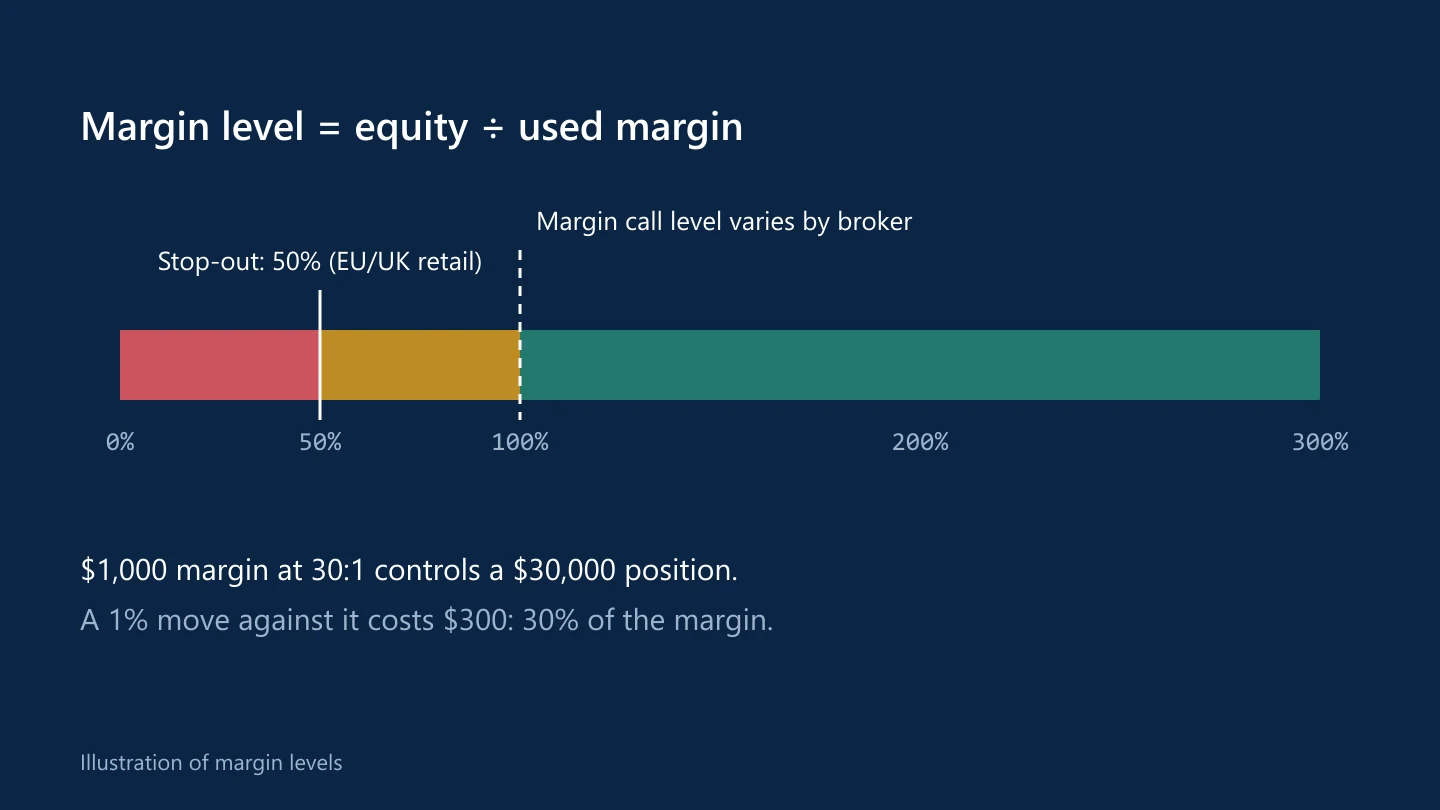
Margin level. The ratio of equity to margin, expressed as a percentage — the number the broker watches, and the one the trader should. At 100% margin level, equity equals the margin: no free margin, and no room for the position to lose more.
The margin guide defines each number with worked examples; the sequence below is what the numbers produce.
The sequence
The margin call's full sequence, step by step:
Step one: the position loses. Price moves against the open position, and the floating loss grows. The balance is unchanged; the equity falls in real time. The margin level — equity divided by margin — falls with it.
Step two: the warning threshold. When the margin level falls to the broker's warning level — commonly 100%, but brokers differ — the broker sends the margin call: a platform alert, an email, or both, warning that the margin level is critical and positions may close. The margin call is not a liquidation; it is the last chance to act — deposit more, close positions, or accept what follows.
Step three: the stop-out. If the margin level keeps falling, it reaches the stop-out level — commonly 50% or 20%, set by the broker and listed in the trading conditions. At the stop-out, the broker closes positions automatically, usually the most losing first, until the margin level recovers above the threshold. The stop-out is the liquidation — the moment the broker protects itself, and the trader's remaining equity.
Step four: the aftermath. The closed positions' losses are realised: the balance falls to match the equity. The account survives or not, depending on how far the positions ran before the stop-out — and in fast markets with gaps, the stop-out can fill well beyond the threshold, which is how accounts go below zero where negative balance protection is absent. The negative balance guide covers that worst case.
The numbers that decide
The sequence's timing is decided by three numbers the trader controls indirectly:
The position size. The larger the position relative to the account, the faster the margin level falls on any given move. A position using 50% of the equity as margin hits the stop-out on a move half as large as one using 25%. Size is the sequence's speed control.
The stop-loss. A stop placed at the planned level exits the trade before the margin system ever engages. The stop-loss is the margin system's bypass — the trader's own, earlier, cheaper exit. Its absence is what makes the margin sequence possible at all. The stop-loss guide covers the placement.
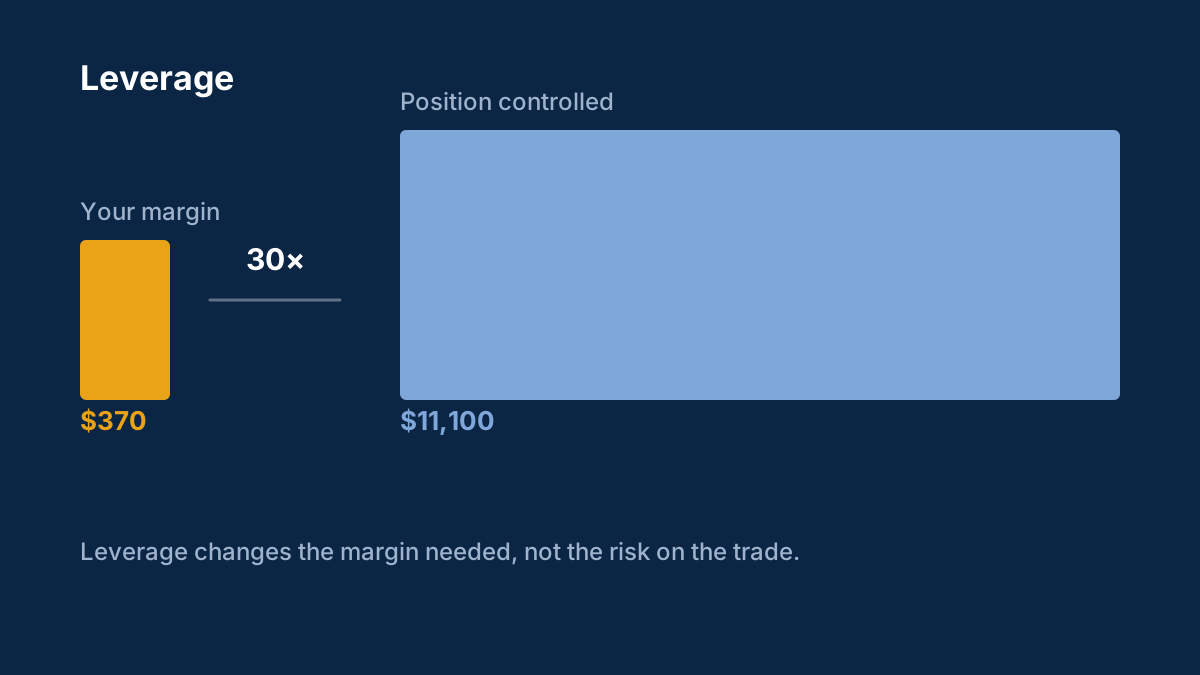
The leverage. High leverage lowers the margin required per position, which allows larger positions for the same equity — and larger positions fall faster. The leverage does not cause the loss; it sets the speed. The leverage guide covers the relationship.
How to never meet it
The margin call is avoidable by construction, and the construction has three parts:
Size by risk, always. The position is calculated from the risk per trade and the stop distance, never from the available margin. The position sizing guide has the four-step method, and it is the margin sequence's prevention.
Use the stop, always. The stop-loss exits the trade at the planned price, before the margin system's thresholds ever matter. A margin call on a stopped trade is impossible — the stop fired first.
Watch the margin level, sometimes. The terminal's margin level is the early warning gauge: below 200%, the account is using half its equity as margin, and the buffer is thinning. The number's job is to be checked before new positions — not to be discovered at the warning. The margin guide explains how to read it.
The honest lesson
The margin call's mechanics are unforgiving but not unfair: the sequence is published, the thresholds are listed, and the trader who sizes by risk and uses stops never meets it. The margin call exists for the traders who skip those two steps — and the market, which is happy to teach the sequence personally, prefers the trader learn it here first.
Sources
Common questions
What is a margin call?
The broker's warning that the margin level has fallen to a critical threshold — commonly 100%. It is the last chance to deposit or close positions before the stop-out fires.
What is the stop-out level?
The margin level — commonly 50% or 20%, set by the broker — at which positions close automatically, usually the most losing first. The stop-out is the liquidation.
What is the difference between a margin call and a stop-out?
The margin call is the warning; the stop-out is the liquidation. The call fires first, at the warning threshold, and gives the trader a chance to act before the automatic close.
How do I avoid a margin call?
Size by risk, never by available margin, and use a stop-loss on every position. A stopped trade cannot reach the margin sequence — the stop exits it first.
What happens if a stop-out fills beyond the threshold?
In fast markets and gaps, the automatic close can fill at a worse price than the threshold implies. Where negative balance protection exists, the balance is reset to zero; where it doesn't, the account can go below zero.
This article is for information only and is not financial advice. Trading forex and CFDs carries a high risk of losing money. Read the risk warning. Spotted an error? Tell the editors.
Comments
Log in to join the discussion. Comments follow the community guidelines.
Log in to commentLoading comments…