Leverage and margin explained: margin calls, stop-outs and how losses grow
Leverage lets you control a large position with a small deposit. It magnifies losses exactly as much as gains, and it is behind most blown trading accounts.
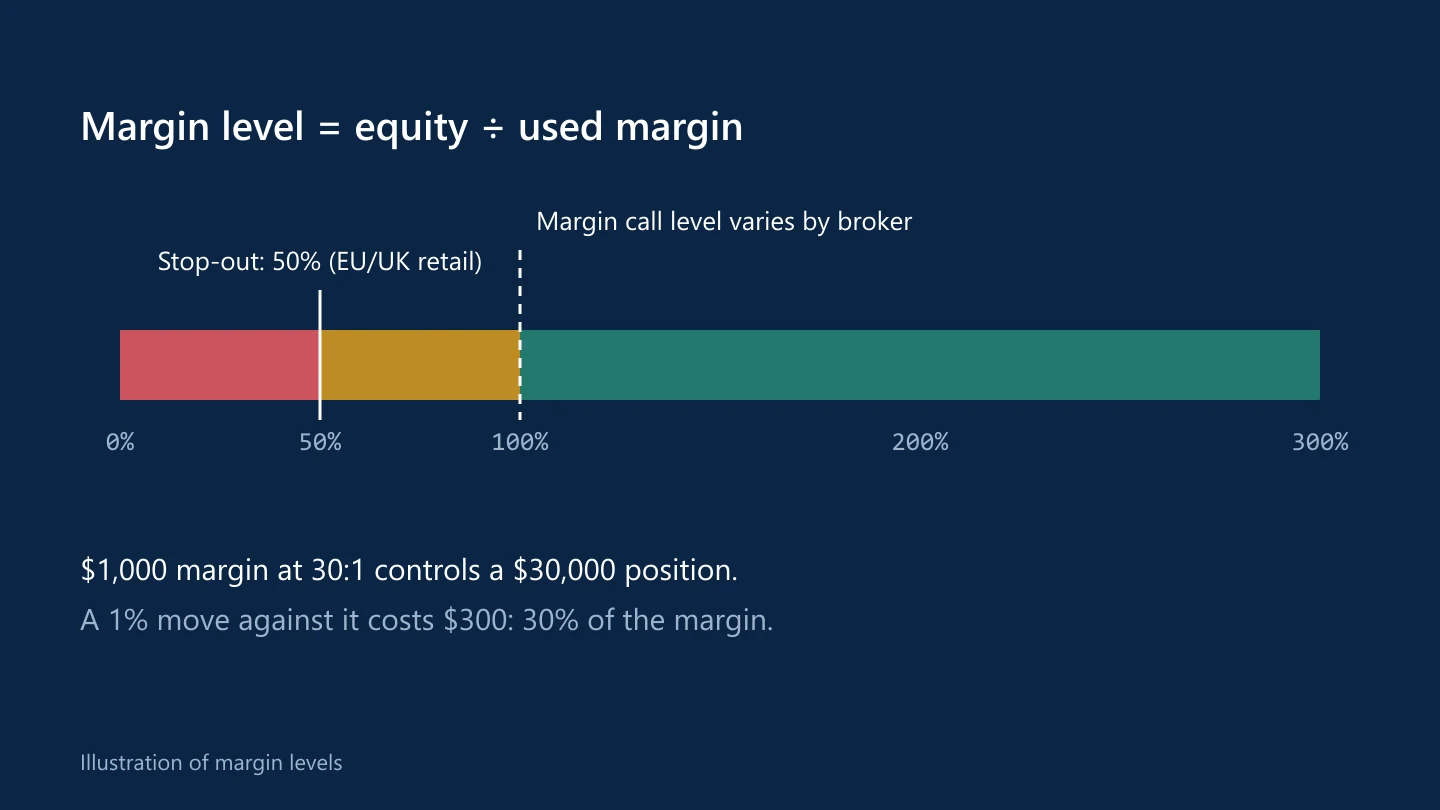
Leverage is what makes forex and CFD trading accessible with a small account, and it is also what makes it risky. Understanding how margin works is essential before you trade with real money.
What leverage means
Leverage is the ratio between the size of your position and the deposit you need to open it. At 30:1, a $1,000 deposit controls a $30,000 position. At 500:1, the same $1,000 controls $500,000.
The deposit is called margin. At 30:1, margin is 3.33% of the position's value; at 100:1 it is 1%.
Why leverage magnifies losses
Profits and losses are calculated on the full position, not on your margin. Take a $30,000 position in EUR/USD opened with $1,000 of margin:
- A 1% move in your favour earns $300, a 30% return on the margin.
- A 1% move against you loses $300, 30% of the margin.
- A 3.3% move against you wipes out the whole deposit.
Currency pairs regularly move 1% in a day, and more around major news.
The numbers on your platform
- Balance: the cash in your account, excluding open positions.
- Equity: balance plus or minus the profit or loss on open trades.
- Used margin: the deposit tied up by open positions.
- Free margin: equity minus used margin; what is left to open new trades or absorb losses.
- Margin level: equity divided by used margin, as a percentage.
Margin calls and stop-outs
When losses reduce your margin level to a set threshold, the broker issues a margin call, a warning that you need to add funds or reduce positions. If the margin level keeps falling, the broker stops you out by closing positions automatically, usually starting with the largest loser.
For retail clients in the EU and UK, brokers must close positions once equity falls to 50% of the margin required. Offshore brokers often set their stop-out much lower, which lets losses run further.
Leverage limits for retail traders
Regulators cap leverage for retail clients:
- EU, UK and Australia: 30:1 on major currency pairs, 20:1 on other pairs, gold and major indices, lower for other commodities, shares and crypto.
- United States: 50:1 on major pairs and 20:1 on others for retail forex.
Offshore companies can offer 500:1 or more. Higher available leverage doesn't oblige you to use it: the leverage you actually use is your total position size divided by your equity.
Negative balance protection
In the EU, UK and Australia, retail clients can't lose more than the money in their account: if a sudden move takes equity below zero, the broker must absorb the difference. Not every jurisdiction requires this. See negative balance protection and client money and leverage limits by country.
Common questions
What does 30:1 leverage mean?
You can control a position 30 times larger than your margin deposit. $1,000 of margin opens a $30,000 position, and gains and losses are calculated on the full $30,000.
What is a margin call?
A warning from your broker that losses have reduced your margin level to a set threshold. If it keeps falling, the broker starts closing positions automatically, which is called a stop-out.
Can I lose more than my deposit?
Retail clients of brokers regulated in the EU, UK and Australia have negative balance protection, so losses are capped at the account balance. Elsewhere, including with many offshore brokers, you could owe more than you deposited.
This article is for information only and is not financial advice. Trading forex and CFDs carries a high risk of losing money. Read the risk warning. Spotted an error? Tell the editors.
Comments
Log in to join the discussion. Comments follow the community guidelines.
Log in to commentLoading comments…