Position sizing: how to risk a fixed percentage per trade
How much you trade matters more than where you enter. A step-by-step method for sizing positions from your stop-loss and the amount you are willing to lose.
Most traders who blow up an account don't do it with one bad idea. They do it with position sizes that turn an ordinary losing streak into a disaster. Position sizing is the part of trading you fully control, so it is the best place to start managing risk.
The method in four steps
- Decide the risk per trade as a percentage of your account. Many traders use between 0.5% and 2%.
- Place the stop-loss where the trade idea is proven wrong, based on the chart, not on how much you want to risk.
- Measure the stop distance in pips.
- Calculate the position size so that hitting the stop loses exactly the amount from step 1.
The formula:
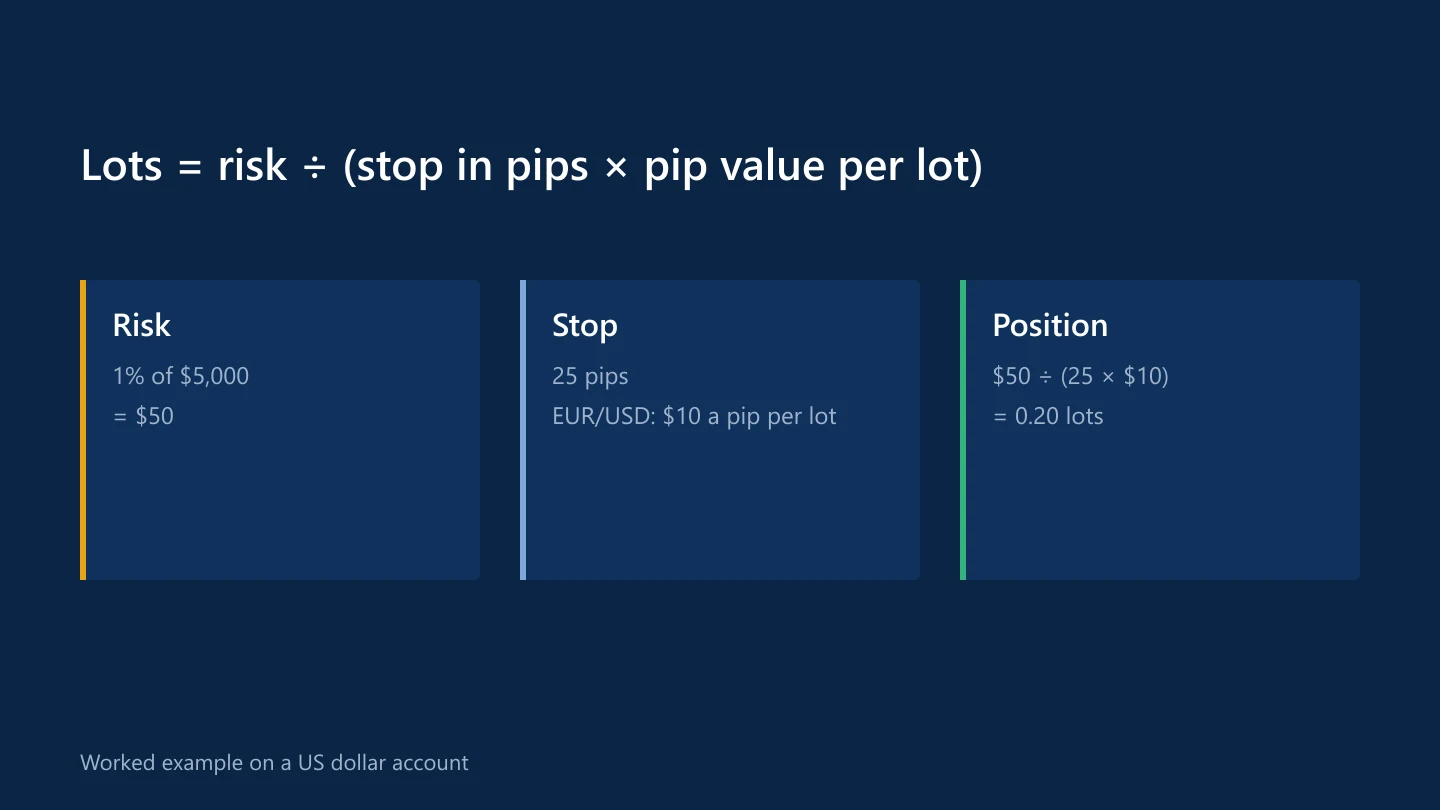
Lots = risk amount ÷ (stop distance in pips × pip value per lot)
Example on EUR/USD
- Account: $5,000
- Risk: 1% = $50
- Stop-loss: 25 pips below entry
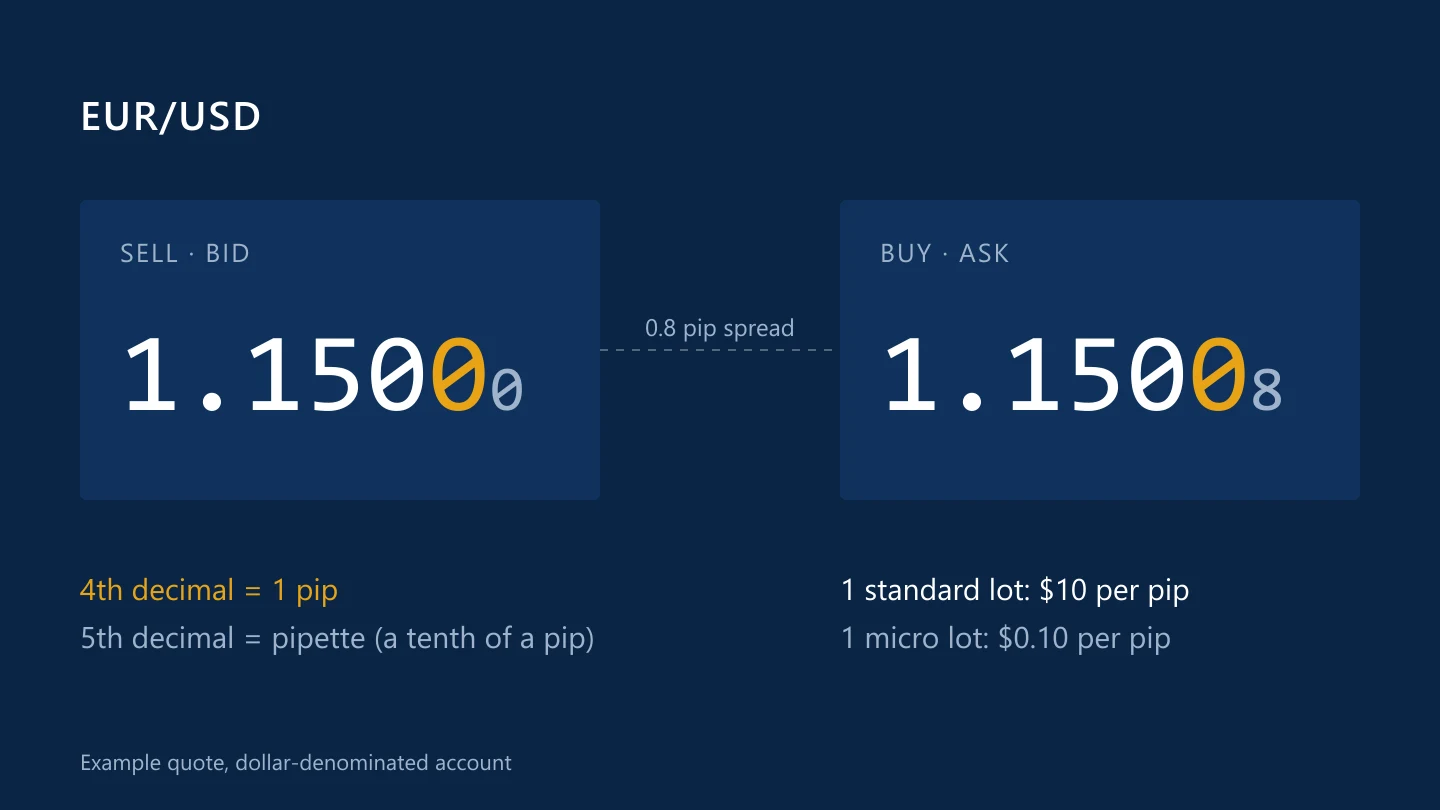
- Pip value for one standard lot of EUR/USD on a dollar account: $10
Position size = $50 ÷ (25 × $10) = 0.20 lots.
If the stop is hit, you lose $50 plus costs. If the chart needs a 50-pip stop instead, the position halves to 0.10 lots. The risk stays the same; the size adapts.
Example on USD/JPY
With USD/JPY at 150.00, one pip on a standard lot is worth about $6.67. Risking $50 with a 30-pip stop:
Position size = $50 ÷ (30 × $6.67) ≈ 0.25 lots.
Why small percentages matter
Losing streaks happen to every strategy. At 2% risk per trade, ten losses in a row leave the account about 18% down. At 10% per trade, the same streak leaves it about 65% down.
Recovering is harder than losing: a 20% drawdown needs a 25% gain to get back to where you started, and a 50% drawdown needs a 100% gain.
Things the formula doesn't cover
- Costs. Spread and commission add to the loss if the stop is hit.
- Slippage and gaps. Stops can fill beyond their level in fast markets or when the market reopens after a weekend. See bid, ask and slippage.
- Correlated positions. Buying EUR/USD and GBP/USD at the same time is close to one larger position against the dollar. Count them together; see currency correlation.
- Account currency. If your account isn't in dollars, convert the pip value into your account currency first.
For how pip values are worked out, see what is a pip.
Common questions
How do I calculate lot size from risk?
Divide the amount you are willing to lose by the stop distance in pips multiplied by the pip value per lot. For $50 risk, a 25-pip stop and $10 per pip per lot, that is 0.20 lots.
What is the 1% rule in trading?
A guideline to risk no more than 1% of the account on any single trade, so a losing streak doesn't cause a drawdown you can't recover from. It is a starting point, not a guarantee.
This article is for information only and is not financial advice. Trading forex and CFDs carries a high risk of losing money. Read the risk warning. Spotted an error? Tell the editors.

Comments
Log in to join the discussion. Comments follow the community guidelines.
Log in to commentLoading comments…