How to keep a trading journal that actually improves your trading
A journal turns a pile of trades into evidence. What to record, the numbers worth calculating and a weekly review routine that takes less than an hour.
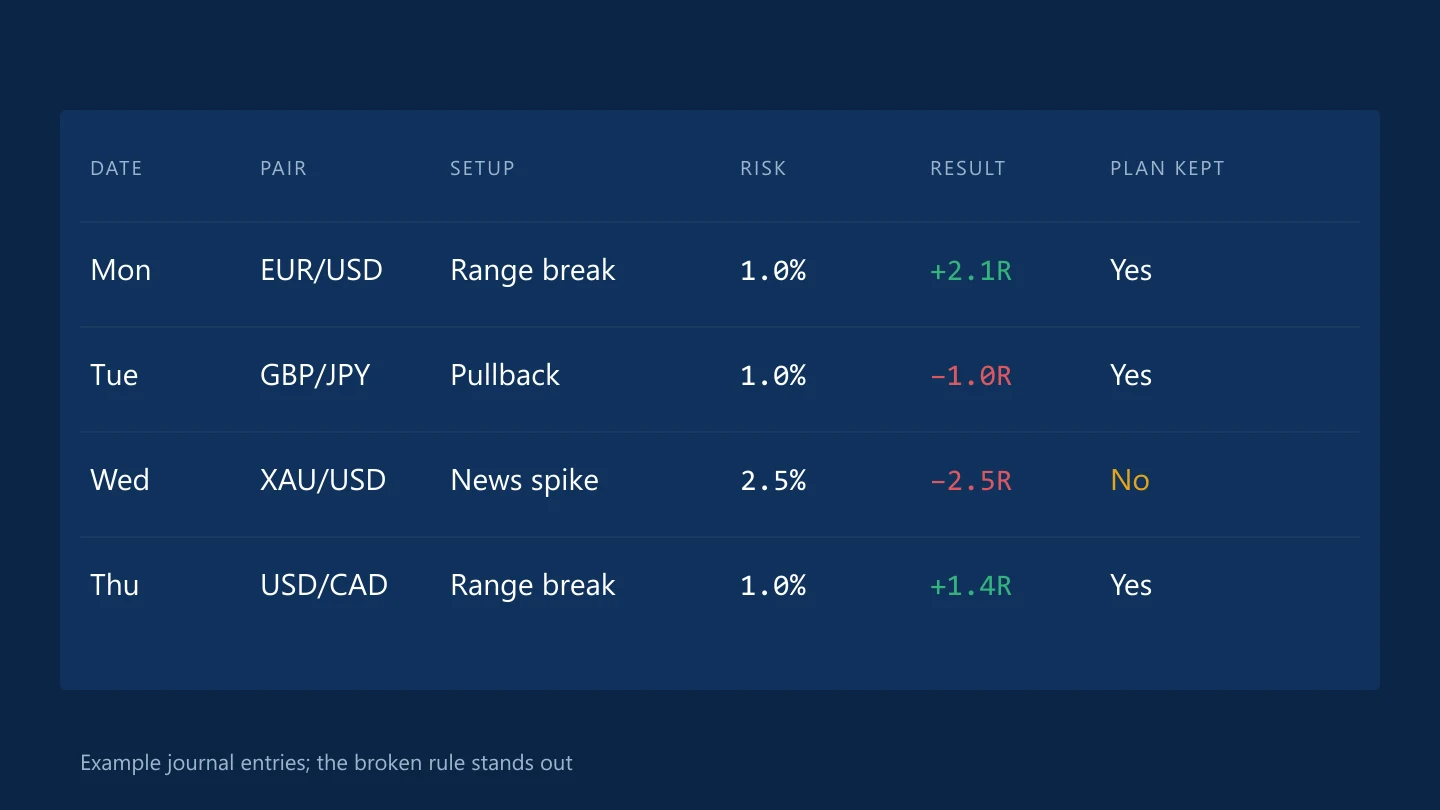
Memory is a poor record of trading. Wins feel like skill, losses feel like bad luck, and patterns stay invisible. A journal fixes that, if you keep it consistently and read it.
What to record for every trade
Before entering:
- Date, time and session
- Pair, direction and position size
- Entry, stop-loss and target, and the risk in money and as a percentage of the account
- The setup or reason, in one or two sentences
- What the economic calendar showed for the next few hours
- How you felt: calm, bored, rushed, trying to win back a loss
After closing:
- Exit price and result in money and in R (the result divided by the amount you risked)
- Whether you followed your plan
- A screenshot of the chart at entry and exit
- One sentence on what you would do differently
The numbers worth calculating
After 30 to 50 trades, calculate:
- Win rate: winning trades divided by all trades
- Average win and average loss, in R
- Expectancy: (win rate × average win) − (loss rate × average loss). A positive number means the approach made money per trade on average over this sample.
- Largest drawdown: the biggest fall from a peak in account value
A 40% win rate can be profitable if average wins are much larger than average losses, and a 70% win rate can lose money if the losses are large.
A weekly review routine
- Filter the week's trades by setup, pair and session.
- Find the rule you broke most often.
- Compare trades taken calmly with those taken in a hurry or after a loss.
- Write one change for next week, and only one.
Tags make patterns visible
Tag each trade with the setup name, the session and any mistake ("moved stop", "entered before news", "oversized"). After a few months, the tags answer questions such as which setup actually pays and which hour you should stop trading.
Tools
A spreadsheet is enough. Many platforms can export trade history, which saves typing prices, but the reasons and emotions still have to be written by hand, and those are often the most useful part.
Members share their templates in the FTC discussion what do you actually record in your trading journal?
Common questions
What should a trading journal include?
For each trade: the pair, direction, size, entry, stop, target, risk, the reason for the trade, how you felt, the result in money and in R, whether you followed your plan, and chart screenshots.
How do I calculate expectancy?
Multiply your win rate by your average win, then subtract your loss rate multiplied by your average loss. Measured in R, a positive result means the approach has made money per trade on average.
This article is for information only and is not financial advice. Trading forex and CFDs carries a high risk of losing money. Read the risk warning. Spotted an error? Tell the editors.
Comments
Log in to join the discussion. Comments follow the community guidelines.
Log in to commentLoading comments…