Norges Bank raises its rate to 4.50% while the Riksbank holds at 1.75% but flags a hike before year-end
Norway's central bank raised its policy rate a quarter point on 24 September, citing inflation still above target. Sweden's Riksbank held, but said the rate should rise more than it forecast in June if the economy keeps outperforming.
Two Nordic central banks announced their September decisions on Thursday 24 September 2026, as previewed the week before (preview). Norges Bank raised its policy rate to 4.50%, while the Riksbank held its rate at 1.75% but said increases are now likely to start before the end of the year.
Norges Bank: rate raised to 4.50%
At its meeting on 23 September, Norges Bank's Monetary Policy and Financial Stability Committee raised the policy rate from 4.25% to 4.50%, effective 25 September. The overnight lending rate is now 5.50% and the reserve rate 3.50%.
"Inflation has been above target for several years. By raising the policy rate, we are helping to reduce inflation. It will likely be necessary to keep the policy rate elevated for a time, and the Committee is prepared to raise the policy rate further if needed to bring inflation down to the 2% target within a reasonable time horizon," said Governor Ida Wolden Bache.
The Committee's reasoning:
- CPI inflation has been higher than Norges Bank projected in June
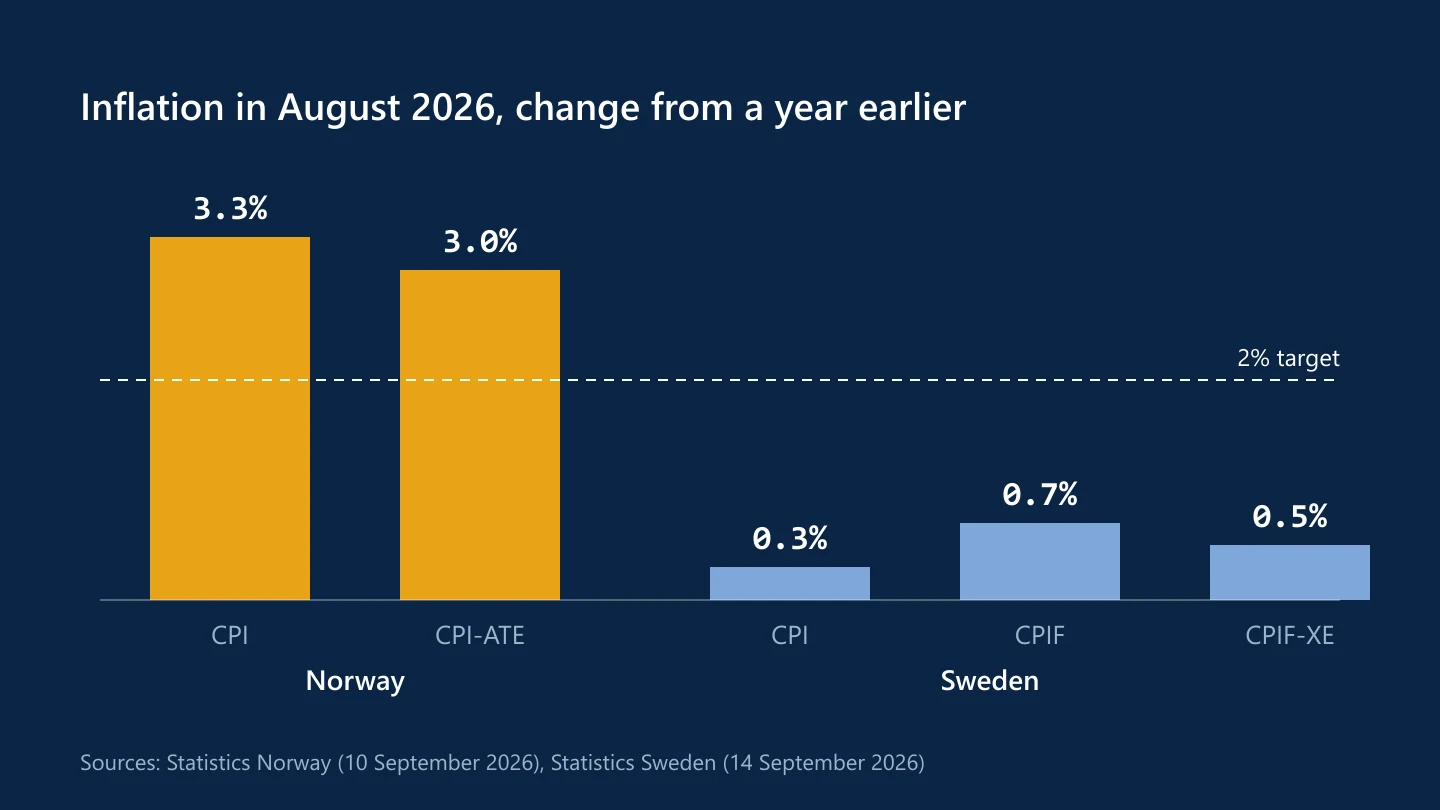
- CPI-ATE, the underlying measure that adjusts for tax changes and excludes energy, has slowed and been lower than projected (this was 3.0% in July; report)
- The krone has strengthened, which will help dampen imported goods inflation
- Wage growth is likely to be lower this year than in 2025, broadly as projected in June
- Capacity utilisation in the Norwegian economy is declining slightly less than the Committee projected in June
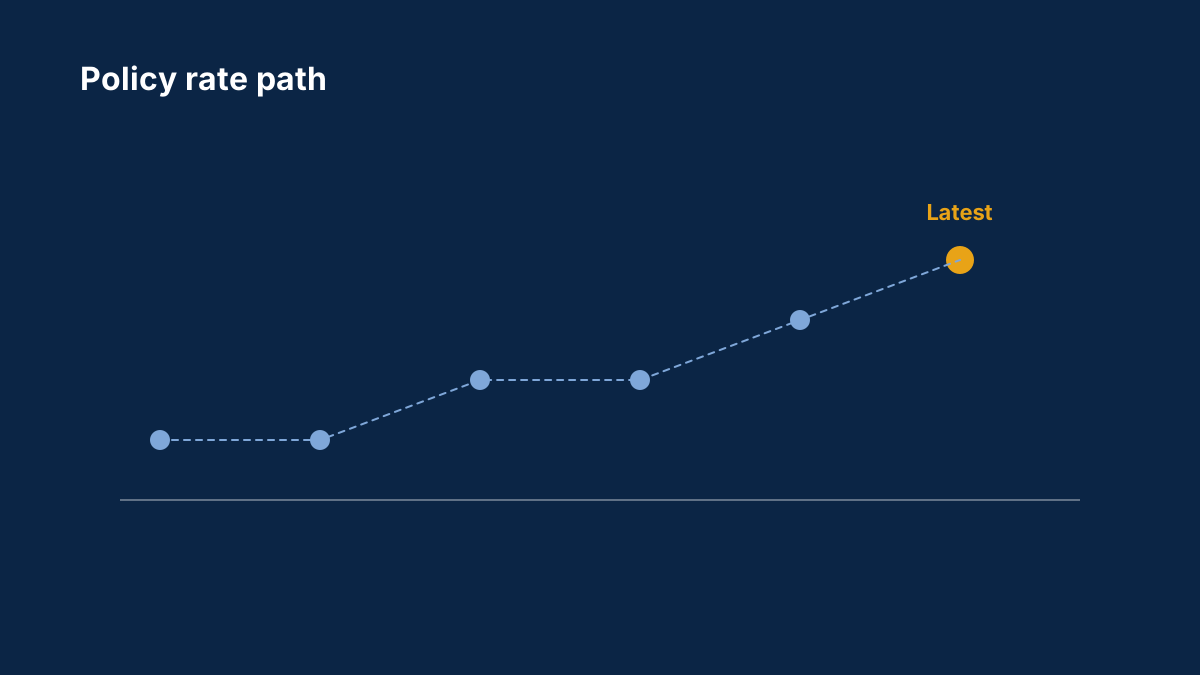
The rate path in the new forecast shows the policy rate staying elevated somewhat longer than in June's forecast, before declining. Inflation is projected to slow from next year and reach 2% in 2029. The next monetary policy decision is published on 5 November 2026.
Riksbank: held at 1.75%, but a hike is now more likely
Sweden's Riksbank left its policy rate unchanged at 1.75%. The Executive Board's statement said that "economic activity is stronger and the supply shocks are continuing," so "the policy rate should be raised more going forward than projected in the June forecast, for inflation to stabilise around 2 per cent," and that "if the outlook for inflation and economic activity remains unchanged," rate increases will begin this year.
Behind the decision:
- August inflation was in line with the June forecast; measured inflation is low mainly because of temporary fiscal policy measures, but inflation adjusted for those effects is close to 2%
- GDP grew faster than expected in the second quarter, which the Riksbank partly attributes to temporary factors, though it says the upturn looks broad
- The krona has continued to weaken, and oil, electricity and fuel prices have risen recently
- The new forecast puts the policy rate path at 1.85% in the fourth quarter of 2026, rising to 2.07% in the first quarter of 2027 and 2.38% by the third quarter of 2027
The next Riksbank decision is published on 4 November 2026, with a press conference at 11:00 that day; minutes from the September meeting are due on 30 September.
What it means for NOK and SEK
Norges Bank's hike widens the rate advantage the krone already has over the euro, while the Riksbank's guidance points toward the krona catching up later this year rather than immediately. Oil and gas exports make the krone especially sensitive to energy prices (commodity currencies explained), and Brent has traded above $100 a barrel since early September (report). For the mechanics of how a rate decision moves a currency, see how interest rate decisions move currencies.
Sources
Common questions
What is Norway's interest rate now?
4.50%. Norges Bank's Monetary Policy and Financial Stability Committee raised the policy rate from 4.25% at its meeting on 23 September 2026, effective 25 September.
Why did Norges Bank raise interest rates?
It said inflation has been above target for several years and that a somewhat tighter monetary policy stance is needed to bring it back to the 2% target within a reasonable time horizon. CPI inflation had run higher than its June projection.
What is Sweden's interest rate?
1.75%, unchanged at the Riksbank's decision on 24 September 2026. The Executive Board said increases are likely to begin before the end of the year if the outlook holds.
Will the Riksbank raise interest rates in 2026?
It hasn't committed to a date, but its 24 September statement said the policy rate should be raised more than it projected in June, and that if the outlook for inflation and growth is unchanged, the increases will begin this year.
When is the next Norges Bank decision?
5 November 2026.
When is the next Riksbank decision?
4 November 2026, with a press conference at 11:00 the same day.
This article is for information only and is not financial advice. Trading forex and CFDs carries a high risk of losing money. Read the risk warning. Spotted an error? Tell the editors.
Related reading
Discussions on this topic
- Norges Bank raised its rate and the Riksbank held: how are you trading the split between NOK and SEK?
- Did your broker's spreads widen during Thursday 24 September's run of five releases?
- Five major releases landed in one day on 24 September. How many can you actually watch at once?
- Three central banks on 24 September: Norges Bank, the Riksbank and the SNB
Comments
Log in to join the discussion. Comments follow the community guidelines.
Log in to commentLoading comments…