Negative balance protection, client money and compensation schemes
What happens to your money if a trade goes badly wrong, or if your broker goes bust? The protections that apply in the UK, EU, Australia and the US, and their limits.
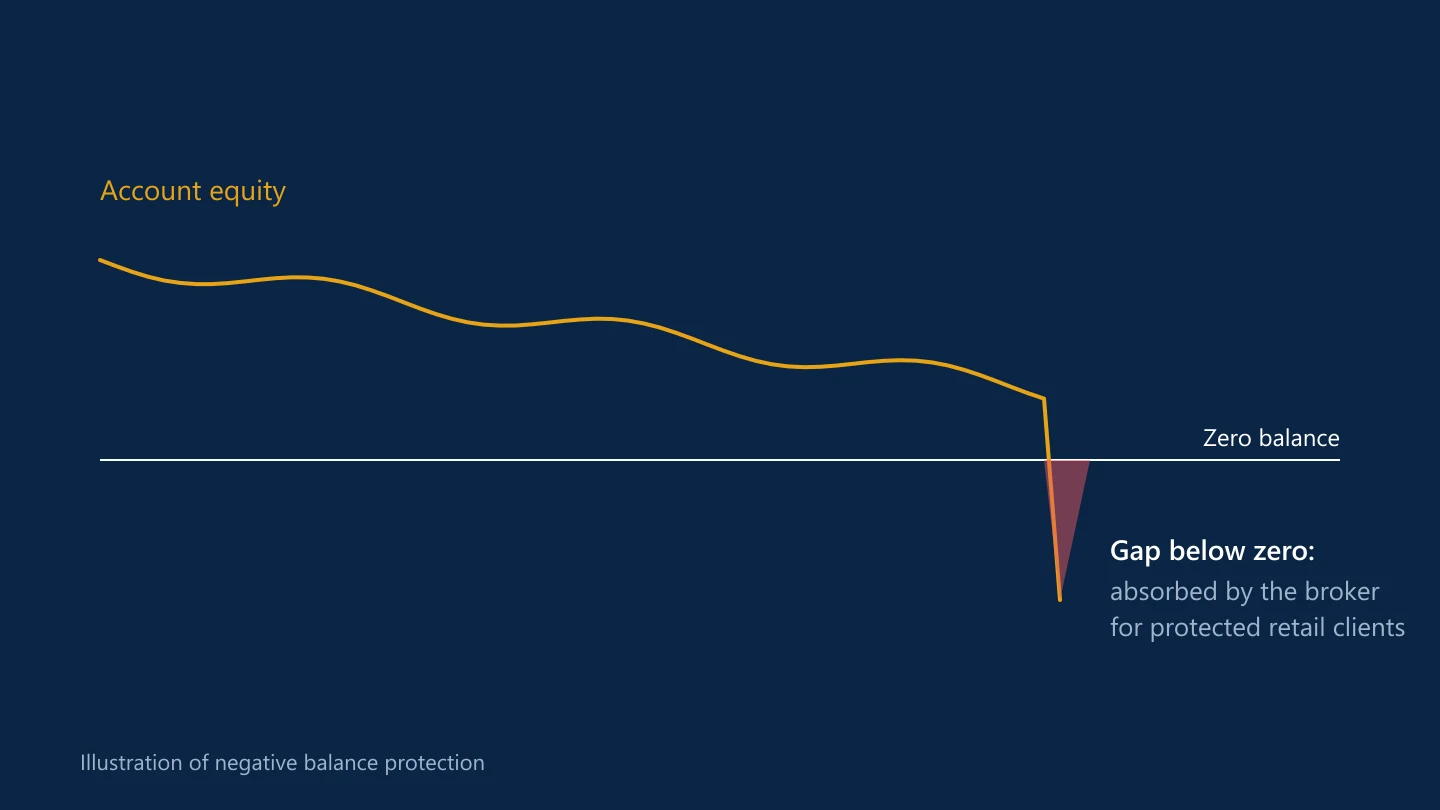
Two different risks sit behind the question "is my money safe with this broker?". One is a trade losing more than your deposit. The other is the broker itself failing. Different rules deal with each.
Negative balance protection
A sudden gap in prices can push an account's equity below zero before the broker can close positions. Negative balance protection means the client can't lose more than the money in the account: the broker absorbs the shortfall.
- EU and UK: required for retail CFD clients, per account.
- Australia: required for retail CFD clients under ASIC's product intervention order.
- Offshore companies: some offer it as a policy, but it may not be a legal requirement.
- Professional clients in the EU and UK give it up.
Client money segregation
Regulated brokers must keep clients' money separate from their own, in designated client bank accounts. In the UK this falls under the FCA's client assets rules; in Australia client money must be held in trust accounts. If the broker fails, segregated money should not be available to the broker's creditors.
Segregation is only as good as its enforcement. Checking that a broker is authorised by a strong regulator matters more than any claim on the website about "segregated accounts".
Compensation schemes
If a firm fails and client money is missing, some countries have a compensation scheme of last resort:
- UK: the Financial Services Compensation Scheme can cover up to £85,000 per person per firm for eligible investment claims.
- Cyprus: the Investor Compensation Fund covers eligible clients of Cypriot investment firms up to €20,000.
Eligibility has conditions, and not every product or client is covered, so check the scheme's own rules.
The United States
Forex accounts at US dealers are not protected by the Securities Investor Protection Corporation, and US dealers must say so. Protection relies on the firms' capital requirements and regulatory oversight by the CFTC and NFA.
What this means in practice
- Know which company holds your account, because protections follow the company's regulator, not the brand.
- Offshore companies of well-known brands may offer fewer or none of these protections; see offshore versus top-tier regulation.
- Keep only the money you need for trading at a broker.
For how the leverage rules fit alongside these protections, see leverage limits for retail traders.
Sources
Common questions
Can I lose more than my deposit trading forex?
Retail clients of brokers regulated in the EU, UK and Australia have negative balance protection, which caps losses at the account balance. With brokers not bound by those rules, a large gap could leave you owing money.
Is my money protected if my broker goes bust?
It depends on the company's regulator. Client money should be segregated, and schemes such as the UK's FSCS (up to £85,000) or Cyprus's Investor Compensation Fund (up to €20,000) may cover eligible claims. US forex accounts aren't covered by SIPC.
This article is for information only and is not financial advice. Trading forex and CFDs carries a high risk of losing money. Read the risk warning. Spotted an error? Tell the editors.
Comments
Log in to join the discussion. Comments follow the community guidelines.
Log in to commentLoading comments…