How to use leverage responsibly: sizing for survival
Leverage multiplies both the gains and the losses, and the account usually learns this before the trader does. Here is how offered leverage differs from used leverage, and how to set yours so a bad week stays a bad week.
Leverage is the reason small accounts can trade the forex market at all — and the reason most small accounts die. One number on the account application decides whether a 50-pip move is a minor loss or a margin call, and most traders choose it without understanding what it does. This guide explains what leverage actually is, how offered leverage differs from used leverage, and how to set yours so that the market's worst days remain survivable.
The full mechanics — margin, free margin, margin level and stop-outs — are in leverage and margin explained. This guide is the decision framework on top of those mechanics.
What leverage actually is
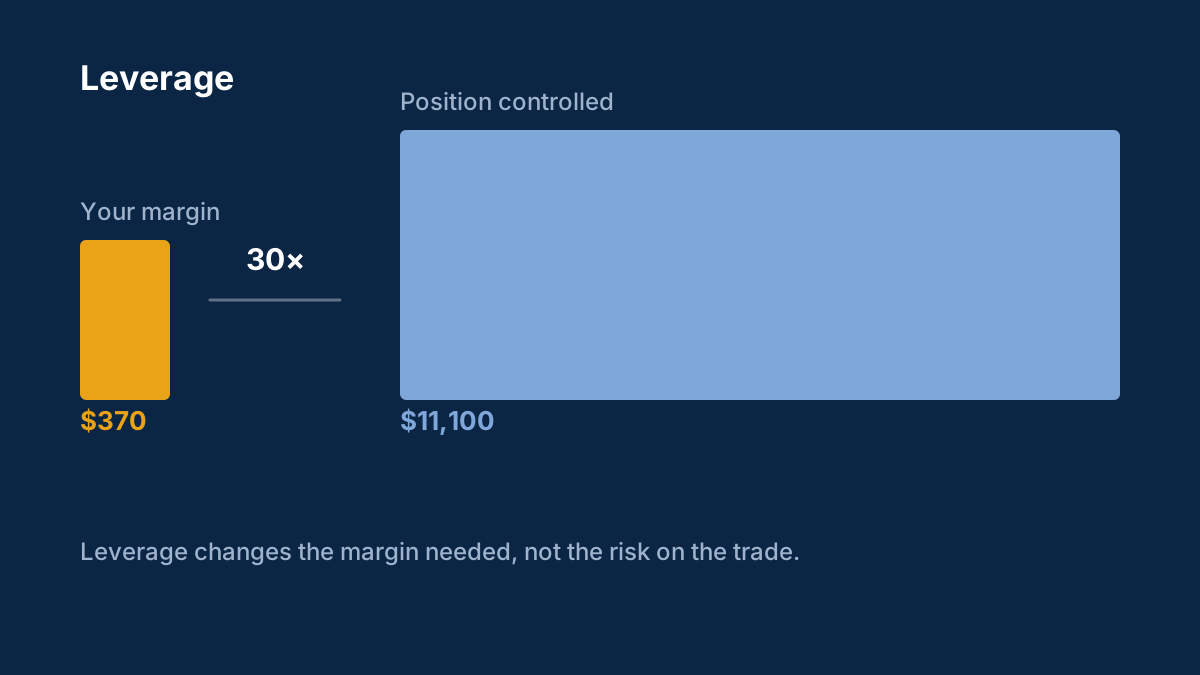
Leverage is borrowed trading capacity. At 100:1, a $1,000 account can control a $100,000 position — the broker lends the difference, using your deposit as margin. The multiplication applies to everything: a 1% move in the pair becomes a 100% move in the account's equity. That symmetry is the entire story of leverage in one sentence: it multiplies both directions, and the market moves in both.
The mistake is treating the offered maximum as a suggestion. The broker offers 500:1 because high leverage is what customers ask for and what generates volume; the offer is not advice about what your account can survive. Leverage limits for retail traders shows how regulators cap the offer by region — 30:1 in the EU and UK, 50:1 in the US — and why those caps exist.
Offered leverage versus used leverage
The number on the application and the number in your trading are different things, and the difference is where survival lives.
Offered leverage is the maximum the broker allows on the account: 30:1, 100:1, 500:1 depending on the region and entity.
Used leverage is what your positions actually employ. A $10,000 account with one 0.10-lot EUR/USD position is controlling about $10,000 of currency — roughly 1:1 used leverage — even if the account offers 500:1.
The professional pattern is simple: accept whatever leverage the broker offers on the application, and then never use most of it. The used leverage is what determines whether a move against you is survivable, and the calculation is yours, not the broker's.
The arithmetic that decides survival
The calculation every trader should be able to do in their head: what does a 1% adverse move do to the account at the current position size?
Take a $10,000 account. One standard lot of EUR/USD controls $100,000. A 1% move against it — 100 pips at these levels — costs about $1,000, or 10% of the account, before the stop even enters the picture. At five standard lots the same move is 50% of the account. The position size, not the pair, decides whether a bad day is a bad day or the end.
The discipline that follows: fix the risk per trade first — 1% of the account is the common standard — then work backwards through the stop distance to the position size. The position sizing guide has the full calculation with worked examples, and it is the single most valuable page on this site for a leveraged account.
Margin level and the stop-out
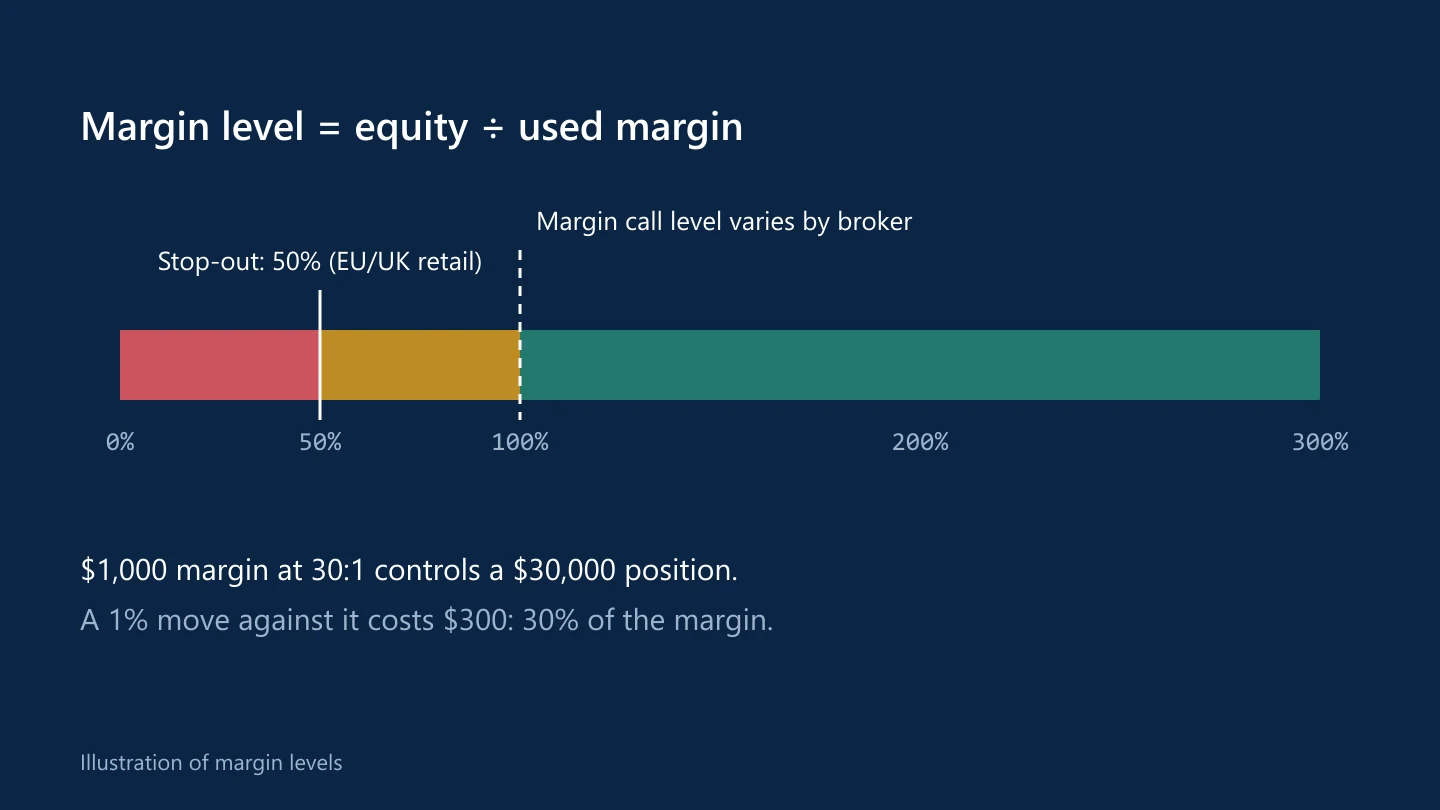
Leverage interacts with margin in a specific way, and the interaction produces the stop-out — the moment the broker closes your positions automatically. As a position moves against you, the margin level (equity divided by used margin) falls. Below a broker-set threshold, positions start closing, usually the worst first.
The stop-out is not a failure of planning; it is the predictable end of too much leverage. The defence is the same arithmetic: position sizes small enough that the margin level never approaches the danger zone in the first place. The margin guide walks through the levels and the thresholds.
Leverage and the losing streak
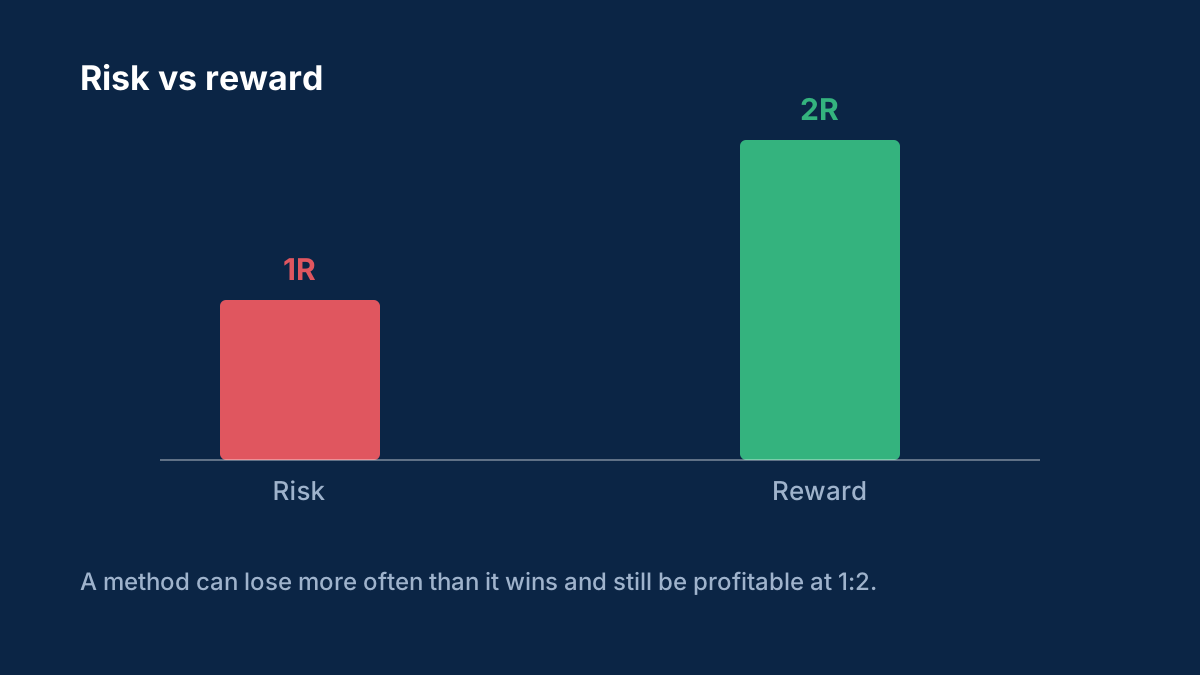
The strongest argument for low used leverage is statistical rather than emotional. Losing streaks are guaranteed — the drawdown guide shows that even a good system produces runs of eight or ten losses. The question leverage answers is what a streak costs.
At 1% risk per trade, ten losses cost about 10% of the account, and recovery is slow but straightforward. At 10% risk per trade, ten losses cost two-thirds of the account, and recovery requires roughly tripling what remains. The recovery maths is the quiet killer: the deeper the drawdown, the harder the climb back. Low leverage is what keeps the drawdown shallow enough that recovery is possible.
The rules that keep leverage safe
Four rules convert the principle into practice:
- Fix risk per trade, not position size. The risk percentage is the constant; the lot size varies with the stop distance. Position sizing is the method.
- Never size up to recover. The recovery trade is how leveraged accounts die — bigger size after losses, chasing the drawdown. The revenge trading guide explains the mechanism.
- Know what a 1% move costs on every position before you open it. If the number frightens you, the size is wrong.
- Reduce for events. Central bank days and major releases widen the plausible range; the position that is safe on a quiet Tuesday may not be safe on payrolls day. Event-sized positions are smaller positions.
Leverage is a tool with a sharp edge: it makes trading possible and makes ruin easy. The traders who last treat it as a calculation — risk first, size second, survival always — and let the broker's maximum offer sit unused. That is the entire secret, and it is not a secret at all.
Sources
Common questions
How much leverage should a beginner use?
Far less than the broker offers. What matters is used leverage — the position size relative to the account — and beginners should risk about 1% per trade, which usually means micro or mini lots at most.
What is the difference between offered and used leverage?
Offered leverage is the account's maximum, set by the broker and the regulator. Used leverage is what your open positions actually employ. The second number decides whether a move against you is survivable.
What is a stop-out?
The point where the broker automatically closes positions because the margin level has fallen below its threshold. It is the predictable end of too much leverage and can be avoided with position sizes that keep margin level safe.
Why is 30:1 leverage capped in Europe but higher elsewhere?
EU and UK regulators cap retail leverage at 30:1 for major pairs to limit client losses; other jurisdictions allow more. The same brand often runs different entities with different caps in different regions.
How do I know if my leverage is too high?
Calculate what a 1% adverse move does to your account at your current position size. If the number is more than a small fraction of the account, the used leverage is too high — reduce the position.
This article is for information only and is not financial advice. Trading forex and CFDs carries a high risk of losing money. Read the risk warning. Spotted an error? Tell the editors.
Comments
Log in to join the discussion. Comments follow the community guidelines.
Log in to commentLoading comments…