How emerging-market currencies differ from the majors
Emerging-market currencies offer higher yields and sharper risks, and they obey rules the majors don't. Here is what makes EM different — the carry, the crises and the thinness — and how to trade the complex.
Emerging-market currencies are where the forex market's risk premia live. The peso, the rand, the real and their peers offer yields far above the majors' — and they charge for it in volatility, crisis risk and thin liquidity, obeying rules the majors never learned. The traders who treat EM like faster versions of EUR/USD fund the market; the traders who learn the EM rulebook trade one of the richest parts of the currency world.
This guide explains what makes EM currencies different and how the differences shape trading. The category's risks are in major, minor and exotic pairs; the carry side in carry trade explained.
The four differences
Four features separate EM currencies from the majors:
The yield. The defining difference. EM interest rates sit well above the majors', because the economies carry higher inflation histories and higher risk premia. The yield is the complex's magnet: it attracts carry flows in calm markets and becomes the liability in crises. The carry guide covers the trade the yield attracts.
The crisis risk. The defining danger. EM currencies are exposed to the classic emerging-market crisis: capital flight, currency collapse, intervention, capital controls. The crisis is not a tail risk in EM — it is a recurring feature, and the complex's history is a cycle of booms and sudden stops. The Asian crisis guide documents the template that still repeats in modern form.
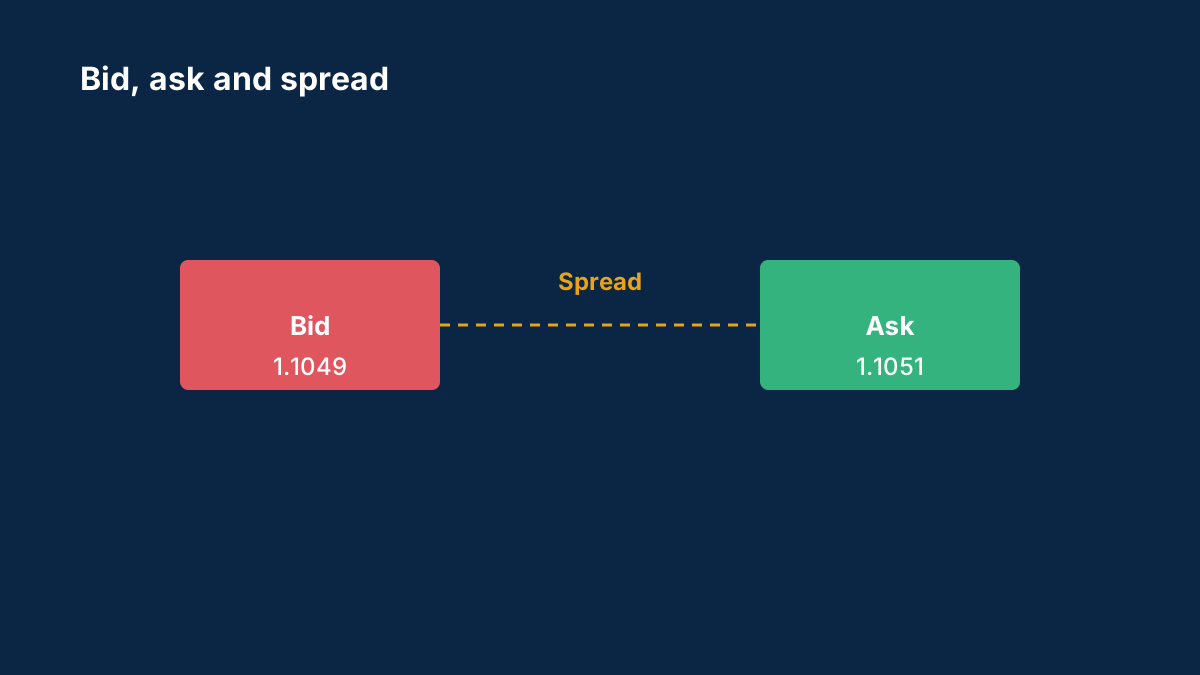
The thinness. EM markets are smaller and less liquid than the majors', which shows up in wider spreads, larger gaps and sharper spikes. The thinness compounds the crisis risk: when the flows reverse, the shallow market moves further and faster. The weekend gaps guide covers the gap mechanics that EM pairs feel most.
The politics. EM currencies are policy instruments as much as markets: governments manage them, interventions are common, and political headlines — elections, fiscal shocks, governance crises — move the currencies more than most data. The PBOC fix explainer shows the managed-float extreme; the rest of the complex carries versions of the same policy overlay.
The EM cycle
The differences combine into the complex's characteristic cycle:
The calm phase. Risk appetite is stable, the carry flows in, and the high-yielders strengthen steadily — the complex's longest and most profitable stretch, which is why EM carry has a permanent following.
The pressure phase. Something shifts — a US rate rise, a global shock, a domestic political event — and the flows slow, then stall. The currencies stop strengthening, the spreads widen, and the early warnings appear.
The stop. Risk appetite turns, the carry unwinds, and the complex falls together — the correlations that were near zero in the calm phase jump toward one, because the flows all reverse through the same door. The carry unwind explainer covers the mechanics.
The reset. The weakest currencies fall furthest, the survivors reprice, and the cycle waits for the next calm phase. The EM trader's edge is recognising the phase and trading it — or standing aside before the stop.
How the rules differ from the majors
The differences change every part of the trading plan:
Sizing. EM positions must be smaller, per unit of account, than major-pair positions — the spreads are wider and the spikes are sharper, and the position that survives EUR/USD's noise does not survive the rand's. The position sizing guide has the method, applied with EM-sized caution.
Holding periods. The carry argues for holding EM positions for days and weeks; the crisis risk argues for watching them constantly. The practical resolution is the swing approach: hold for the carry, monitor for the stop. The swap-free and carry discussion covers the income side.
The news filter. EM pairs react to a wider calendar: their own data, the US data that sets global risk appetite, and the political headlines that no calendar carries. The economic calendar guide covers the scheduled side; the unscheduled side is why EM traders read the news more than most.
The correlation discipline. In the calm phase, EM pairs trade independently; in the stop, they fall together. The trader holding three EM longs has one position in the calm and three losses in the stop — the correlation's regime-dependence is the complex's most important structural fact. The correlation guide covers the measurement.
The practical read
The EM framework compresses into a routine:
- Read the global risk mood first — the complex's master switch. The risk sentiment guide supplies the five-minute read.
- Check the carry's health: are the rate gaps intact, and is the calm phase holding?
- Mark the complex's shared calendar — US data, the dollar's path and each currency's domestic events.
- Trade the calm phase with the carry, and stand aside — or fade — when the pressure signals appear.
- Never hold an EM book into a risk event with positions sized for the calm. The stop is the complex's real test.
EM currencies are the forex market's risk premium, made tradeable: higher yield, deeper cycles, sharper lessons. Learn the four differences, read the cycle's phase, and the market's richest corner becomes its most teachable.
Sources
Common questions
Why do emerging-market currencies have higher yields?
Their economies carry higher inflation histories and risk premia, so their interest rates sit above the majors'. The yield attracts carry flows in calm markets — and becomes the liability in crises.
What is the biggest risk in EM currency trading?
The sudden stop: capital flight and currency collapse when risk appetite turns. The crisis is a recurring feature of the complex, not a tail risk, and it compounds with the markets' thin liquidity.
Why do EM currencies fall together in crises?
Because the flows all reverse through the same door: the carry unwinds, and the correlations that were near zero in the calm phase jump toward one. Diversification inside the complex fails exactly when it is needed.
How should I size EM positions?
Smaller than major-pair positions per unit of account — the spreads are wider and the spikes sharper. The position that survives EUR/USD's noise does not survive the rand's.
How do I know which phase of the EM cycle we are in?
Read the risk mood and the carry's health: stable risk appetite with intact rate gaps is the calm phase; widening spreads and stalling strength are the pressure phase; correlated falls are the stop.
This article is for information only and is not financial advice. Trading forex and CFDs carries a high risk of losing money. Read the risk warning. Spotted an error? Tell the editors.
Comments
Log in to join the discussion. Comments follow the community guidelines.
Log in to commentLoading comments…