Leverage limits for retail traders in the EU, UK, Australia, Japan and the US
Regulators cap how much leverage brokers can give retail clients. The limits by market and region, and what professional status changes.
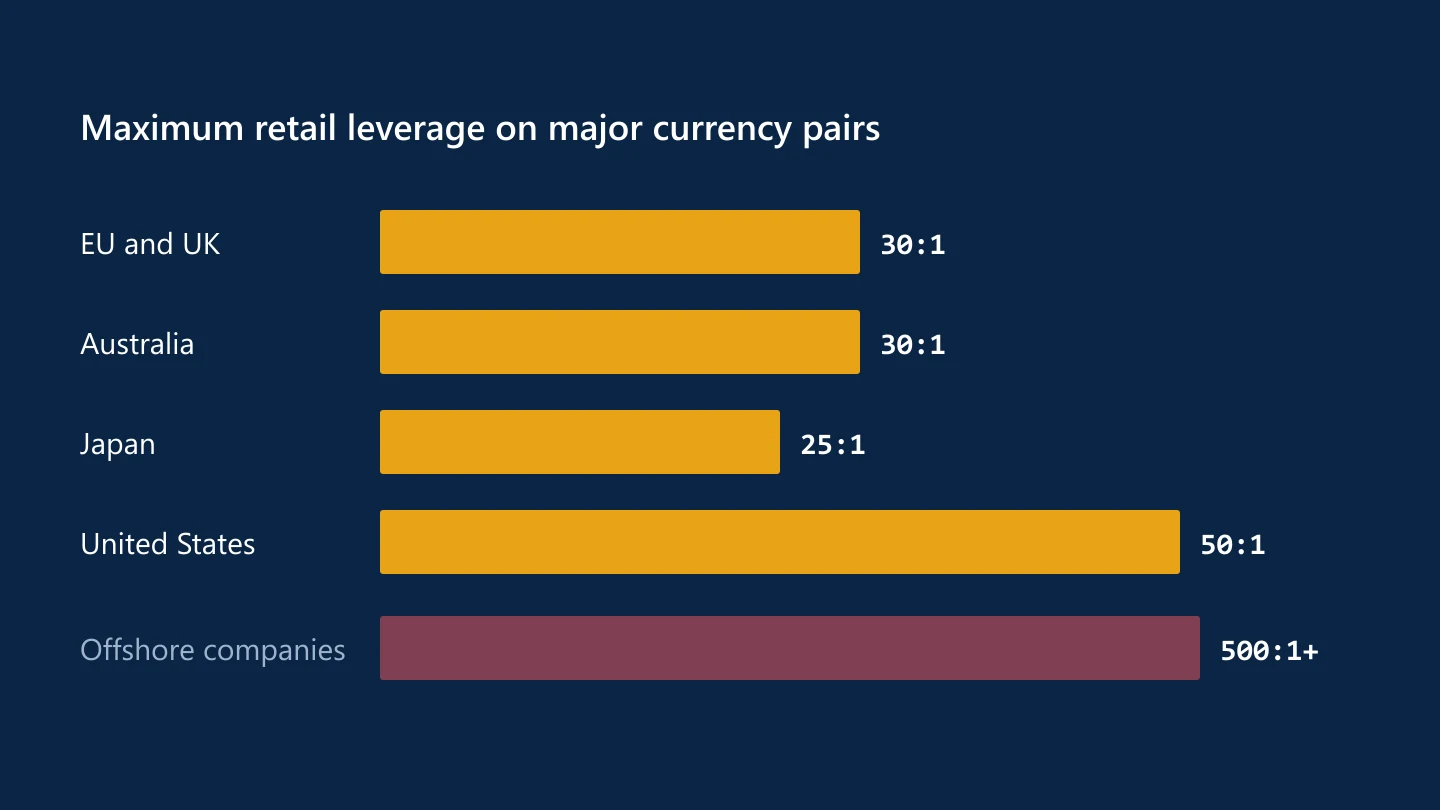
Leverage caps are one of the main differences between regulated and offshore brokers. Here is what applies to retail clients in the largest regulated markets.
European Union
Under the European Securities and Markets Authority's CFD measures, retail leverage is limited to:
- 30:1 on major currency pairs
- 20:1 on non-major currency pairs, gold and major stock indices
- 10:1 on commodities other than gold and on non-major indices
- 5:1 on individual shares and other underlying assets
- 2:1 on cryptocurrencies
The same measures require brokers to close positions when an account's equity falls to 50% of the required margin, to provide negative balance protection per account and to stop offering bonuses and other incentives to trade.
United Kingdom
The Financial Conduct Authority applies equivalent limits and protections to retail CFD clients, including the same leverage ratios.
Australia
The Australian Securities and Investments Commission's product intervention order, in force since 29 March 2021 and later extended, limits retail CFD leverage to:
- 30:1 on major currency pairs
- 20:1 on minor currency pairs, gold and major indices
- 10:1 on other commodities and minor indices
- 5:1 on shares and 2:1 on crypto assets
The order also standardised margin close-outs, introduced negative balance protection and banned inducements such as trading credits and gifts.
Japan
Retail forex leverage in Japan is capped at 25:1.
United States
Retail forex is regulated by the Commodity Futures Trading Commission and the National Futures Association. Leverage is limited to 50:1 on major currency pairs and 20:1 on others. US rules also require positions to be closed first-in, first-out and don't allow hedging the same pair; see trading forex in the United States.
Offshore companies
Brokers licensed in offshore jurisdictions often offer 500:1 or more. That doesn't make trading cheaper, only riskier: see offshore versus top-tier regulation.
Professional clients
In the EU and UK, experienced traders can ask to be treated as professional clients and receive higher leverage, but they give up retail protections such as negative balance protection. Brokers must check that clients meet criteria, which include at least two of the following:
- Trading in significant size, on average 10 times a quarter over the previous four quarters
- A financial instrument portfolio, including cash, above €500,000
- At least a year working in the financial sector in a role requiring knowledge of the products
The leverage you actually use
A cap sets the maximum. The leverage you really run is your total open position size divided by your account equity, and it is fully under your control through position sizing.
Sources
Common questions
What is the maximum forex leverage in the EU and UK?
30:1 on major currency pairs for retail clients, 20:1 on other pairs, gold and major indices, and lower limits for other markets.
What leverage can US forex traders use?
Up to 50:1 on major currency pairs and 20:1 on other pairs, under CFTC and NFA rules.
Can I get higher leverage as a professional client?
In the EU and UK, if you meet the criteria for professional status. You give up retail protections such as negative balance protection and the 50% margin close-out rule.
This article is for information only and is not financial advice. Trading forex and CFDs carries a high risk of losing money. Read the risk warning. Spotted an error? Tell the editors.

Comments
Log in to join the discussion. Comments follow the community guidelines.
Log in to commentLoading comments…