Revenge trading and overtrading: how to spot them and stop
Trading to win back a loss, or trading out of boredom, are two of the fastest ways to damage an account. Learn the warning signs and the rules that interrupt them.
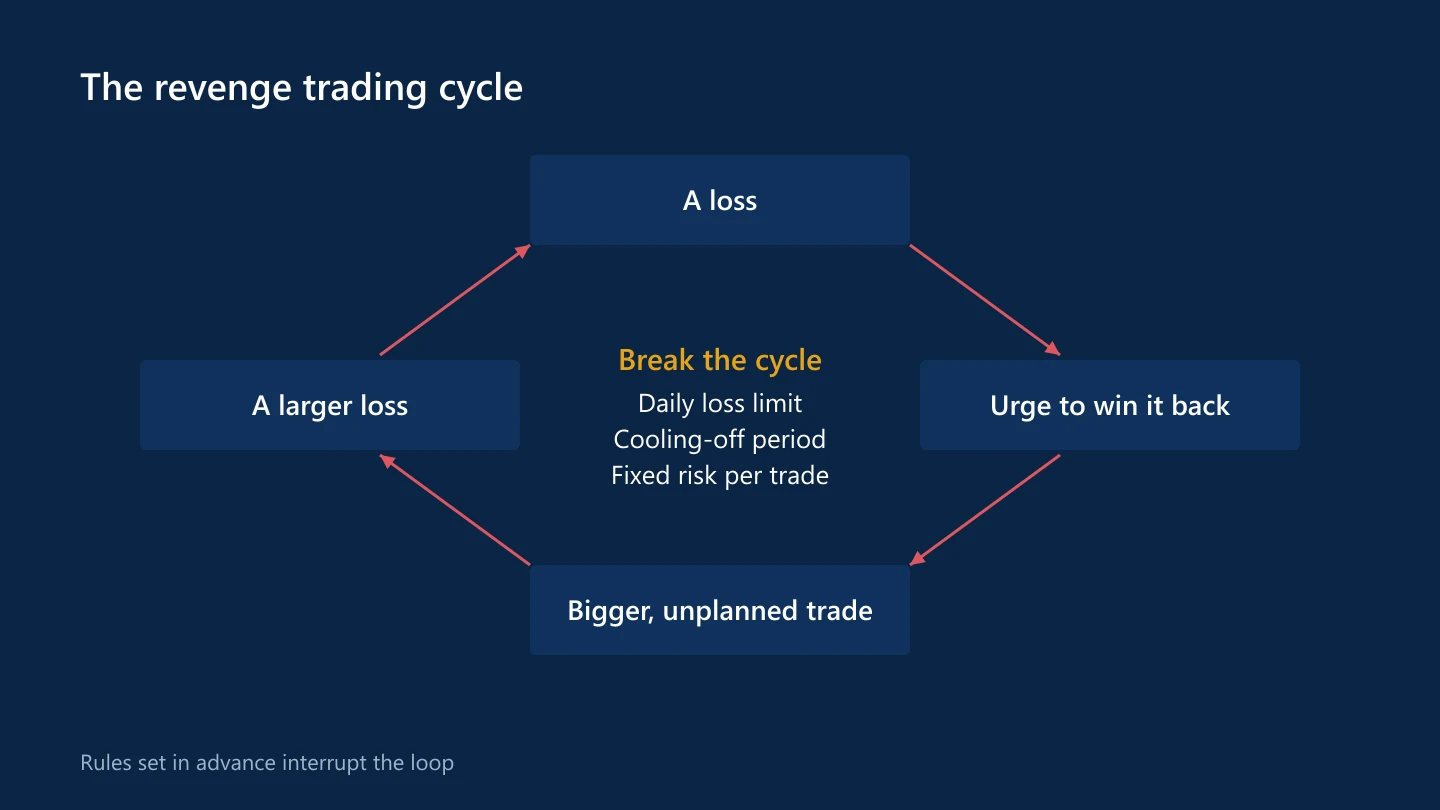
Most traders who wreck an account don't do it with one bad idea. It happens in a sequence: a loss, a quick trade to win it back, a bigger trade when that fails, then a string of decisions no plan would have allowed.
Revenge trading
Revenge trading means opening a trade to recover a loss rather than because your method produced a signal. It's driven by the discomfort of being down. Research on loss aversion, most famously Daniel Kahneman and Amos Tversky's prospect theory, found that people feel losses more strongly than equal gains, and become more willing to take risks to avoid accepting a loss.
Signs you're doing it:
- entering a new trade within minutes of a loss, often in the same pair
- increasing position size to make the money back faster
- switching to a pair or time frame you don't normally trade
- skipping your usual checklist or ignoring the economic calendar
Overtrading
Overtrading is taking more trades than your method produces. It often starts with boredom in a quiet market, or with the belief that more trades mean more profit. Every extra trade adds costs, and extra trades are usually weaker setups than the ones your rules were built around.
Signs you're doing it:
- your number of trades per week has risen without any change to your method
- you're trading sessions you normally skip
- your win rate and average win are falling as your activity rises
Rules that interrupt the cycle
Set these while you're calm, so they're already in place when you're not:
- A daily loss limit. Stop for the day after a set number of losses or a fixed percentage, such as two losses or 2%.
- A cooling-off period. Wait a fixed time, for example 30 minutes, after any loss before placing another trade.
- A maximum number of trades per day or week, based on how often your method really produces setups.
- Fixed risk per trade that doesn't change after losses; see drawdown and recovery.
- A written reason before every entry. If you can't write it in one sentence from your plan, don't take the trade.
Use your journal to catch it
Note your state of mind and whether each trade followed the plan in your trading journal. After a few weeks, compare trades taken within an hour of a loss with the rest. For most people, that comparison is the strongest argument for a cooling-off rule.
If you keep breaking your own rules, cut your position size sharply or go back to a demo account until the rules hold. And if trading has stopped feeling like a choice, talk to someone: many problem gambling support services also help people whose trading has become compulsive.
Sources
Common questions
What is revenge trading?
Opening a trade to win back a recent loss rather than because your trading plan gives a signal, often with a bigger position than usual.
How do I stop overtrading?
Set a maximum number of trades and a daily loss limit in advance, require a written reason from your plan before each entry, and check in your journal whether the extra trades have helped or hurt your results.
Why do traders take bigger risks after a loss?
Loss aversion: people feel losses more strongly than equal gains and become more willing to take risks to avoid accepting a loss. Rules set in advance, such as a cooling-off period, help counter it.
This article is for information only and is not financial advice. Trading forex and CFDs carries a high risk of losing money. Read the risk warning. Spotted an error? Tell the editors.
Comments
Log in to join the discussion. Comments follow the community guidelines.
Log in to commentLoading comments…