Currency correlation: why EUR/USD and GBP/USD often move together
Pairs that share a currency or an economic driver tend to move in step. How correlation works, why it changes and how it can quietly double your risk.
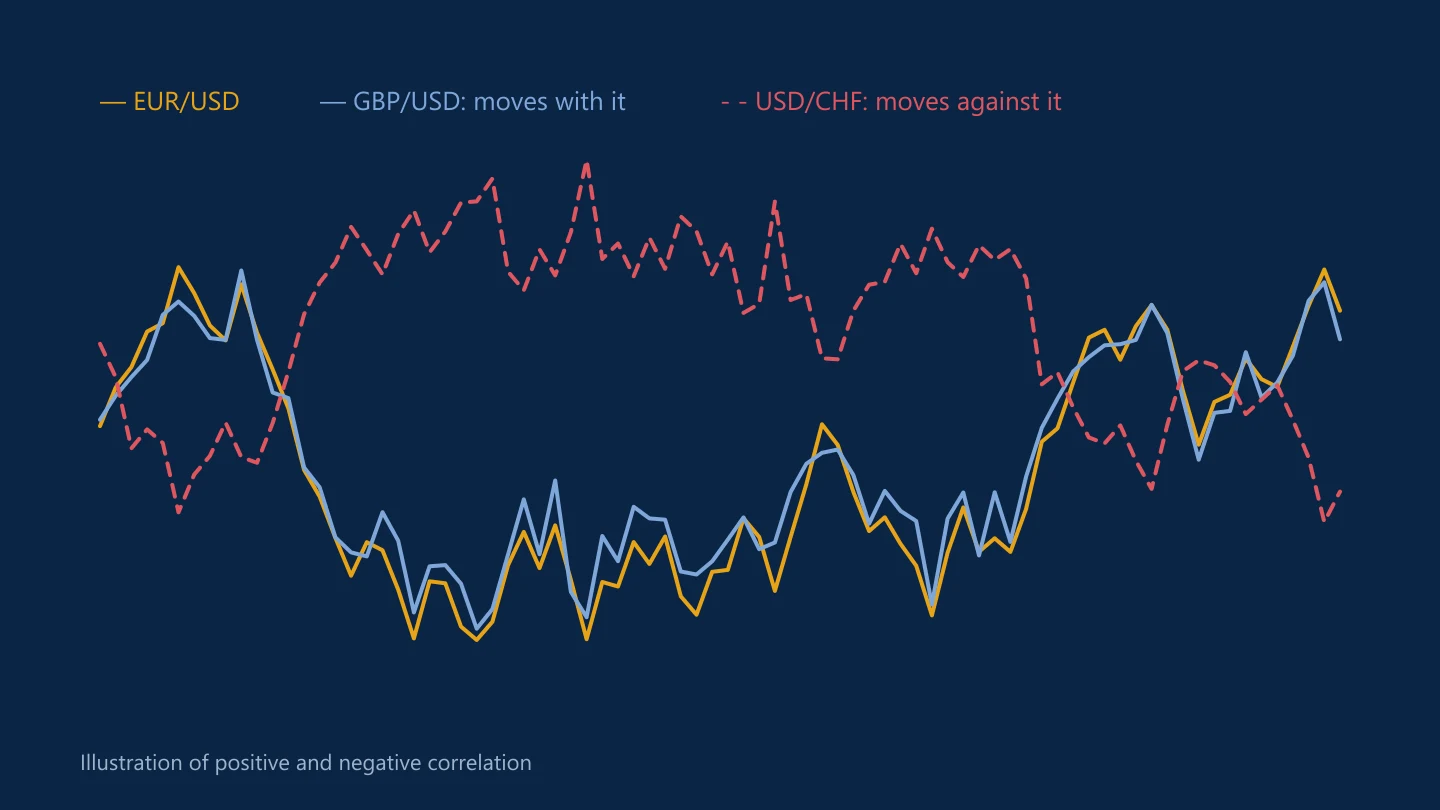
Currency pairs don't move independently. Pairs that share a currency, or that respond to the same economic forces, often rise and fall together. Ignoring that is one of the most common ways traders take on more risk than they realise.
Measuring correlation
Correlation is measured with a coefficient between −1 and +1:
- +1: the two pairs move in exactly the same direction.
- 0: no consistent relationship.
- −1: they move in exactly opposite directions.
Traders usually calculate it over a rolling window, such as the last 50 daily closes, because the relationship changes over time.
Pairs that are often positively correlated
- EUR/USD and GBP/USD: both have the dollar as the quote currency, and the euro and pound respond to similar European conditions.
- AUD/USD and NZD/USD: two commodity-linked economies with close trade ties.
Pairs that are often negatively correlated
- EUR/USD and USD/CHF: the dollar is on opposite sides of the two pairs.
- USD/CAD and oil prices: higher oil tends to strengthen the Canadian dollar, which pushes USD/CAD down; see oil and the Canadian dollar.
Why correlation changes
Correlations are not constant. They shift when:
- One country's central bank changes course while the other doesn't
- A political or economic shock hits one economy
- Market mood swings between risk-on and risk-off
A correlation that held for a year can fade within weeks, so check it against recent data rather than relying on rules of thumb.
What it means for risk
If you buy EUR/USD and GBP/USD at the same time, you effectively hold one larger position against the dollar. If each trade risks 1% of your account, a strong dollar move can hit both stops, turning 1% risk into close to 2%.
Opening EUR/USD long and USD/CHF long, on the other hand, may largely cancel out, leaving you paying two sets of costs for very little net exposure.
Count correlated positions together when you size positions, and watch live prices for the pairs you hold.
Common questions
Which currency pairs are positively correlated?
EUR/USD and GBP/USD, and AUD/USD and NZD/USD, often move in the same direction, although correlations change over time.
Why does correlation matter for risk management?
Holding highly correlated positions is similar to holding one bigger position. A single move can hit several stops at once and multiply the loss.
This article is for information only and is not financial advice. Trading forex and CFDs carries a high risk of losing money. Read the risk warning. Spotted an error? Tell the editors.

Comments
Log in to join the discussion. Comments follow the community guidelines.
Log in to commentLoading comments…