Currency intervention explained: how and why governments step in
When a currency moves too far, too fast, authorities can buy or sell it directly. How intervention works, Japan's record operations and what it means for traders.
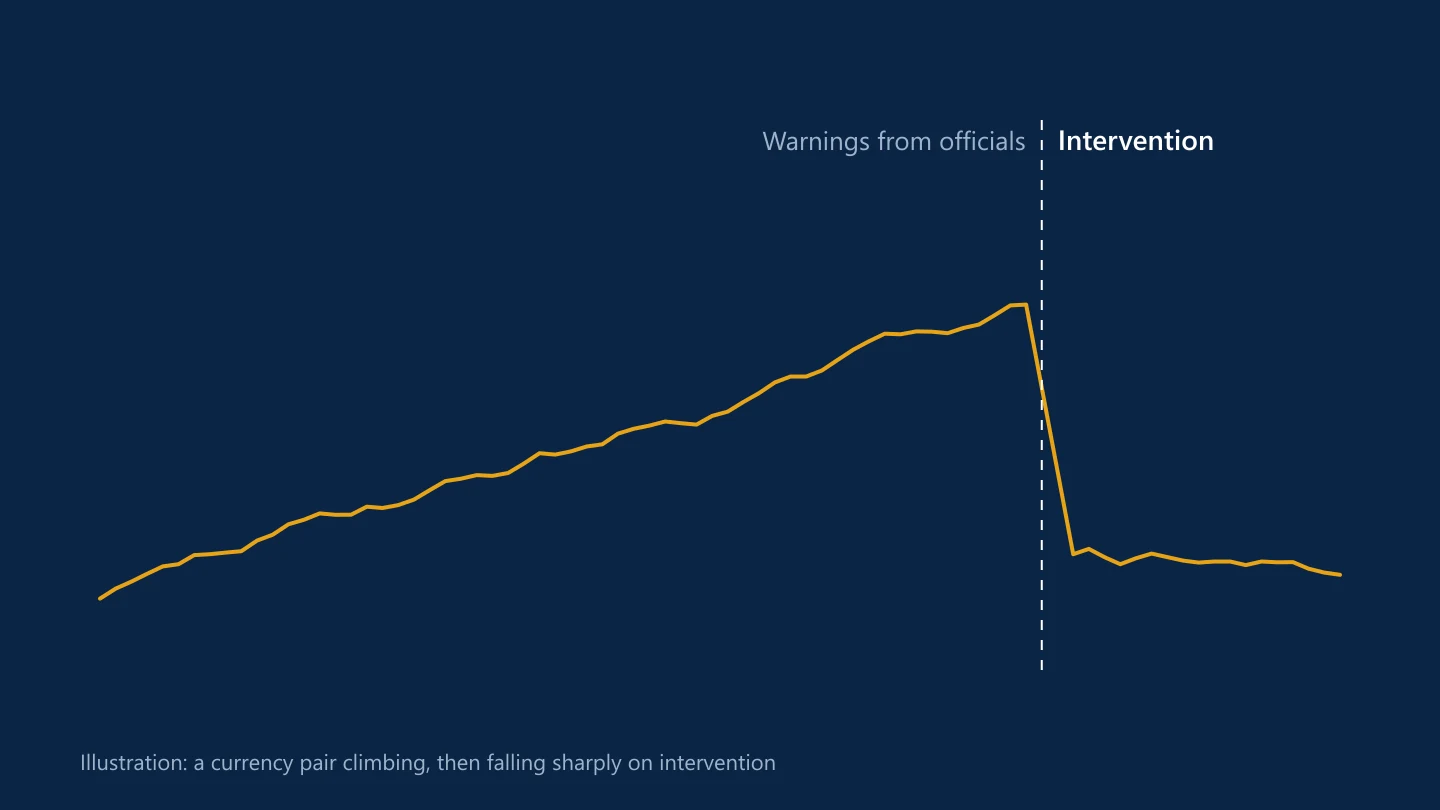
Currency intervention is when a government or central bank trades in the foreign exchange market to move its own currency. It is rare, powerful and often dramatic on the charts.
How it works
- To weaken a currency, the authority sells it and buys foreign currency, adding to its reserves.
- To strengthen a currency, it sells foreign reserves, usually dollars, and buys its own currency.
Buying support has a natural limit, because reserves can run out. Selling a currency is limited mainly by the inflation and political effects of adding more of it.
Who decides in Japan
Japan's Ministry of Finance decides when to intervene, and the Bank of Japan carries out the trades as its agent. The ministry publishes intervention totals at the end of each month, with a quarterly breakdown by day.
Japan's recent yen-buying operations
After years of yen weakness driven by the gap between Japanese and US interest rates, Japan has bought yen repeatedly:
- 2022: about ¥9.2 trillion over September and October.
- April–May 2024: ¥9.79 trillion, spent over two days, a monthly record at the time.
- 28 April to 27 May 2026: ¥11.73 trillion, about $74 billion, a new record according to Ministry of Finance data.
- 31 July 2026: a joint operation with the US Treasury, which Finance Minister Katayama Satsuki confirmed on 3 August. Details are in Japan and the US confirm joint intervention.
Warning signs before intervention
Authorities rarely surprise the market without warning. Traders watch for:
- Verbal intervention: officials saying they are watching the market "with a high sense of urgency" or that moves are "excessive" or "speculative".
- Rate checks: reports that the central bank has asked dealers for prices, often seen as the last step before action.
- Fast one-way moves to new multi-decade levels.
Switzerland: the opposite problem
The Swiss National Bank has intervened to weaken the franc, a safe-haven currency. It held a minimum exchange rate of 1.20 francs per euro from 2011 until it abruptly scrapped it on 15 January 2015. In 2026 it has said it has an increased willingness to intervene again if the franc appreciates too quickly. See safe-haven currencies.
Does intervention work?
Intervention can halt a move and punish one-way positioning, but it rarely reverses a trend on its own if the underlying drivers, especially interest rate differentials, stay the same. Coordinated action by several countries has more force: the 1985 Plaza Accord, when major economies agreed to push the dollar lower, is the classic example.
What it means for traders
- Moves of several figures in minutes are possible, with wide spreads and slippage.
- Stops on the losing side can fill far from their levels; see bid, ask and slippage.
- After confirmed intervention, holding large positions against the authorities carries extra risk, which is one reason traders cut size in USD/JPY near intervention zones.
Sources
- Ministry of Finance, Japan: foreign exchange intervention operations
- Ministry of Finance, Japan: statement by Minister Katayama Satsuki, 3 August 2026
- Xinhua: Japan spends 11.73 trln yen on forex intervention in April–May
- Nippon.com: Japan spends record amount on yen-buying intervention in October 2022
Common questions
What is currency intervention?
When a government or central bank buys or sells its own currency in the foreign exchange market to influence its value.
How much has Japan spent on yen intervention?
About ¥9.2 trillion in September and October 2022, ¥9.79 trillion in April–May 2024 and a record ¥11.73 trillion between 28 April and 27 May 2026, according to Ministry of Finance data. Japan also intervened jointly with the US on 31 July 2026.
What is a rate check?
When a central bank contacts dealers to ask for exchange rate quotes. Markets often read it as a warning that intervention may follow.
This article is for information only and is not financial advice. Trading forex and CFDs carries a high risk of losing money. Read the risk warning. Spotted an error? Tell the editors.


Comments
Log in to join the discussion. Comments follow the community guidelines.
Log in to commentLoading comments…