US PCE inflation is 3.4% in August as consumer spending jumps 0.9% and real incomes stall
The Fed's preferred inflation gauge rose 0.3% on the month, with core PCE up 3.0% on the year. Spending rose $190.8 billion while real disposable income was unchanged and the saving rate was 4.1%.

The personal consumption expenditures (PCE) price index, the Federal Reserve's preferred measure of inflation, rose 0.3% in August 2026 and was 3.4% higher than a year earlier, the Bureau of Economic Analysis said on 30 September. Excluding food and energy, prices rose 0.2% on the month and 3.0% on the year.
The figures
- PCE price index: +0.3% on the month (July: +0.1%), +3.4% on the year
- Core PCE price index: +0.2% on the month (July: +0.1%), +3.0% on the year
- Personal income: +0.2%, or $66.6 billion, mainly compensation and government social benefits
- Disposable personal income: +0.3%, but 0.0% after adjusting for prices
- Consumer spending (PCE): +0.9%, or $190.8 billion: $114.1 billion on goods and $76.7 billion on services. After adjusting for prices, +0.6%
- Saving rate: 4.1%, with personal saving of $990.2 billion
Spending outran incomes
Spending rose much faster than income, and real disposable income was unchanged, so the gap was filled by saving less. That is a pattern the Fed watches because spending that is not backed by income gains is harder to sustain.
A note on revisions
The release presents monthly results from BEA's annual update of the National Economic Accounts, which revises personal income and outlays back to January 2021. Earlier published figures, including July's report, may therefore differ from the revised series.
What it means for the Fed and the dollar
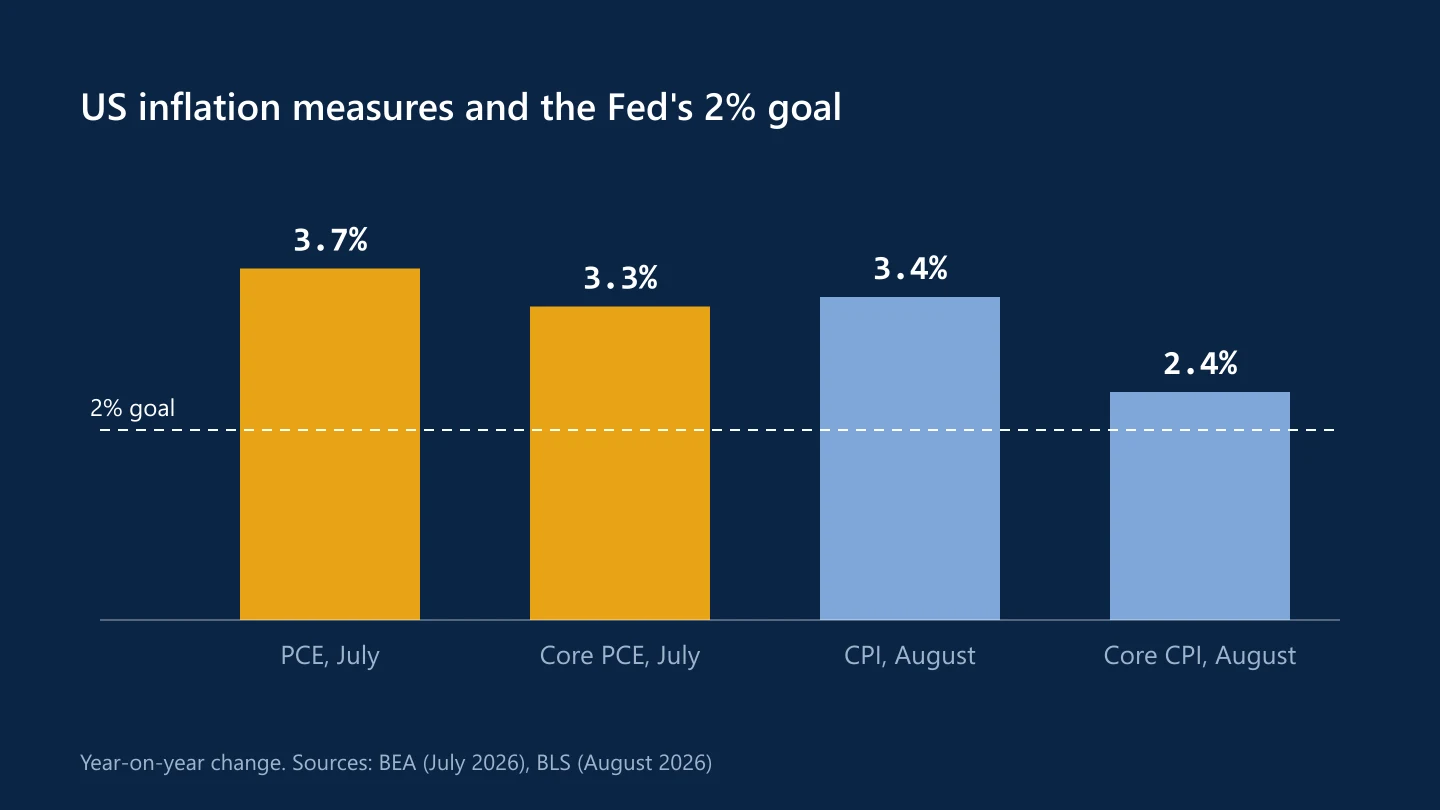
The Fed's projections in September had PCE inflation at 3.7% in 2026 and core PCE at 3.4% (report). August's consumer price index showed inflation at 3.4% with core at 2.4% (report); the two gauges measure core inflation differently, which is why they can diverge. With payrolls slowing in September (report), the committee has strong spending and 3% core inflation on one side and weaker hiring on the other. CPI explained covers headline and core measures.
What happens next
September's PCE figures and the advance estimate of third-quarter GDP are both published on 29 October at 8:30 a.m. Eastern Time, a day after the Fed's decision.
Sources
Common questions
What was US PCE inflation in August 2026?
The PCE price index rose 0.3% on the month and 3.4% from a year earlier. Excluding food and energy it rose 0.2% and 3.0%, the Bureau of Economic Analysis reported on 30 September 2026.
What is the PCE price index?
A measure of the prices paid by consumers, published by the Bureau of Economic Analysis with personal income and spending. The Federal Reserve's 2% inflation goal is defined in terms of PCE.
How much did US consumer spending rise in August 2026?
Spending rose 0.9%, or $190.8 billion, and 0.6% after adjusting for prices. Real disposable personal income was unchanged.
What was the US saving rate in August 2026?
4.1%, with personal saving of $990.2 billion.
Why can PCE and CPI inflation differ?
The two indexes weight goods and services differently and cover different spending. In August the annual rate excluding food and energy was 3.0% on the PCE measure and 2.4% on the CPI measure.
When is the next PCE report?
29 October 2026 at 8:30 a.m. Eastern Time, covering September, together with the advance estimate of third-quarter GDP.
This article is for information only and is not financial advice. Trading forex and CFDs carries a high risk of losing money. Read the risk warning. Spotted an error? Tell the editors.


Comments
Log in to join the discussion. Comments follow the community guidelines.
Log in to commentLoading comments…