GDP explained for forex traders: quarterly, annualized and monthly growth
GDP measures the size of an economy, but growth is reported differently in the US, Canada, UK, euro area and Australia. How to read a GDP release, what revisions mean and when it moves currencies.
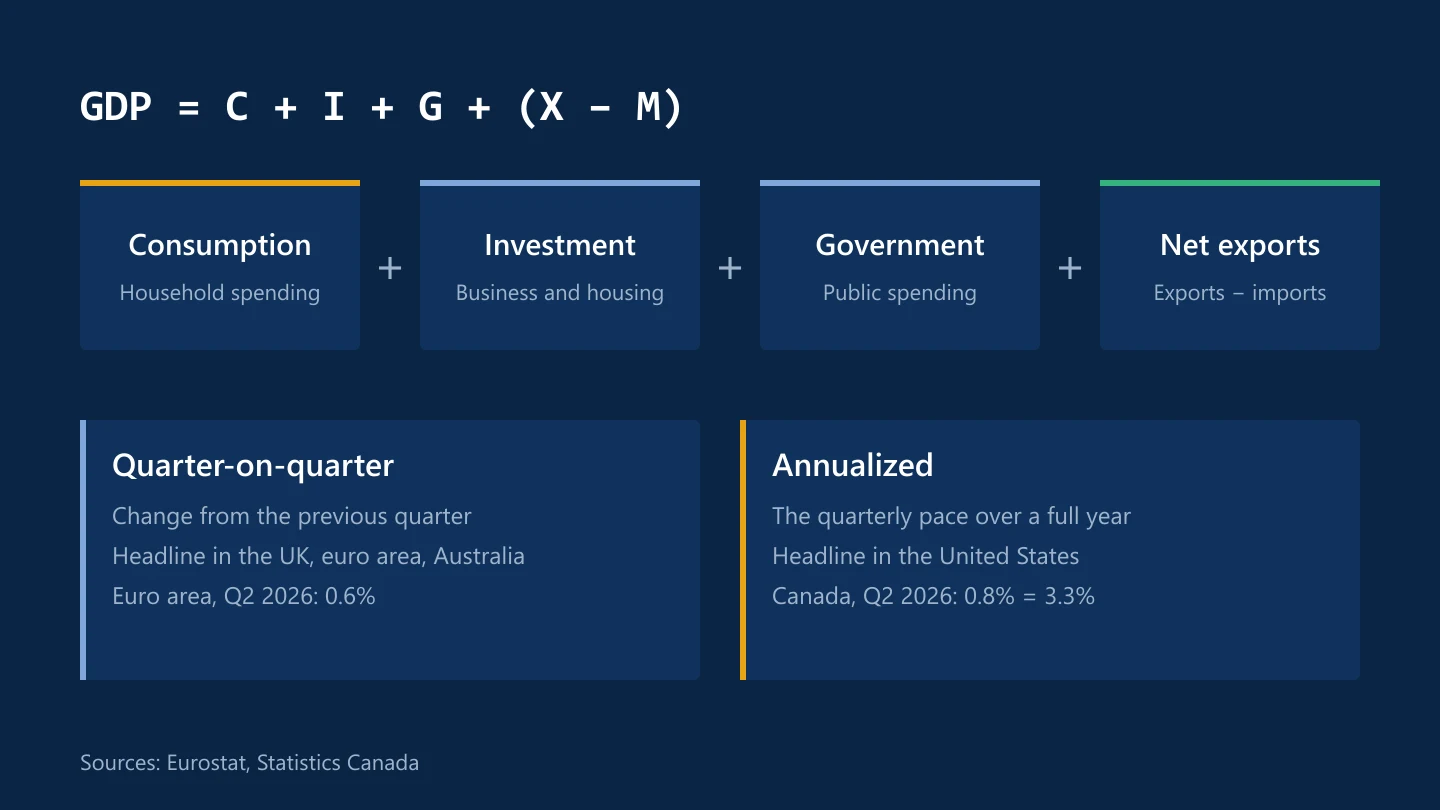
Gross domestic product, or GDP, measures the value of everything an economy produces over a period. For currency traders it's a core measure of economic health, but countries report it in different ways, and the differences cause real confusion.
What GDP adds up
The expenditure approach adds four parts:
GDP = consumption + investment + government spending + (exports − imports)
- Consumption: household spending, usually the largest part in advanced economies
- Investment: business spending on equipment and buildings, housing, and changes in inventories
- Government spending on goods and services
- Net exports: exports minus imports
GDP can also be measured by adding up incomes, or the output of each industry. Statistical agencies reconcile the approaches.
Headline growth figures are almost always real GDP, adjusted for inflation, so growth reflects more output rather than higher prices.
Same quarter, different numbers
The biggest trap is how growth is expressed:
- Quarter-on-quarter: the change from the previous quarter. The euro area, UK and Australia headline this. The euro area grew 0.6% in the second quarter of 2026 (report) and Australia 0.4% (report).
- Annualized: the quarterly rate compounded over four quarters. The United States headlines this, and Canadian results are widely reported the same way. Canada's second-quarter growth was 0.8% quarter-on-quarter, or 3.3% annualized (report).
- Year-on-year: the change from the same quarter a year earlier.
A 0.8% quarter and a 3.3% annualized rate describe the same growth. Compare like with like before concluding one economy is growing faster than another.
Monthly GDP
Some countries publish monthly estimates. The UK's Office for National Statistics does, and UK GDP grew 0.4% in July 2026 (report). Statistics Canada publishes monthly GDP along with an early estimate for the following month.
Estimates and revisions
GDP is estimated in stages as more information arrives. The US Bureau of Economic Analysis, for example, publishes an advance estimate about a month after a quarter ends, then updates it. Revisions can change the story: a quarter first reported as flat can later show growth or contraction.
How GDP moves currencies
- The surprise matters more than the level. Markets react to the difference between the figure and forecasts on the economic calendar.
- Timing reduces the impact. GDP covers a period that ended weeks earlier, and surveys such as PMIs, jobs reports and retail sales have often signalled the result already. That's why GDP usually moves currencies less than inflation or employment data.
- Composition counts. Growth driven by consumer spending says more about domestic inflation pressure than growth from a one-off jump in exports or inventories.
- It feeds into central bank decisions. Stronger growth can support expectations of higher interest rates, the main channel through which it affects exchange rates (rate decisions and currencies).
Sources
Common questions
What is the difference between quarterly and annualized GDP growth?
Quarterly growth is the change from the previous quarter. Annualized growth compounds that rate over four quarters. Canada's 0.8% growth in the second quarter of 2026 equals 3.3% annualized.
Does GDP move the forex market?
It can, especially when the figure differs from forecasts, but GDP often moves currencies less than inflation or jobs data, because earlier indicators have already signalled much of the result.
What is real GDP?
GDP adjusted for inflation, so that growth reflects changes in the volume of output rather than changes in prices.
This article is for information only and is not financial advice. Trading forex and CFDs carries a high risk of losing money. Read the risk warning. Spotted an error? Tell the editors.

Comments
Log in to join the discussion. Comments follow the community guidelines.
Log in to commentLoading comments…