The sterling flash crash of 7 October 2016: what the BIS investigation found
Sterling fell about 9% against the dollar in early Asian trading before recovering much of the move. The BIS found no single cause. What it concluded, and what it means for your stops.
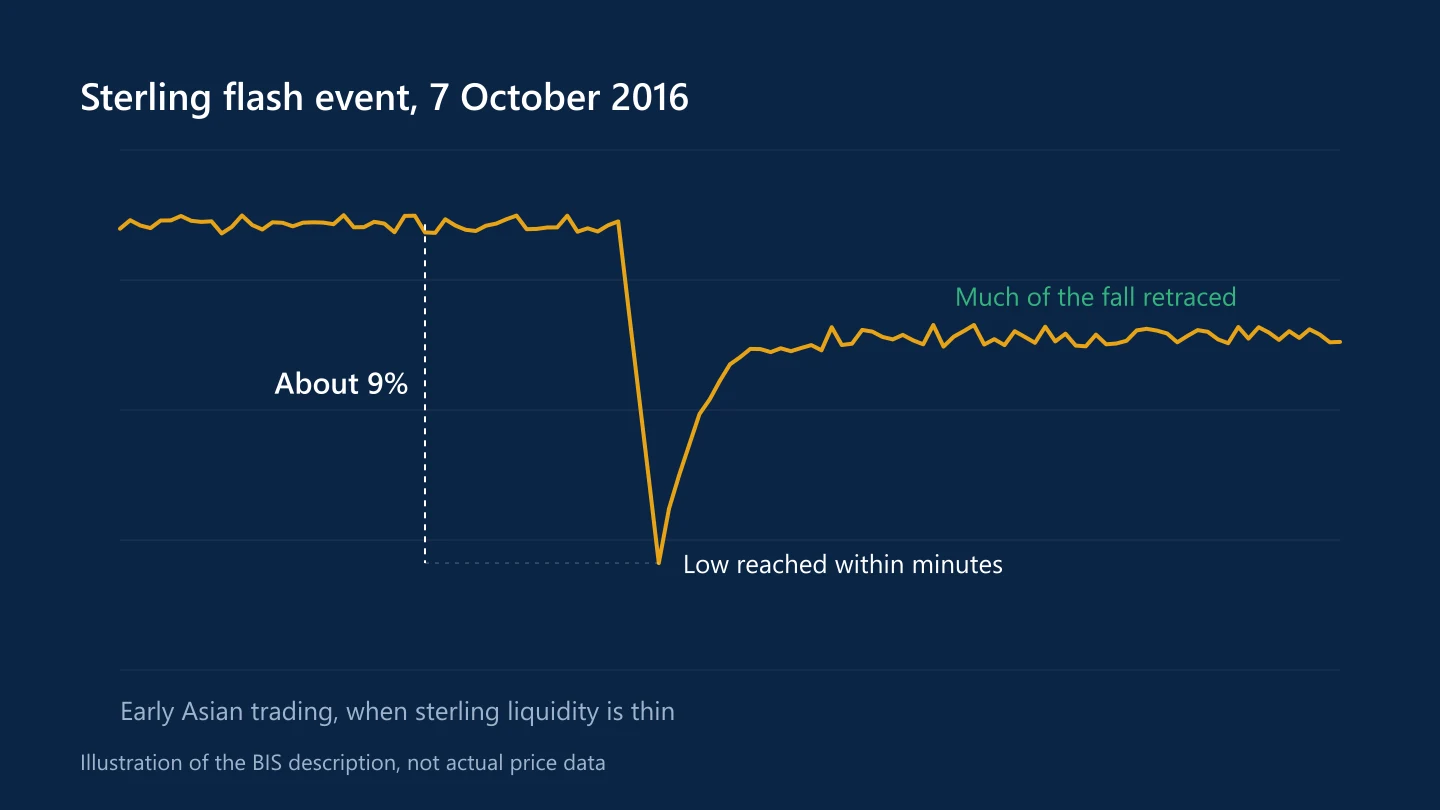
During Asian trading on 7 October 2016, sterling suddenly fell around 9% against the US dollar, then quickly recovered much of the drop. It happened at one of the quietest times of the trading day for the pound, when few European or American traders were at their desks.
What the investigation found
The Bank for International Settlements' Markets Committee investigated and published its report on 13 January 2017. It pointed to a confluence of factors rather than a single clear cause:
- Time of day. The report concluded that the time of day played a significant role in making the sterling market vulnerable to imbalances in order flow.
- Options hedging. Demand to sell sterling to hedge options positions added to the pressure as the price fell.
- Stop-loss orders. As sterling dropped, stop-loss orders were triggered, adding more selling.
- Algorithms and experience. The presence of staff with less expertise in how particular algorithms behave in such conditions appears to have amplified the move.
Mark Carney, then Governor of the Bank of England, noted that systemic financial institutions incurred no material losses, and that spillovers to other markets were very limited.
What changed
The Markets Committee built lessons from the event into the FX Global Code, a set of principles for wholesale foreign exchange market participants. They cover participants' obligation to consider how their trading could disrupt the market, governance of algorithmic execution, and how the lowest or highest price in a flash event should be determined.
What it means for retail traders
- Liquidity varies by hour. The same pair can behave very differently in the Asian session than in London hours.
- Stops fill at the next available price. In a sudden drop, a stop can fill far below its level (where to place a stop-loss, bid, ask and slippage).
- Prices in a flash event aren't the same everywhere. Which low was "real" depended on each trading venue's liquidity at that moment, one of the questions the FX Global Code addresses.
- Position size is the real protection. A 9% move in minutes is survivable when leverage is modest (leverage and margin).
Sterling's live chart is on the GBP/USD page.
Sources
Common questions
What caused the 2016 sterling flash crash?
The BIS found no single cause. Low liquidity in early Asian trading, selling to hedge options, stop-loss orders and algorithms run by less experienced staff combined to amplify the move.
How much did the pound fall in the flash crash?
Sterling fell around 9% against the US dollar in early Asian trading on 7 October 2016, before quickly recovering much of the move.
What is the FX Global Code?
A set of principles for good practice in the wholesale foreign exchange market. Lessons from the sterling flash event, including on algorithmic execution, were incorporated into it.
This article is for information only and is not financial advice. Trading forex and CFDs carries a high risk of losing money. Read the risk warning. Spotted an error? Tell the editors.

Comments
Log in to join the discussion. Comments follow the community guidelines.
Log in to commentLoading comments…