Forex market hours: the Sydney, Tokyo, London and New York sessions
Currencies trade around the clock on weekdays, but not with the same liquidity. Session times in UTC, the overlaps that matter and the daylight-saving trap.
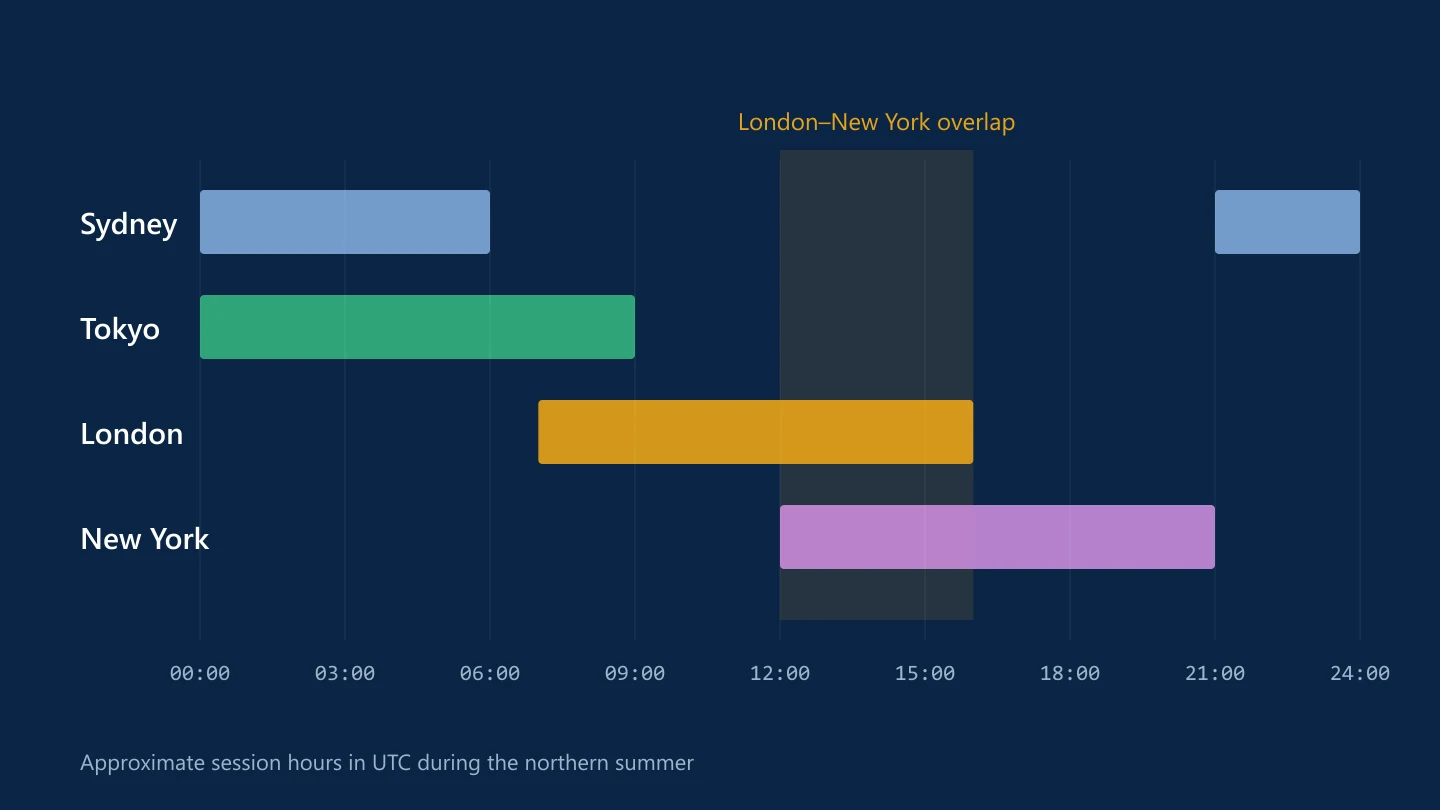
The foreign exchange market has no central exchange and no closing bell during the week. Banks and dealers in different financial centres hand trading over from one time zone to the next, from Sunday evening in New York to Friday evening in New York.
When the week starts and ends
Most brokers open the market at 5 p.m. New York time on Sunday and close it at 5 p.m. New York time on Friday. That is 21:00 UTC when New York is on daylight saving time and 22:00 UTC when it isn't.
The four sessions
Session times are market conventions rather than official hours, and different sources quote them slightly differently. In UTC, during the northern summer (roughly March to October):
- Sydney: about 21:00 to 06:00
- Tokyo: about 00:00 to 09:00
- London: about 07:00 to 16:00
- New York: about 12:00 to 21:00
During the northern winter, London and New York run an hour later in UTC terms: roughly 08:00 to 17:00 and 13:00 to 22:00. Sydney moves the other way, because Australia's daylight saving runs from October to April.
Why the overlaps matter
Liquidity is deepest when two major centres are open at once, especially the London–New York overlap, from about 12:00 to 16:00 UTC in summer. Spreads on the major pairs are usually at their tightest then, and most US economic data is released during that window, at 8:30 a.m. New York time.
The Tokyo–London handover is quieter but often active for yen crosses and for EUR/USD as European traders arrive.
What each session tends to look like
- Asian hours often trade in narrower ranges, with the yen, Australian and New Zealand dollars most active. Data from China, Japan and Australia lands here.
- London accounts for the largest share of global currency trading. Many of the day's biggest moves in euro, sterling and franc pairs start in the first hours of the session.
- New York brings US data releases and, from 2 p.m. New York time on decision days, the Federal Reserve. Liquidity drops off after London closes.
These are tendencies, not rules. Central bank surprises, geopolitical news and intervention can move any pair at any hour.
The daylight-saving trap
The US moves its clocks on the second Sunday in March and the first Sunday in November. The UK and EU change on the last Sundays of March and October. For a few weeks each spring and autumn, the gap between London and New York is one hour shorter than usual, which shifts release times on your chart. The economic calendar shows every event in your own time zone.
Quiet times to be careful
Spreads can widen sharply around the daily rollover at 5 p.m. New York time, in the first minutes after the Sunday open and on public holidays in major centres. Stop orders placed close to the price are most at risk of filling badly then.
Sources
Common questions
What time does the forex market open on Sunday?
Most brokers open at 5 p.m. New York time on Sunday, which is 21:00 UTC in summer and 22:00 UTC in winter.
What is the best time to trade forex?
Liquidity is usually highest during the London–New York overlap, roughly 12:00 to 16:00 UTC in the northern summer, when spreads on major pairs tend to be tightest. Whether that suits you depends on the pairs you trade and your strategy.
Is the forex market open 24 hours?
It trades around the clock from Sunday evening to Friday evening, New York time, with a short daily rollover at 5 p.m. New York time at most brokers.
This article is for information only and is not financial advice. Trading forex and CFDs carries a high risk of losing money. Read the risk warning. Spotted an error? Tell the editors.
Comments
Log in to join the discussion. Comments follow the community guidelines.
Log in to commentLoading comments…