Spot, forwards, FX swaps, options and futures: the forex products explained
FX swaps, not spot trades, are the biggest part of the $9.6 trillion-a-day currency market. A plain guide to each foreign exchange product, who uses it, and where retail CFDs fit.
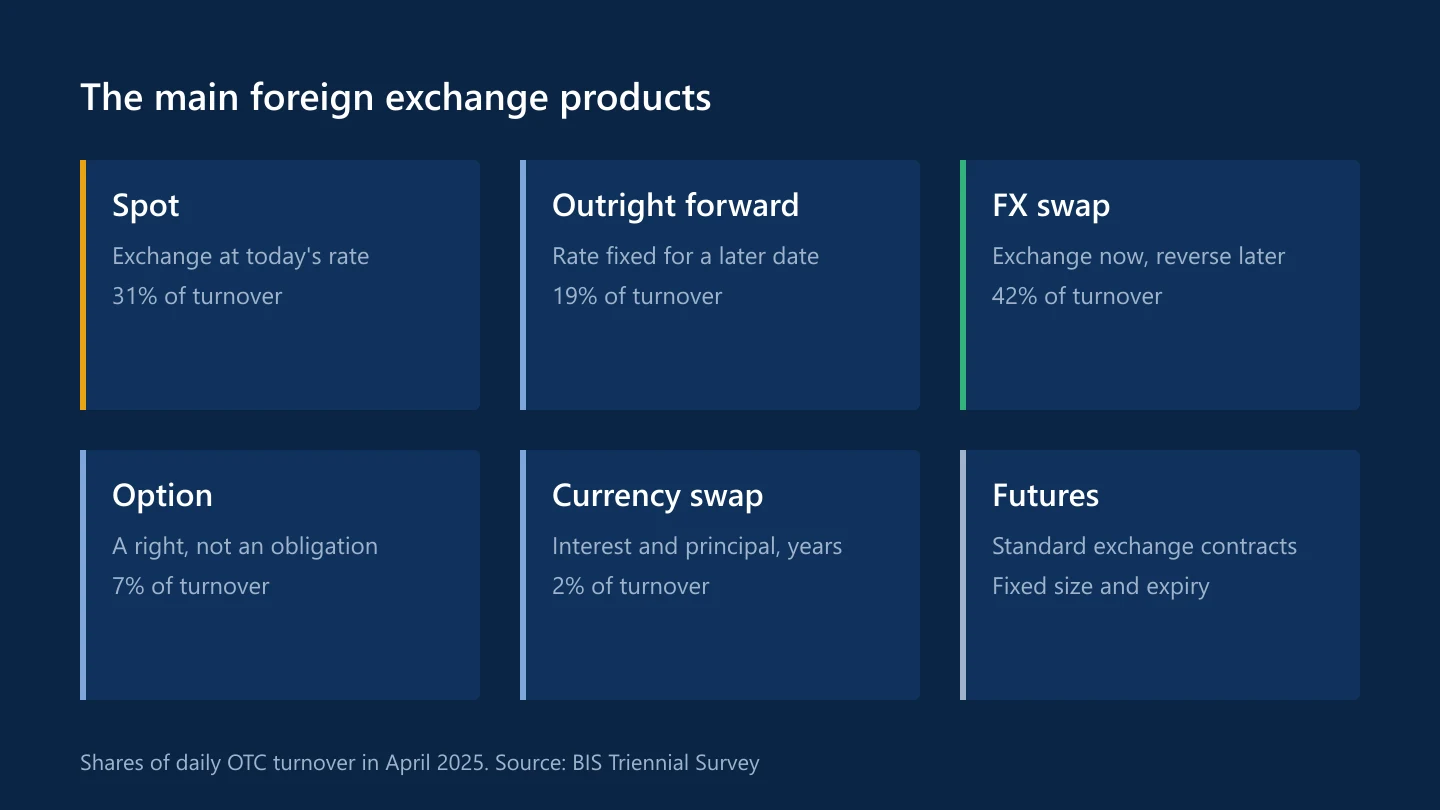
When people talk about "the forex market" they usually mean spot trading: exchanging one currency for another at today's price. But spot is only about a third of the market. According to the BIS Triennial Survey for April 2025, daily turnover split into FX swaps ($4.0 trillion), spot ($3.0 trillion), outright forwards ($1.8 trillion), options (7% of turnover) and currency swaps (2%).
Spot
A spot trade exchanges two currencies at the current rate for settlement shortly afterwards, normally two business days later. USD/CAD is a common exception, settling one business day after the trade. Spot made up 31% of turnover in April 2025.
Retail forex and CFD accounts are built on spot prices, but positions don't settle. Open positions are rolled forward each day instead, and the interest rate difference between the two currencies is charged or paid as swap.
Outright forwards
A forward fixes an exchange rate today for an exchange on a future date. Companies use forwards to lock in the cost of future imports or the value of export revenue. The forward rate differs from the spot rate by the interest rate difference between the two currencies over the period, not by a forecast of where the exchange rate will go.
FX swaps
An FX swap combines two trades: exchange currencies now, and reverse the exchange on a later date at a rate agreed today. Banks and institutions use swaps to borrow one currency against another for a set period, so they're mainly funding tools. At 42% of turnover, they were the largest category in 2025.
Currency swaps
Currency swaps are similar but longer term. They usually exchange interest payments in two currencies over several years, as well as the principal. Companies use them to convert borrowing in one currency into another.
Options
An FX option gives the buyer the right, but not the obligation, to exchange currencies at a set rate on or before a set date, in return for a premium. Options let hedgers protect against an adverse move while keeping the benefit of a favourable one. Hedging of options can also affect spot prices, as it did in the sterling flash crash.
Currency futures
Futures are standardised contracts traded on exchanges such as CME, with fixed contract sizes, set expiry dates and central clearing. Most other currency products trade over the counter, directly between banks and their clients. The ICE US Dollar Index also trades as a future (DXY explained).
Where retail products fit
- CFDs and rolling spot track spot prices, with daily rollover and swap.
- Spread bets, offered in the UK and Ireland, work similarly, with gains and losses set per point of movement.
- Futures are available through futures brokers, and are one way US traders access currencies alongside retail spot forex (trading forex from the US).
Knowing the wider market explains things retail traders see every day, such as why swap exists and why spreads widen at the daily rollover (bid, ask and slippage). For the size of each market, see how big is the forex market.
Sources
Common questions
What is the difference between spot and forward forex?
A spot trade exchanges currencies at today's rate, normally settling two business days later. A forward fixes a rate today for an exchange on a later date, with the difference from spot reflecting the interest rate gap between the two currencies.
What is an FX swap?
Two linked trades: exchanging currencies now and reversing the exchange on a later date at a rate agreed today. FX swaps are mainly funding tools and made up 42% of forex turnover in April 2025.
Are retail forex CFDs spot trades?
CFDs and rolling spot accounts use spot prices, but positions don't settle. They roll over each day, with swap charged or paid for the interest rate difference.
This article is for information only and is not financial advice. Trading forex and CFDs carries a high risk of losing money. Read the risk warning. Spotted an error? Tell the editors.
Comments
Log in to join the discussion. Comments follow the community guidelines.
Log in to commentLoading comments…