The US Dollar Index (DXY) explained: its six currencies and their weights
The ICE US Dollar Index measures the dollar against six currencies, with the euro at 57.6%. How it's calculated, why its 1973 base and fixed weights matter, and how traders use it.
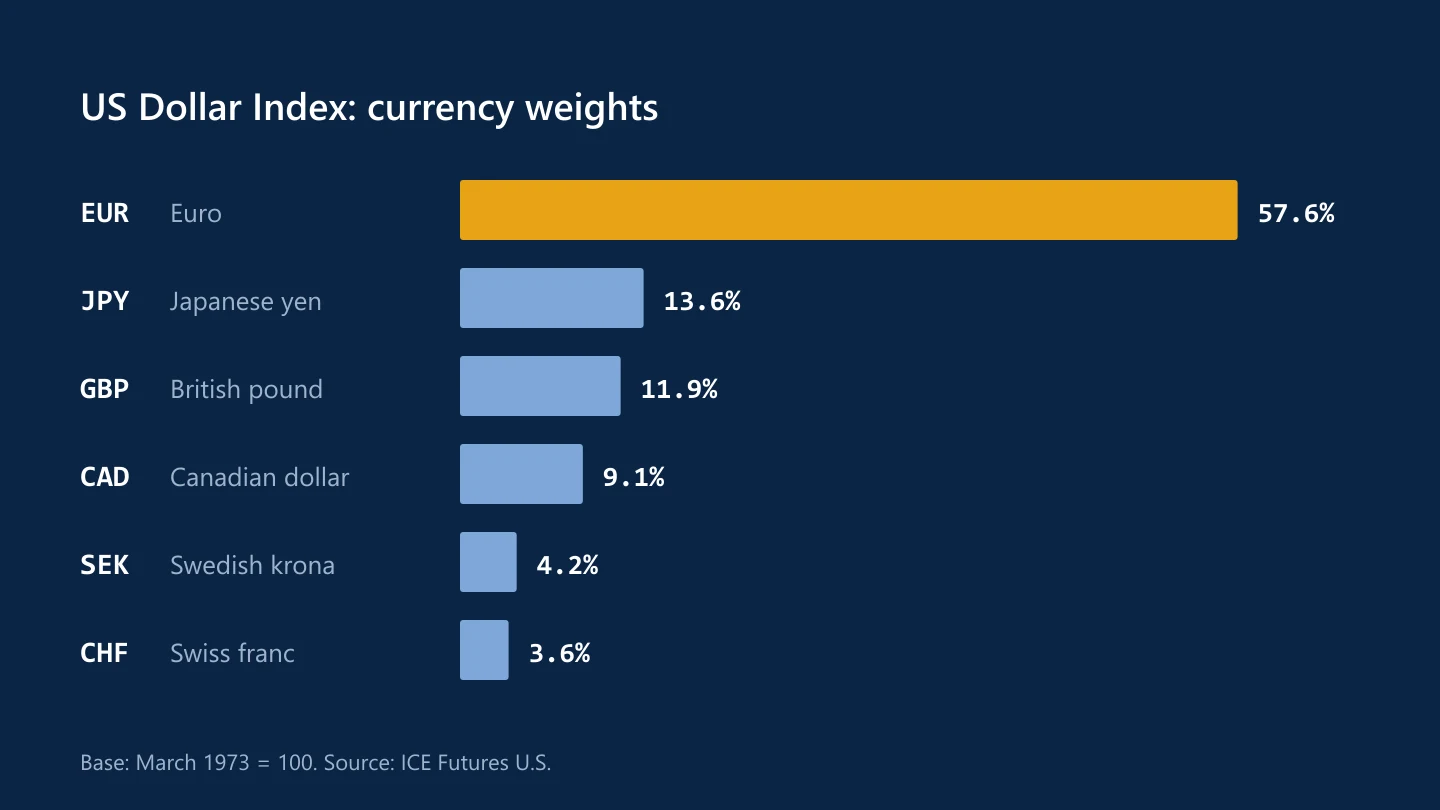
The US Dollar Index, often called DXY after a common data-vendor symbol, measures the value of the US dollar against a basket of six currencies. It's maintained by ICE Futures U.S. and was originally developed by the Federal Reserve in 1973, when major currencies began to float.
The basket
- Euro (EUR): 57.6%
- Japanese yen (JPY): 13.6%
- British pound (GBP): 11.9%
- Canadian dollar (CAD): 9.1%
- Swedish krona (SEK): 4.2%
- Swiss franc (CHF): 3.6%
Before the euro existed, the index had ten currencies. The euro replaced five of them: the Deutsche Mark, French franc, Italian lira, Dutch guilder and Belgian franc. ICE says that was the only adjustment to the index, which has no scheduled rebalancing.
How it's calculated
The index is a geometric average of the six exchange rates:
USDX = 50.14348112 × EURUSD^−0.576 × USDJPY^0.136 × GBPUSD^−0.119 × USDCAD^0.091 × USDSEK^0.042 × USDCHF^0.036
Where the dollar is the quote currency, as in EUR/USD and GBP/USD, the exponent is negative, so a rise in those pairs lowers the index. The index is measured against March 1973, when it was set at 100, so a reading of 97 means the dollar is about 3% weaker against the basket than it was then.
ICE calculates the index about every 15 seconds from spot prices. Futures on the index were listed in November 1985.
What the index does and doesn't tell you
- It's mostly a euro index. With the euro at 57.6%, DXY often moves as a mirror image of EUR/USD.
- It leaves out major trading partners. China and Mexico, two of the largest US trading partners, aren't in the basket, nor are most emerging market currencies. The Federal Reserve publishes broader trade-weighted dollar indexes for that reason.
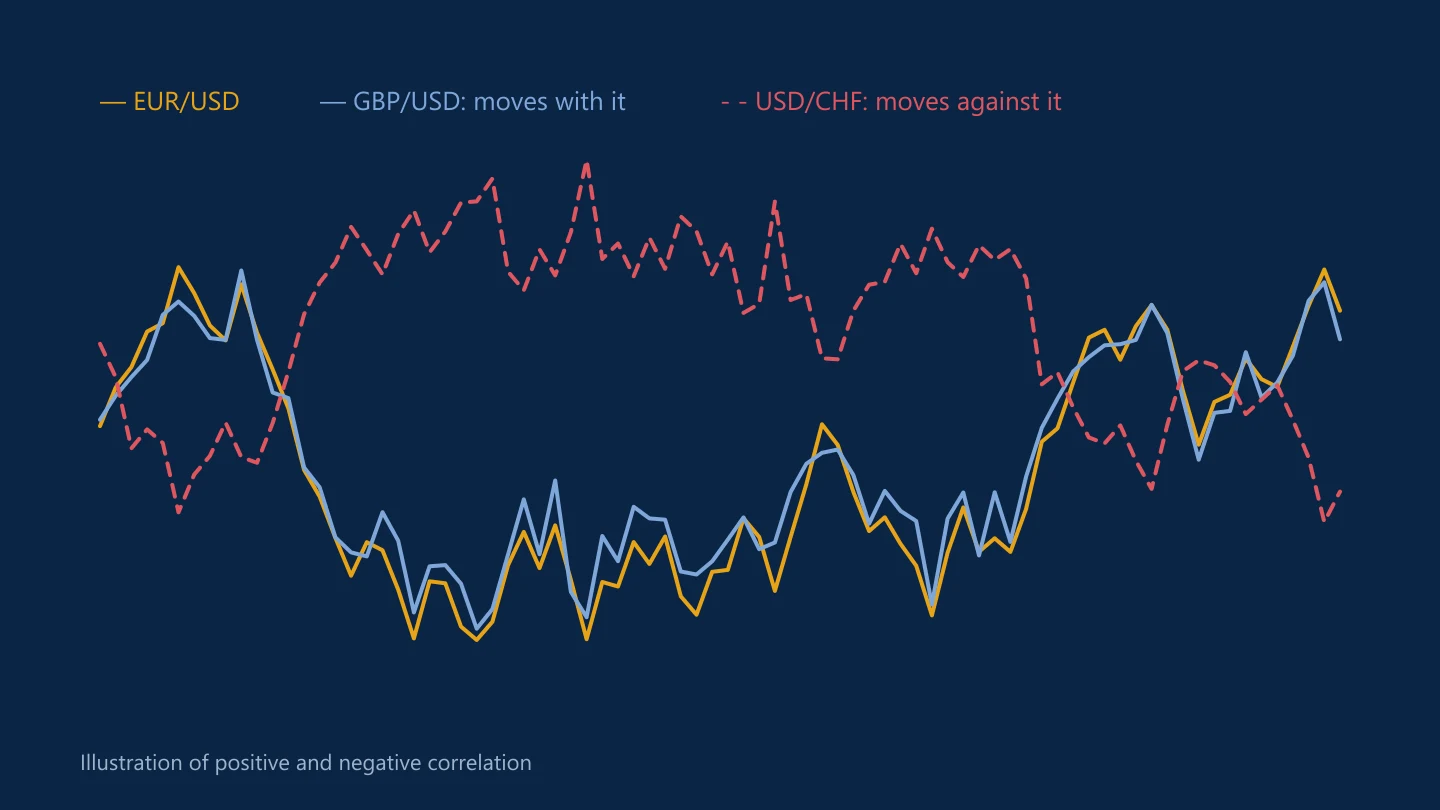
- It's a useful filter. Traders check DXY to see whether a move in a pair is about the dollar broadly or about the other currency. If EUR/USD, GBP/USD and USD/JPY all show dollar strength at once, the move is probably dollar-driven (currency correlation).
Trading the dollar index
Retail traders usually reach the index through CFDs or exchange-traded futures. ICE's futures contract is worth $1,000 times the index value and settles by physical delivery of the six currencies. Many traders never trade it at all and use it only as a reference chart. The index's 1973 starting point is explained in from Bretton Woods to floating exchange rates.
Sources
Common questions
What currencies are in the US Dollar Index?
The euro (57.6%), Japanese yen (13.6%), British pound (11.9%), Canadian dollar (9.1%), Swedish krona (4.2%) and Swiss franc (3.6%).
What does a DXY reading of 100 mean?
The index was set at 100 in March 1973. A reading above 100 means the dollar is stronger against the six-currency basket than it was then; below 100 means weaker.
Why does DXY move opposite to EUR/USD?
The euro makes up 57.6% of the index and enters the formula with a negative exponent, so when EUR/USD rises the index falls.
This article is for information only and is not financial advice. Trading forex and CFDs carries a high risk of losing money. Read the risk warning. Spotted an error? Tell the editors.


Comments
Log in to join the discussion. Comments follow the community guidelines.
Log in to commentLoading comments…