How big is the forex market? $9.6 trillion a day, according to the BIS
The BIS Triennial Survey found foreign exchange turnover averaged $9.6 trillion a day in April 2025, up 28% in three years. Where trading happens, which currencies dominate and who is trading.
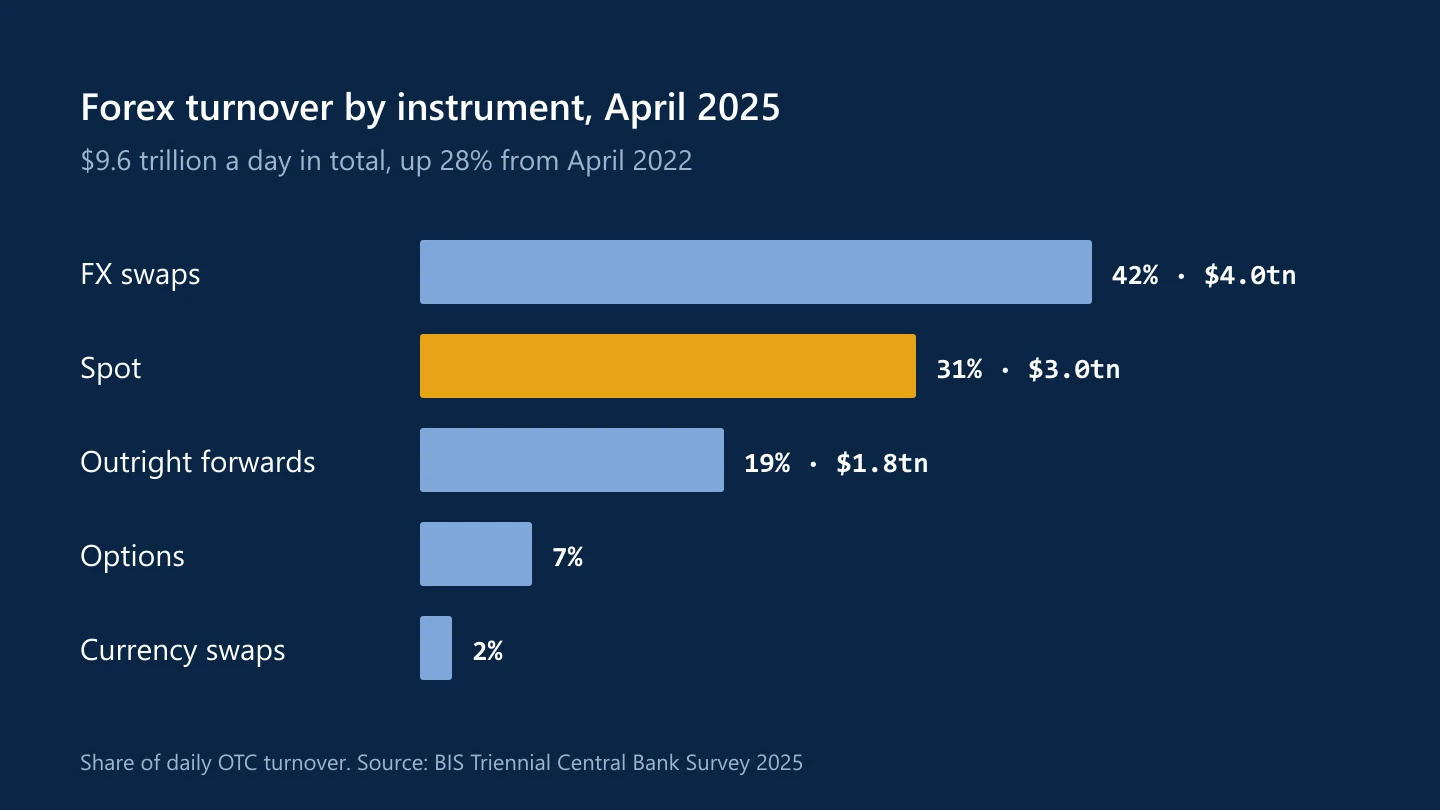
The foreign exchange market is the largest financial market in the world. The most complete measure of its size is the Bank for International Settlements' Triennial Central Bank Survey, which gathers data from central banks and more than a thousand banks and dealers every three years. The latest survey, covering April 2025, found that turnover averaged $9.6 trillion a day, up 28% from $7.5 trillion in April 2022.
April 2025 was also an unusually volatile month, with sharp currency moves after the US tariff announcements early in the month, which is worth keeping in mind when comparing surveys.
What gets traded
Daily turnover by instrument in April 2025:
- FX swaps: $4.0 trillion, 42% of the total
- Spot: $3.0 trillion, 31%
- Outright forwards: $1.8 trillion, 19%
- Options: 7%
- Currency swaps: 2%
Spot trading, the kind closest to what retail traders do, grew 42% since 2022. FX swaps, used mostly by banks and companies to manage funding, remain the largest category. Each product is explained in spot, forwards, FX swaps and futures.
Which currencies dominate
Every trade involves two currencies, so the shares add up to 200%:
- US dollar: 89.2%
- Euro: 28.9%
- Japanese yen: 16.8%
- Pound sterling: 10.2%
- Chinese renminbi: 8.5%
- Swiss franc: 6.4%
All ten of the most traded currency pairs include the US dollar. USD/CNY accounted for 8.1% of turnover, up from 6.6% in 2022.
Where trading happens
Trading is concentrated in a handful of financial centres. The United Kingdom accounted for about 38% of turnover, the United States about 19%, Singapore 11.8% and Hong Kong 7.0%. Together, those four handled 75% of global trading. London's share is why the London session is the busiest part of the day.
Who trades
- Dealers trading with each other: 46% of turnover
- Other financial institutions, including smaller banks, institutional investors and hedge funds: 50%
- Non-financial customers, such as companies: 5%
Retail traders make up a small part of these figures, reaching the market through brokers that deal with larger banks and liquidity providers.
What the numbers mean for you
A market this deep usually means tight spreads on major pairs in busy hours. It doesn't mean every pair is liquid at every moment. Turnover in less traded currencies is far thinner, and even major pairs can gap at quiet times, as the sterling flash crash showed. The next Triennial Survey is due in 2028.
Sources
Common questions
How much is traded in the forex market each day?
Global foreign exchange turnover averaged $9.6 trillion a day in April 2025, according to the Bank for International Settlements' Triennial Survey.
What is the most traded currency?
The US dollar, which was on one side of 89.2% of all trades in April 2025. The euro was second, at 28.9%.
Where does most forex trading happen?
The United Kingdom accounted for about 38% of global turnover in April 2025, followed by the United States with about 19%, Singapore with 11.8% and Hong Kong with 7.0%.
This article is for information only and is not financial advice. Trading forex and CFDs carries a high risk of losing money. Read the risk warning. Spotted an error? Tell the editors.
Comments
Log in to join the discussion. Comments follow the community guidelines.
Log in to commentLoading comments…