Trading forex from the United States: leverage limits, FIFO and no CFDs
US retail forex traders work under different rules from almost everyone else. Who can offer accounts, what the NFA's rules mean in practice and why offshore offers are risky.
The United States regulates retail forex more tightly than most countries. The rules affect which brokers you can use, how much leverage you get and even how you can close trades.
Who can offer you an account
Retail forex accounts for US residents must be offered by firms registered with the Commodity Futures Trading Commission, as a futures commission merchant or retail foreign exchange dealer, and that are members of the National Futures Association. You can look up any firm in the NFA's BASIC database.
Among the brokers profiled on FTC, OANDA and FOREX.com are registered in this way.
Leverage
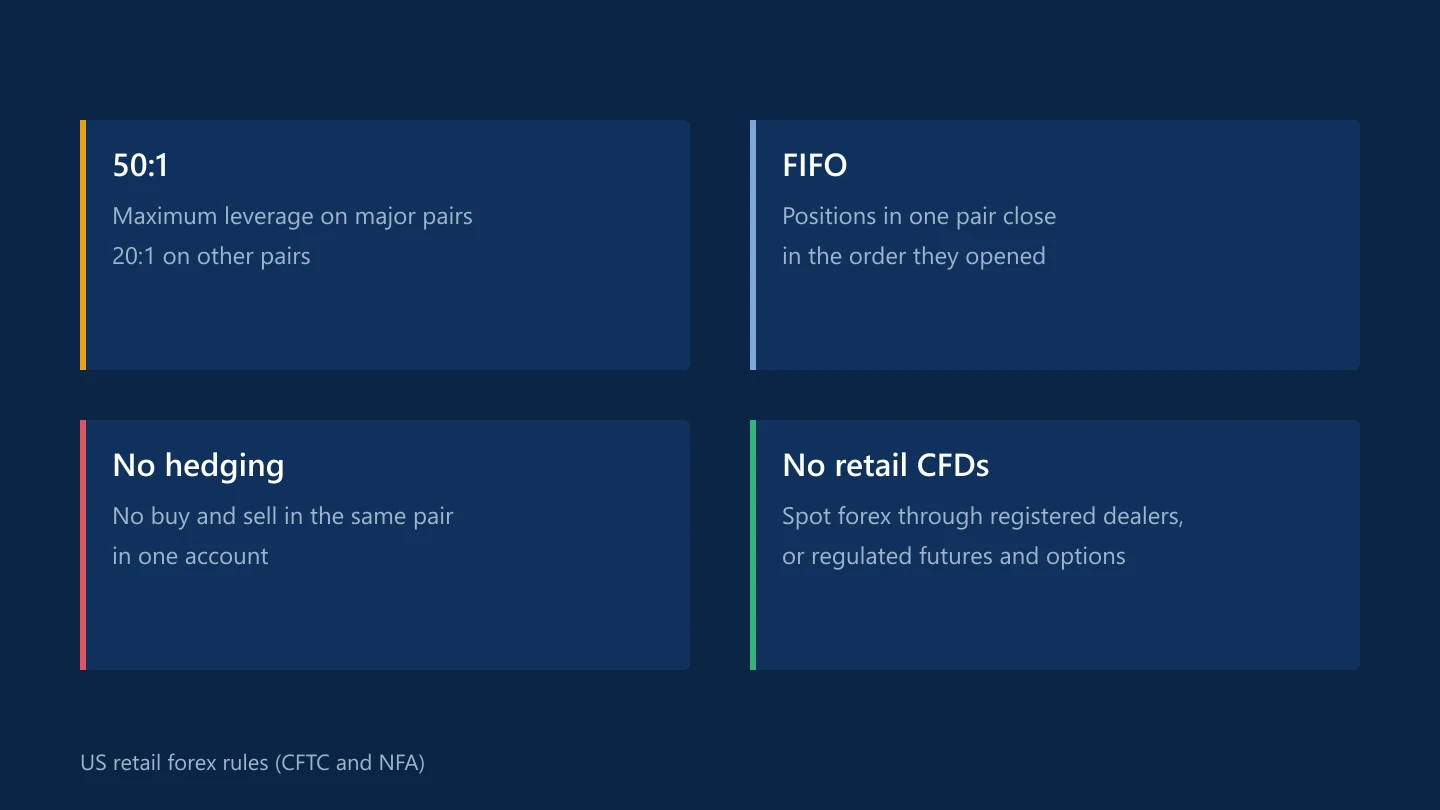
US retail leverage is limited to 50:1 on major currency pairs and 20:1 on other pairs. That is higher than the 30:1 retail limit in the EU, UK and Australia, but far below offshore offers.
FIFO and no hedging
NFA Compliance Rule 2-43(b) affects how positions are managed:
- No hedging: you can't hold a buy and a sell in the same pair at the same time in the same account.
- First-in, first-out: if you have several positions in the same pair, they must be closed in the order they were opened.
Platforms used by US brokers enforce these rules automatically, which changes how some strategies and Expert Advisors behave.
No CFDs for retail traders
Contracts for difference aren't available to US retail traders. US residents trade spot forex through registered dealers, or currency futures and options on regulated exchanges.
Protection
Retail forex accounts at US dealers are not covered by SIPC. Protection relies on the firms' capital requirements and the CFTC's and NFA's oversight.
Offshore brokers that accept US clients
Some offshore brokers accept US residents without being registered with the CFTC. Dealing with them means giving up US regulatory oversight and protections, and the CFTC has repeatedly warned about unregistered firms and forex fraud. Check registration on the NFA's database before opening any account.
For leverage rules in other countries, see leverage limits for retail traders.
Sources
Common questions
Can Americans trade forex?
Yes, through brokers registered with the CFTC and members of the NFA. US rules limit leverage, don't allow hedging and require first-in, first-out closing.
What is the FIFO rule in forex?
Under NFA Compliance Rule 2-43(b), US retail forex positions in the same pair must be closed in the order they were opened, and hedged positions in the same pair aren't allowed.
Can US traders use CFDs?
No. CFDs aren't available to retail traders in the United States.
This article is for information only and is not financial advice. Trading forex and CFDs carries a high risk of losing money. Read the risk warning. Spotted an error? Tell the editors.
Comments
Log in to join the discussion. Comments follow the community guidelines.
Log in to commentLoading comments…