What the “% of retail accounts lose money” warning actually means
Regulated CFD brokers must publish the share of their retail clients who lose money. How the figure is calculated, what it tells you and what it doesn't.
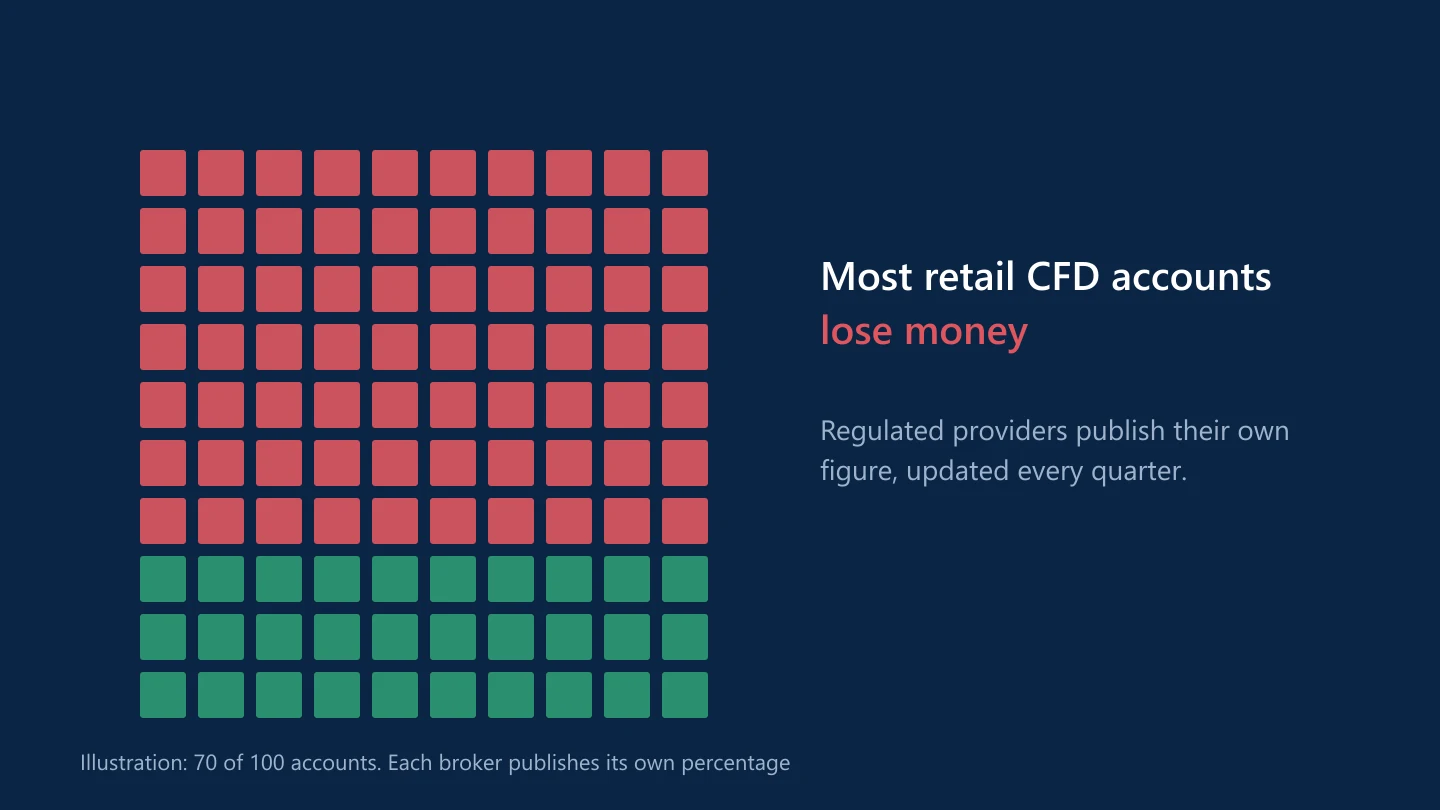
If you have visited a regulated CFD broker's website in Europe or the UK, you have seen a warning along the lines of "72% of retail investor accounts lose money when trading CFDs with this provider". The number is not marketing; regulators require it.
Where the warning comes from
In 2018 the European Securities and Markets Authority introduced measures to protect retail clients trading CFDs. Alongside leverage limits and negative balance protection, they included a standard risk warning that each provider must show with its own percentage of retail accounts that lose money. The UK's Financial Conduct Authority adopted equivalent rules.
How the figure is calculated
The percentage refers to the broker's own retail clients, not to the market as a whole. It is based on accounts that traded CFDs over the previous twelve months, and it is refreshed every quarter.
It is also company-specific. A brand's UK company, its EU company and its offshore company each have different clients, and only some of them are required to publish a figure at all.
Examples from FTC's broker profiles
On their websites in September 2026, providers published figures including:
- Pepperstone Limited (UK): 72.9%
- IG (UK): 69%
- Saxo Capital Markets UK: 60%
- eToro: 51%
What the number tells you
- Most retail CFD accounts lose money, at every large regulated provider. That is the main message, and it is consistent across the industry.
- The warning is a reminder that leverage magnifies losses; see leverage and margin.
What it doesn't tell you
- It isn't a quality score. A lower figure can reflect a different mix of clients or products, such as more long-term investors or lower-risk instruments, rather than better conditions.
- It doesn't predict your result. Your outcome depends on your own trading, costs and risk management.
- Offshore companies usually don't publish it, so a missing figure isn't a good sign.
Using it sensibly
Treat the percentage as a baseline reality check. If you plan to trade CFDs, assume you start among the majority who lose, and build your plan around position sizing and costs you understand.
Sources
Common questions
Why do most retail CFD traders lose money?
CFDs are leveraged, so small price moves cause large gains or losses relative to the deposit, and trading costs add up. Regulators require brokers to publish the share of their retail accounts that lose money for this reason.
Is a broker with a lower loss percentage better?
Not necessarily. The figure depends on the broker's mix of clients and products. It is a reminder of risk, not a measure of the broker's quality or of your own likely result.
This article is for information only and is not financial advice. Trading forex and CFDs carries a high risk of losing money. Read the risk warning. Spotted an error? Tell the editors.

Comments
Log in to join the discussion. Comments follow the community guidelines.
Log in to commentLoading comments…