Offshore brokers vs top-tier regulation: what changes for you
Many well-known brands open accounts for clients in some countries through offshore companies. What you gain in leverage and what you give up in protection.
A broker's brand can be licensed by the UK's FCA and still open your account through a company in Seychelles, the Bahamas or Belize. It is legal and common, and it changes the rules that apply to you.
Why brokers use offshore companies
Top-tier regulators restrict leverage, marketing and bonuses, and require capital and reporting. An offshore company lets a brand offer higher leverage and promotions to clients in countries where the stricter company can't or won't operate.
Among the brokers profiled on FTC, for example:
- IC Markets serves many clients through Raw Trading Ltd, licensed in Seychelles, alongside its Australian and Cypriot companies.
- XM onboards many international clients through XM Global Limited, licensed in Belize.
- Pepperstone and FxPro each have a company licensed in the Bahamas.
- eToro and Tickmill each have a company licensed in Seychelles.
What typically changes
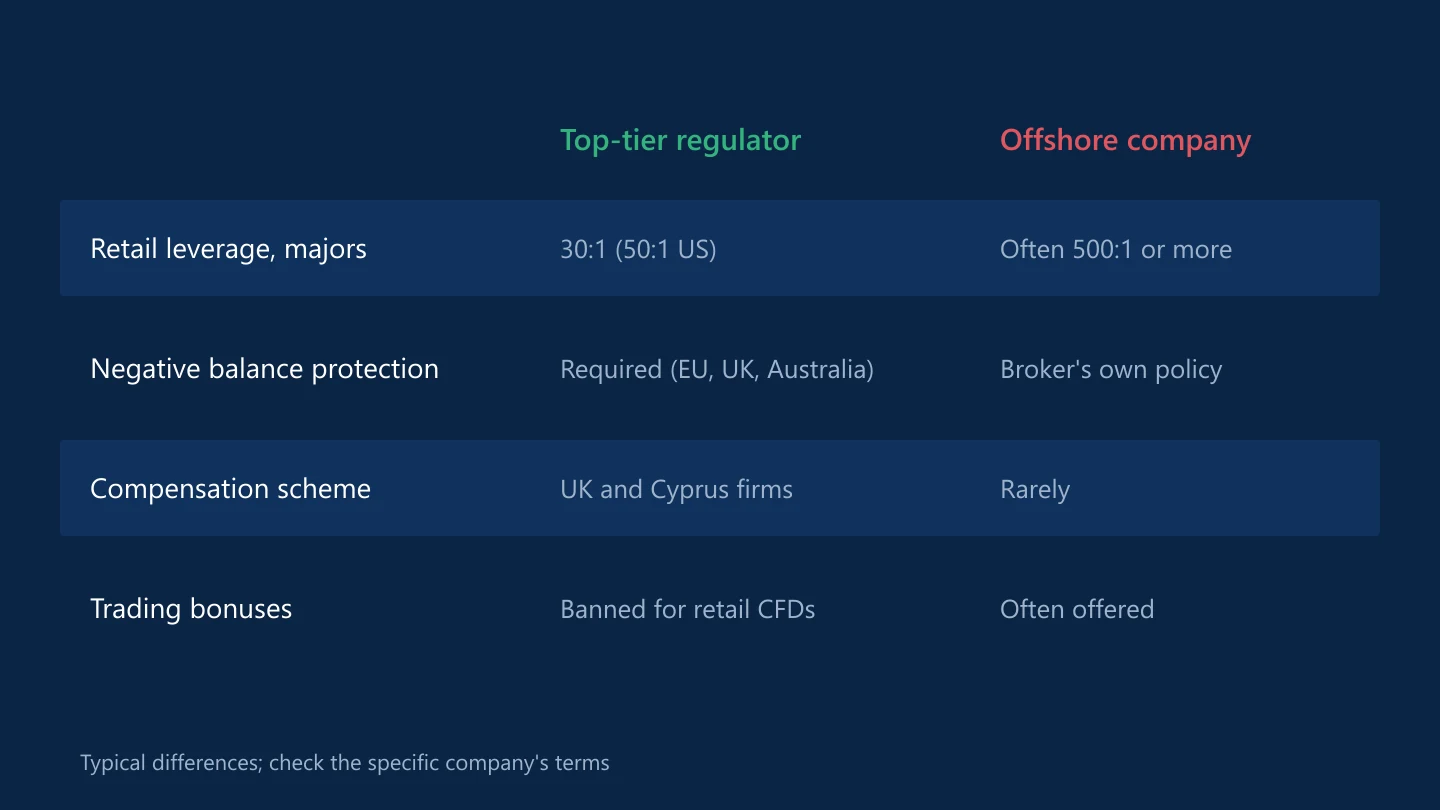
Leverage. Top-tier retail limits are 30:1 on major pairs in the EU, UK and Australia and 50:1 in the US. Offshore companies often allow 500:1 or more.
Negative balance protection. Required for retail clients in the EU, UK and Australia; with offshore companies it depends on the broker's own policy.
Compensation schemes. Clients of UK and Cypriot investment firms may be covered by compensation schemes if a firm fails. Offshore clients generally aren't.
Bonuses and promotions. Banned for retail CFD clients in the EU, UK and Australia; often offered offshore.
Complaints. Top-tier jurisdictions have ombudsman or dispute schemes with real powers. Offshore routes are usually weaker.
How to tell which company you are with
- The account-opening form names the company. Read it before submitting.
- The client agreement and the risk warning in the website footer name it too.
- Your country of residence usually decides it, not the website address you typed.
Registration isn't regulation
Some jurisdictions let companies register without licensing them to deal in forex or CFDs. A company number from a business registry is not a licence. Check the regulator's own register, as described in how to check if a broker is regulated.
A fair way to decide
Higher leverage doesn't reduce trading costs; it only lets you take bigger positions with a smaller deposit. If you can open an account with a company regulated by a top-tier authority, you get stronger protection for the same trading. FTC's broker profiles list every company with its regulator, and the method page explains the regulator tiers.
Sources
Common questions
Is an offshore broker illegal?
Not in itself. But an offshore company offers fewer protections than one regulated by a top-tier authority, and some firms solicit clients in countries where they aren't authorised to operate.
Why do offshore brokers offer 500:1 leverage?
Offshore regulators don't impose the retail leverage limits used in the EU, UK, Australia and the US. Higher leverage increases both potential gains and losses.
This article is for information only and is not financial advice. Trading forex and CFDs carries a high risk of losing money. Read the risk warning. Spotted an error? Tell the editors.

Comments
Log in to join the discussion. Comments follow the community guidelines.
Log in to commentLoading comments…