How to set a stop-loss and take-profit: the R-based method
Stops and targets decide the economics of every trade before it starts. Here is the R-based method: anchor the stop to structure, set the target from the risk, and let the maths filter the trades.
The stop-loss and the take-profit are the two decisions that determine whether a trading method can make money — before the entry's quality is even considered. The stop decides what being wrong costs; the target decides what being right pays; and the relationship between them is the trade's entire economics. Traders who set both from structure and risk trade with the maths on their side; traders who set them by feel trade with the maths against them.
This guide sets out the R-based method: the stop anchored to structure, the target measured from the risk, and the filter that follows. The anchoring logic is in where to place a stop-loss; the economics in risk-reward and expectancy.
What R means
R is the amount risked on a trade — the distance from entry to stop, expressed in money. A trade that risks $50 and makes $100 has made 2R; a trade that risks $50 and loses $30 has lost 0.6R. Measuring results in R instead of money removes account size from the analysis and turns every trade into the same unit: multiples of its own risk.
The R-based method's first move is therefore to define R before anything else: the stop distance times the pip value, kept at the plan's risk percentage. The position sizing guide has the full calculation.
The stop: anchored to structure
The stop's job is to sit where the trade idea is wrong, and the trade idea lives at the structure it was built on. The anchors:
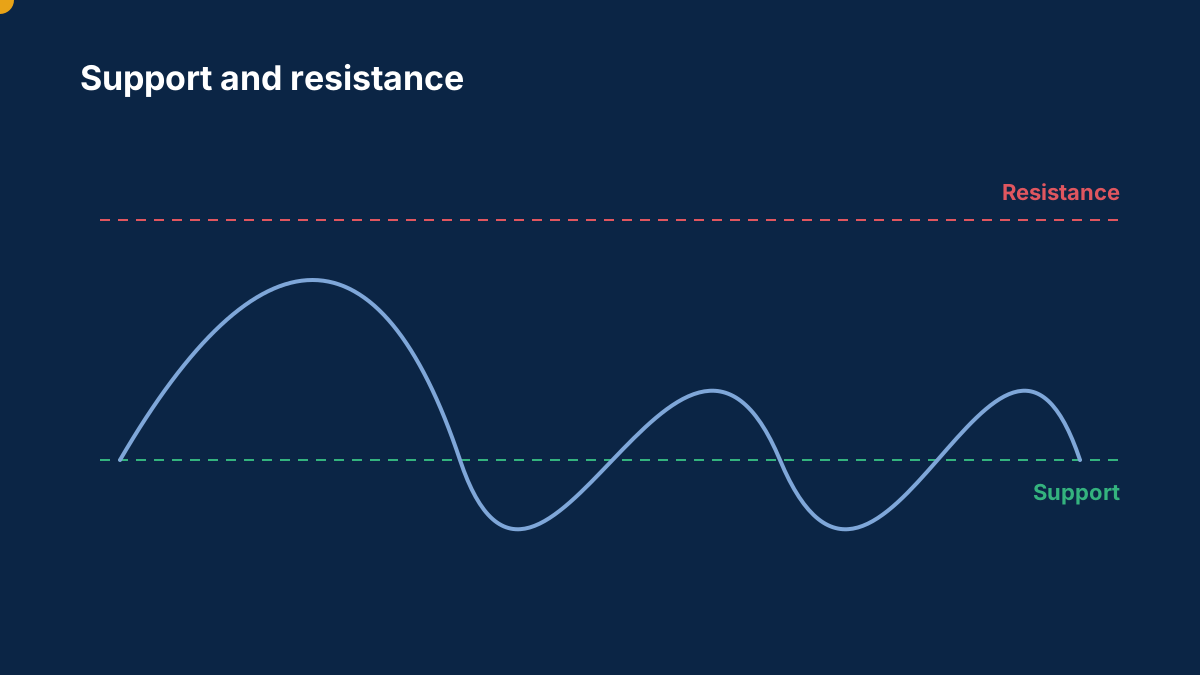
Beyond the level. A bounce trade at support stops below the support zone — the point where the support has failed and the idea is dead. A breakout trade stops beyond the broken level, where the break is proven fake. The support and resistance guide defines the zones.
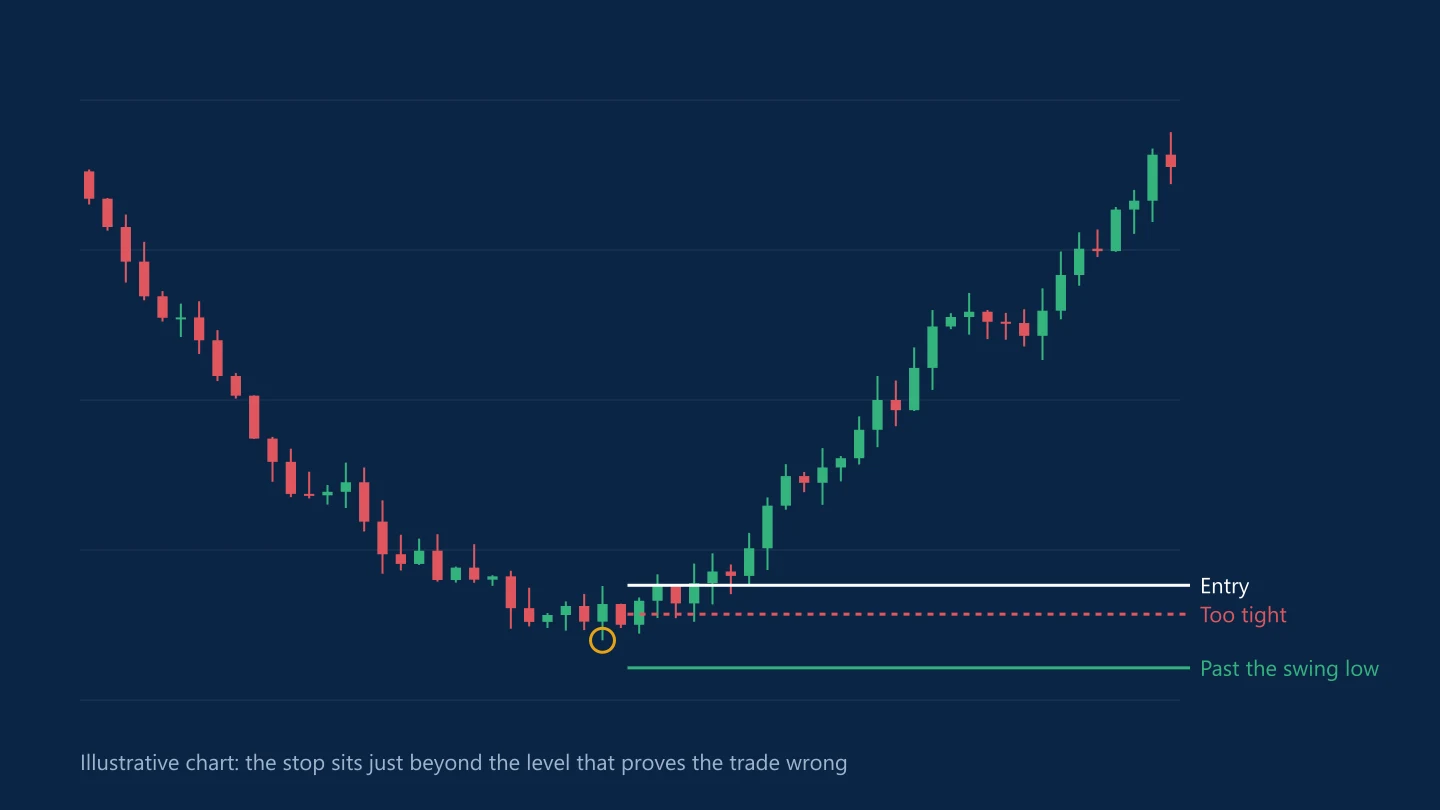
Beyond the swing. A trend trade stops beyond the pullback's extreme — the lower low that would break the trend's structure. The trend guide has the structure rules.
Beyond the volatility. Where no clean structure exists, the stop is volatility-based: a multiple of ATR that places it outside the pair's normal noise. The ATR guide has the method.
The common errors are both fixed by the anchoring rule. Stops too close — inside the noise, where ordinary movement reaches — die before the idea is tested. Stops at arbitrary pip distances ignore the structure the trade was built on. The anchor is always: where is the idea wrong?
The target: measured from the risk
The target's job is to pay for the risk, and the R-based method sets it as a multiple of the stop distance:
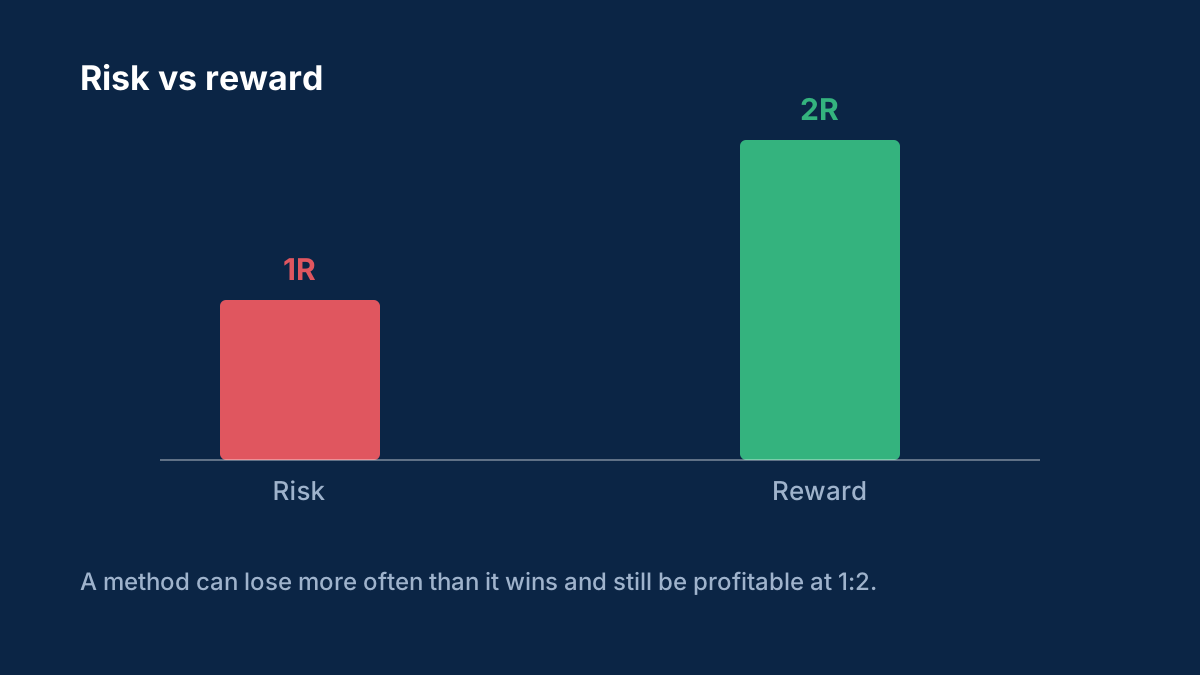
The minimum is the filter. The standard floor is 2R: the target must be at least twice the stop distance, or the trade is not taken. The filter's maths is in the expectancy guide: at 2R, a method can be profitable at win rates below 40%; at 1R it needs to win far more than half the time.
Structure decides the rest. The target sits at the next level in the trade's direction — the next support or resistance, the range's opposite boundary, the measured move of the pattern. When the structure's target clears the 2R floor, the trade passes; when it doesn't, the trade is skipped, whatever the entry looked like.
Partials are a choice, not a default. Splitting the target — half at 1R, the rest at 2R or beyond — changes the economics and should be tested against the single-target version. The exit testing in the expectancy guide covers how to compare the schemes.
The R-based workflow
The method compresses into a four-step routine run before every trade:
- Mark the structure — the level or swing the trade is built on.
- Place the stop beyond it, with a buffer for the spread. That distance, in money, is 1R.
- Find the target at the next structure in the trade's direction. Measure it in R.
- Apply the filter: below the plan's minimum R — commonly 2R — the trade is skipped, no exceptions.
The routine takes a minute and performs the plan's entire risk architecture. The trades that pass it are the ones where being right pays more than being wrong costs — the only trades worth taking.
The mistakes the method prevents
The R-based method exists to prevent the three classic errors:
The arbitrary stop. The pip-distance stop that ignores structure dies of noise or leaves the idea untested. The anchor fixes it.
The mismatched target. The target closer than the stop — the 3-pip-stop, 1-pip-target scalps that need near-perfect win rates to survive. The 2R floor filters them.
The feel-based exit. The target and stop decided after entry, under a live position's emotional pressure. The pre-trade routine removes the decision from the pressured moment — the same pre-commitment logic as the trade management guide.
Stops and targets are not accessories to the trade; they are the trade's economics, decided in advance. Anchor the stop to structure, measure the target in R, and let the filter refuse the trades that don't pay — and the maths, which punishes everyone else, starts working for you.
Sources
Common questions
What is the R in trading?
R is the amount risked on a trade — the stop distance in money. Results are measured in multiples of R: a trade that risks $50 and makes $100 has made 2R, whatever the account size.
Where should I place my stop-loss?
Beyond the structure the trade was built on — beyond the level, the swing or a volatility multiple. The stop sits where the trade idea is wrong, not at an arbitrary pip distance.
What is a good risk-reward ratio?
A minimum of 1:2 is the common floor: the target at least twice the stop distance. At 2R, a method profits at win rates under 40%; at 1R it needs to win far more than half the time.
Should I skip trades with a bad risk-reward?
Yes. If the structure's target cannot clear the plan's minimum R, the trade is skipped whatever the entry looks like. The filter is what keeps the method's maths profitable.
Why measure results in R instead of money?
R removes account size from the analysis and makes every trade comparable. The journal's R records reveal the method's true expectancy, which money-denominated results obscure.
This article is for information only and is not financial advice. Trading forex and CFDs carries a high risk of losing money. Read the risk warning. Spotted an error? Tell the editors.
Comments
Log in to join the discussion. Comments follow the community guidelines.
Log in to commentLoading comments…