Scalping, day trading, swing trading and position trading compared
Trading styles differ in holding time, costs, screen time and overnight risk. Compare them side by side to find the style that fits your schedule and account.
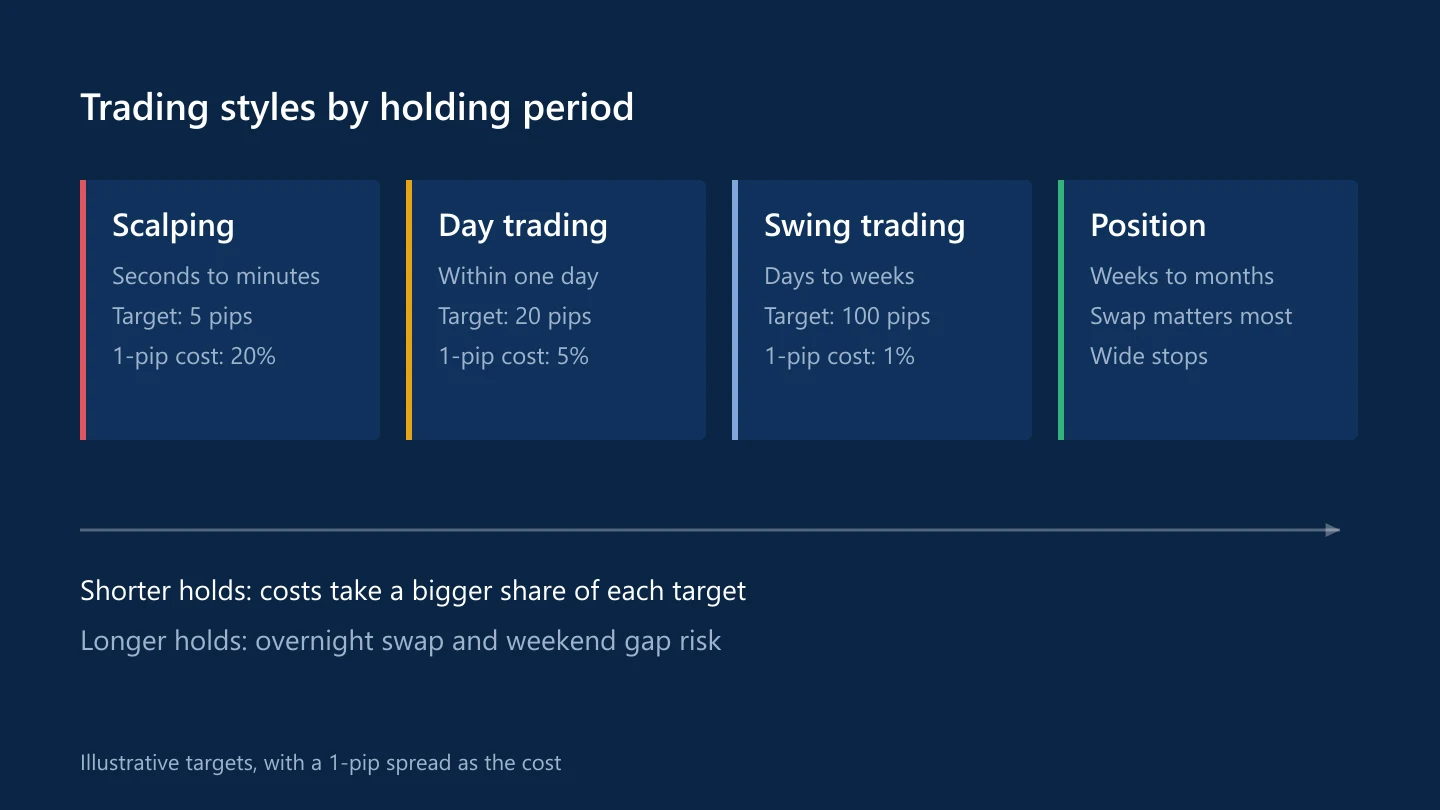
Trading style is mostly a question of how long you hold a position. That choice shapes everything else: how much each trade costs relative to its target, how long you spend in front of a screen, and which risks you carry overnight and over weekends.
The four main styles
Scalping
Positions last seconds to minutes and aim for a few pips. Scalpers need very low costs, fast execution and long stretches of concentration. A 1-pip spread on a 5-pip target takes 20% of the potential gain before the trade starts. Some brokers and most prop firms have rules on very short holding times or trading around news, so read the terms.
Day trading
Positions open and close within the same day, often within a single trading session. There's no overnight swap and no weekend gap risk, but day traders must be available during the hours they trade, typically the London or New York session.
Swing trading
Positions last from several days to a few weeks and try to capture one move within a trend. Costs are small relative to targets of 100 pips or more, and a daily look at the charts is often enough. In exchange, swing traders pay or receive swap every night and carry weekend gap risk.
Position trading
Positions last weeks to months and usually rest on interest rate differences, central bank policy and long-term trends. Swap becomes a large part of the result, positive or negative (see the carry trade). Stops are wide, so positions are small relative to the account.
Costs relative to the target
The same 1-pip cost looks very different against different targets:
- a 5-pip scalp: 20% of the target
- a 20-pip day trade: 5%
- a 100-pip swing trade: 1%
Slippage comes on top, and it also hurts short-term trades most.
Choosing a style
- Match it to your schedule. Someone with a full-time job usually can't day trade the London session, but can review daily charts in the evening.
- Match it to your temperament. Scalping means many decisions under pressure. Position trading means sitting through large swings against you.
- Match it to your account. Wider stops on longer holds need smaller positions to keep the same money at risk; see position sizing.
Many beginners are drawn to scalping because it feels active. The cost arithmetic above is a good reason to learn on longer time frames first, where mistakes unfold more slowly and costs take a smaller bite.
Common questions
What is the difference between swing trading and day trading?
Day traders close every position within the same day, so they avoid swap and weekend gaps. Swing traders hold for days or weeks, paying or receiving swap and carrying gap risk, but their costs are smaller relative to their targets.
Is scalping a good style for beginners?
Scalping is difficult because costs are large relative to small targets: a 1-pip spread is 20% of a 5-pip target. It also demands fast execution and constant attention.
Which trading style needs the least screen time?
Swing and position trading, which can be managed by reviewing daily or weekly charts, need far less screen time than scalping or day trading.
This article is for information only and is not financial advice. Trading forex and CFDs carries a high risk of losing money. Read the risk warning. Spotted an error? Tell the editors.
Comments
Log in to join the discussion. Comments follow the community guidelines.
Log in to commentLoading comments…