How prop firm evaluations work, and the risks to know first
Proprietary trading firms sell challenges that promise a funded account. What you are actually paying for, the rules that end most attempts, and what to check before buying one.
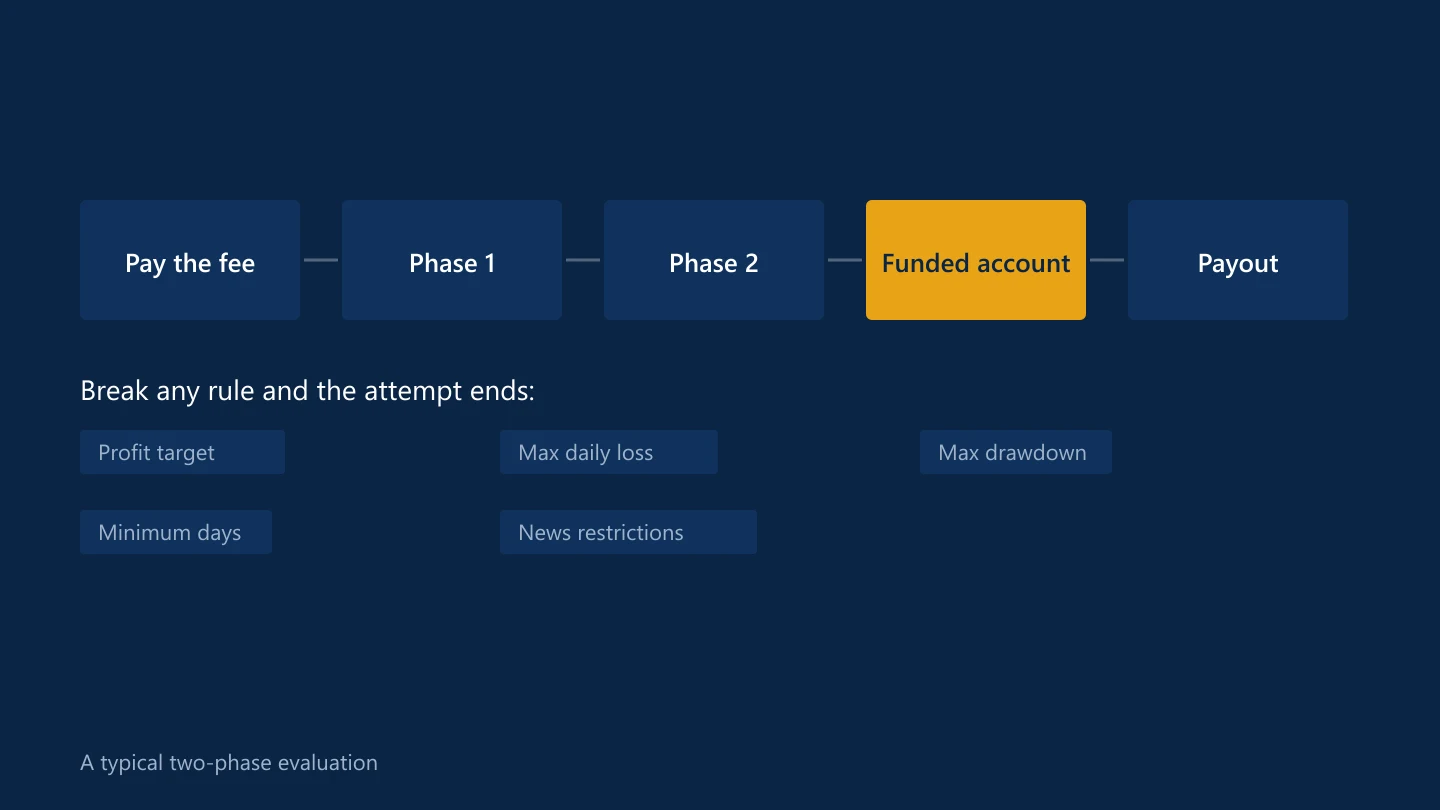
"Trade our capital" is one of the most common adverts aimed at forex traders. Retail prop firms sell evaluations: you pay a fee, trade under strict rules, and if you pass, you receive a share of the profits made on a larger account.
How a typical evaluation works
- You buy a challenge for a stated account size. The fee usually scales with the size.
- You trade a practice or simulated account under the firm's rules.
- You must hit a profit target without breaking any risk limit, sometimes in two or more phases.
- If you pass, you get a "funded" account and a profit split, often with the fee refunded from your first payout.
The rules that end most attempts
- Maximum daily loss: a limit on how much the account can fall in one day, often measured from the day's starting balance or equity.
- Maximum overall drawdown: a limit on total losses, which may be fixed or trail your highest balance.
- Minimum trading days before you can pass.
- Restrictions on holding positions over weekends or through major news releases.
- Consistency rules that limit how much of your profit can come from one day.
Read exactly how each limit is calculated. A trailing drawdown measured on equity, including open positions, is far stricter than one based on closing balance.
What you are really buying
In most retail prop models, the evaluation and often the funded account run on simulated trading. The firm's revenue comes largely from evaluation fees. That doesn't make every firm dishonest, but it means your "funded" status depends on the firm's own terms, and on the firm staying in business and willing to pay.
The risks
- Rule changes and denied payouts. Firms can change terms or refuse payouts under clauses in their agreements.
- Firms closing. Several have shut down or stopped serving clients in some countries, leaving traders with unpaid profits.
- Regulation. Prop firms that don't hold client deposits often aren't regulated as brokers, so the protections described in client money and compensation don't apply to your fees.
- Behaviour. Daily loss rules and time pressure can push traders to overtrade.
Before paying for a challenge
- Find the legal company behind the brand and where it is registered.
- Read the full terms, especially payout conditions and prohibited strategies.
- Look for independent evidence of payouts, not only screenshots the firm shares.
- Treat the fee as money you can afford to lose.
Members compare experiences in the FTC community. FTC doesn't list or rank prop firms.
Common questions
Are prop firms regulated?
Many retail prop firms aren't regulated as brokers, because they sell evaluation services and don't hold client deposits for trading. Check the company behind the brand and its terms carefully.
Is a prop firm account real money?
In many retail prop models, evaluations and often funded accounts run on simulated trading, with payouts made by the firm under its terms. Read the agreement to see how your account works.
This article is for information only and is not financial advice. Trading forex and CFDs carries a high risk of losing money. Read the risk warning. Spotted an error? Tell the editors.
Comments
Log in to join the discussion. Comments follow the community guidelines.
Log in to commentLoading comments…