Withdrawing money from a forex broker: verification checks, delays and complaints
Why regulated brokers ask for ID and proof of address, how withdrawals normally work, which delays are routine and which are warning signs, and how to escalate a complaint.
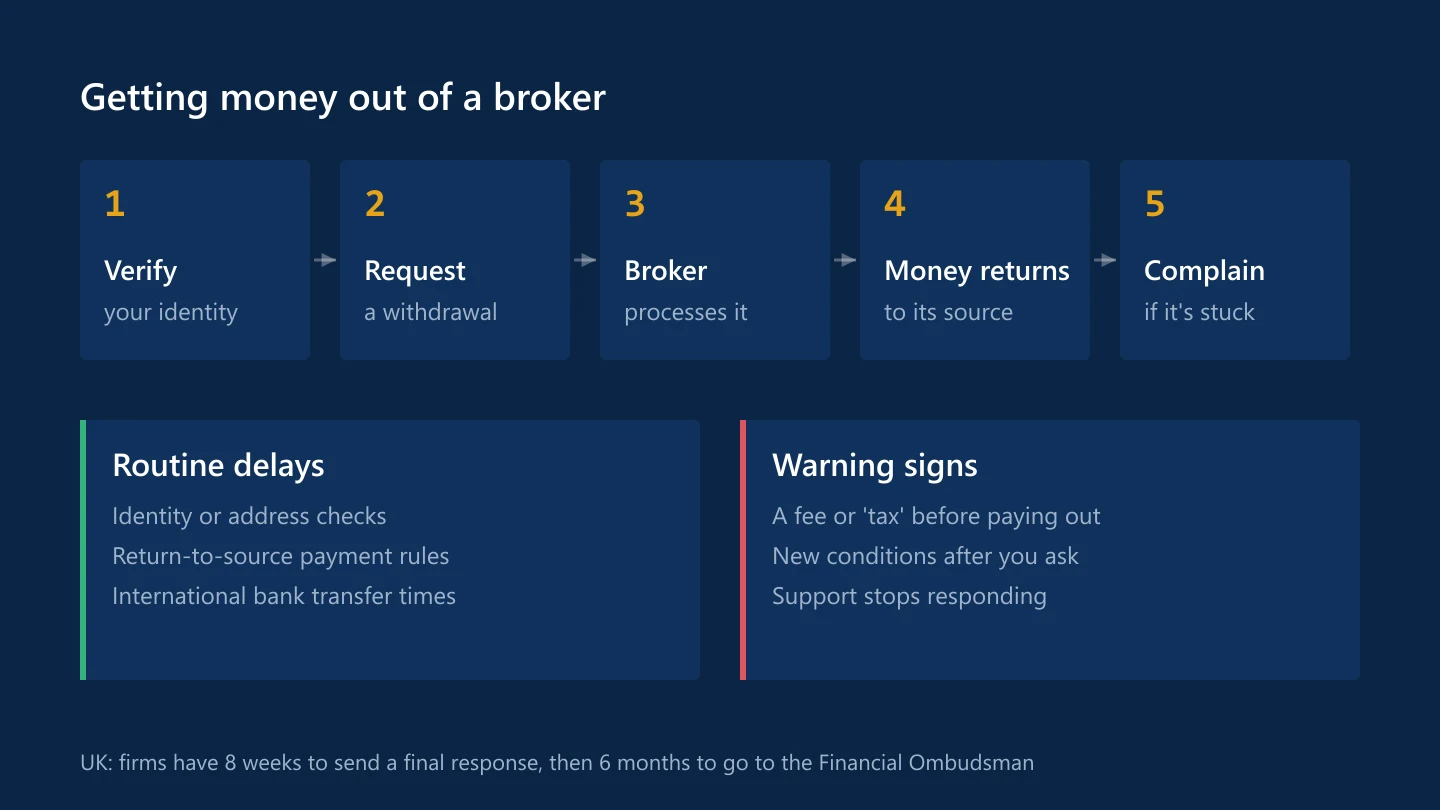
Getting your money out is the real test of any broker. At regulated firms, most withdrawal delays come down to verification checks or payment rules. Some delays, though, are warning signs.
Why brokers verify your identity
Regulated brokers must follow anti-money laundering rules, which require them to identify their clients. Expect to provide:
- Proof of identity: a passport, national ID card or driving licence
- Proof of address: a recent utility bill or bank statement
- Sometimes, source of funds: an explanation or evidence of where your money came from, especially for larger deposits
- Sometimes, proof of your payment method: for example a photo of your card with most of the number covered
Brokers in many countries must also check that leveraged products are appropriate for you, which is why they ask about your trading knowledge and experience.
Upload documents only through the broker's own website or app, reached by typing its address yourself, never through a link sent in a message.
How withdrawals normally work
- Back to the source. To prevent money laundering, brokers usually return money to the method you deposited with, up to the amount deposited, before sending any profits by bank transfer.
- Your name only. Payments normally go only to an account in your own name.
- Processing, then payment. Many brokers process requests within one or two business days; the money then takes as long as the payment method needs, and international bank transfers take longest.
- Open positions. A withdrawal reduces your free margin. Check that what remains still covers any open trades (leverage and margin).
Delays that are warning signs
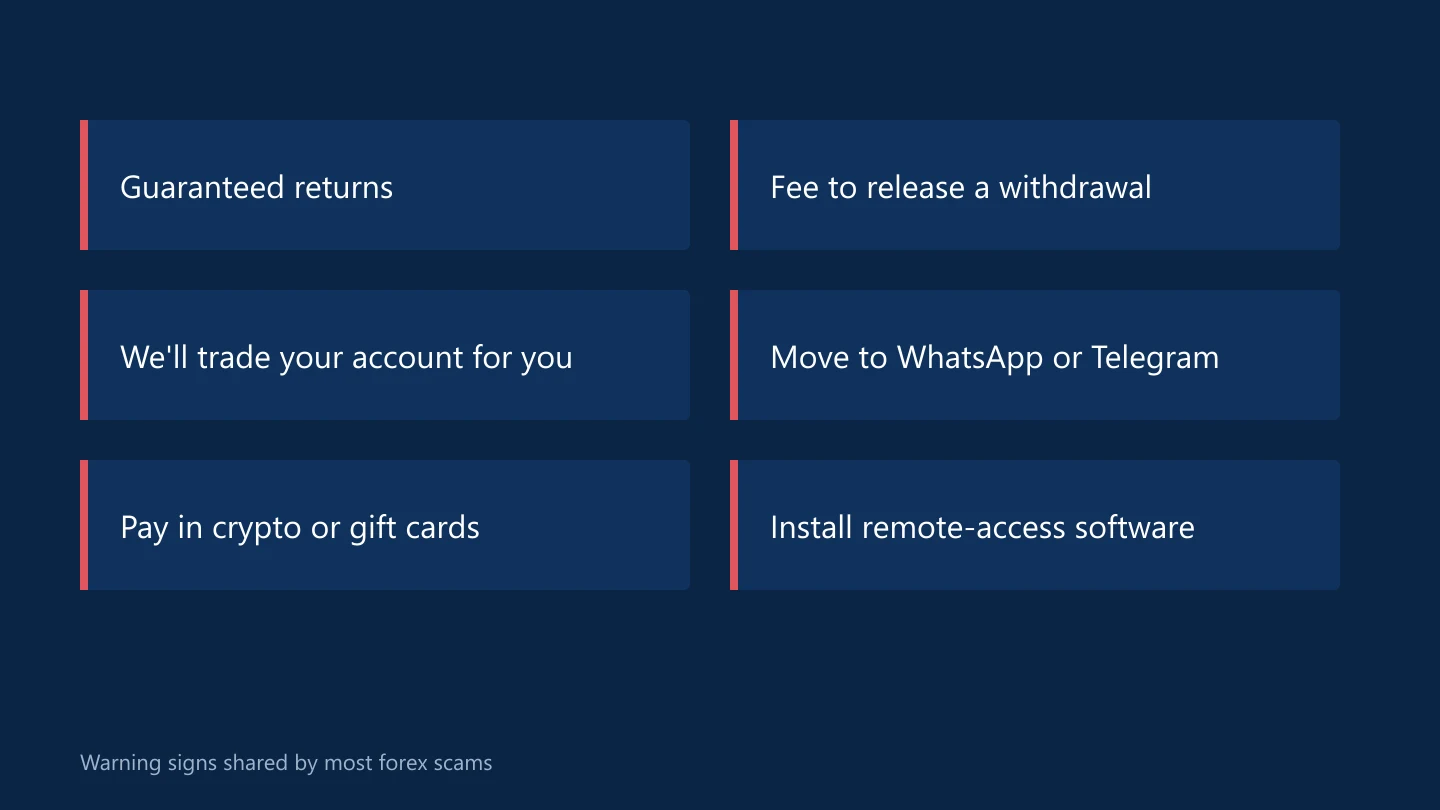
- A fee or "tax" you must pay before withdrawing. Legitimate brokers deduct fees from your balance; they don't ask you to send more money first.
- New conditions after you ask to withdraw, such as a trading volume requirement tied to a bonus you didn't knowingly accept.
- Pressure to keep trading or to "upgrade" your account instead.
- Support that stops responding.
- A firm that isn't on any regulator's register, or that is using the name of a regulated firm (check a broker's regulation).
Anyone who later offers to recover your money for an upfront fee is almost certainly running a second scam (forex scams).
How to complain
- Complain to the broker in writing, with dates, amounts and screenshots of your request.
- Wait for a final response. In the UK, firms have up to eight weeks to resolve a complaint and send a final response.
- Escalate to the ombudsman. UK clients then have six months from the final response to take the complaint to the Financial Ombudsman Service. In Australia, complaints go to the Australian Financial Complaints Authority (AFCA). EU countries have their own dispute resolution schemes, usually listed by the national regulator.
- Report suspected fraud to your financial regulator and the police.
These routes generally apply only when your account is with a firm authorised in that country. An account with an offshore company of the same brand usually falls outside them (offshore vs top-tier regulation).
Sources
Common questions
Why does my forex broker need my ID?
Regulated brokers must follow anti-money laundering rules that require them to verify clients' identity and address, and sometimes where deposited money came from.
How long do forex broker withdrawals take?
Many brokers process requests within one or two business days, and the transfer then takes as long as the payment method needs; international bank transfers usually take longest. Outstanding verification checks can add delays.
What can I do if my broker won't process a withdrawal?
Complain in writing first. In the UK, the firm has up to eight weeks to send a final response, and you then have six months to take the complaint to the Financial Ombudsman Service. In Australia, complaints go to AFCA.
This article is for information only and is not financial advice. Trading forex and CFDs carries a high risk of losing money. Read the risk warning. Spotted an error? Tell the editors.
Comments
Log in to join the discussion. Comments follow the community guidelines.
Log in to commentLoading comments…