EUR/USD has fallen four weeks in a row. Does a streak like that count as a signal for you, or is it just a description?
On ECB reference rates the euro closed each of the last four weeks lower against the dollar: $1.1622 on 4 September, $1.1592 on 11 September, $1.1460 on 18 September, $1.1403 on 25 September and $1.1225 on 2 October, then $1.1204 on 5 October, the lowest since 16 May 2025 (full report). These are once-a-day fixings, not trading prices.
A streak is a description of what already happened. Whether it says anything about what comes next is one of the oldest debates in trading. Trend followers see persistence. Mean-reversion traders see a stretched move. Many people see nothing, because fundamentals, not streaks, set price.
The timeframe matters too. A move that looks like a clear trend on a weekly chart can be a series of small ranges on an hourly one. How to trade trends and how to trade ranging markets cover the two approaches.
We would like to hear your method:
- Do you count consecutive weekly or daily moves, or do you use other measures such as moving averages or breakouts?
- If you do use streaks, what do you look for to tell continuation from exhaustion?
- Which timeframe do you use to call a trend after a long fall, and why?
- Have you tested the idea on your own records?
How to trade EUR/USD covers the pair.
Please share your own approach and reasoning, not calls for others to copy. Posts that promise a direction or sell signals will be removed.
Background: How to trade ranging markets: the range trader's playbook
Markets spend more time ranging than trending, and most trend systems bleed in the chop. Here is how to define a range precisely, trade its edges, and recognise the moment it ends.
How do you know if a market is ranging?
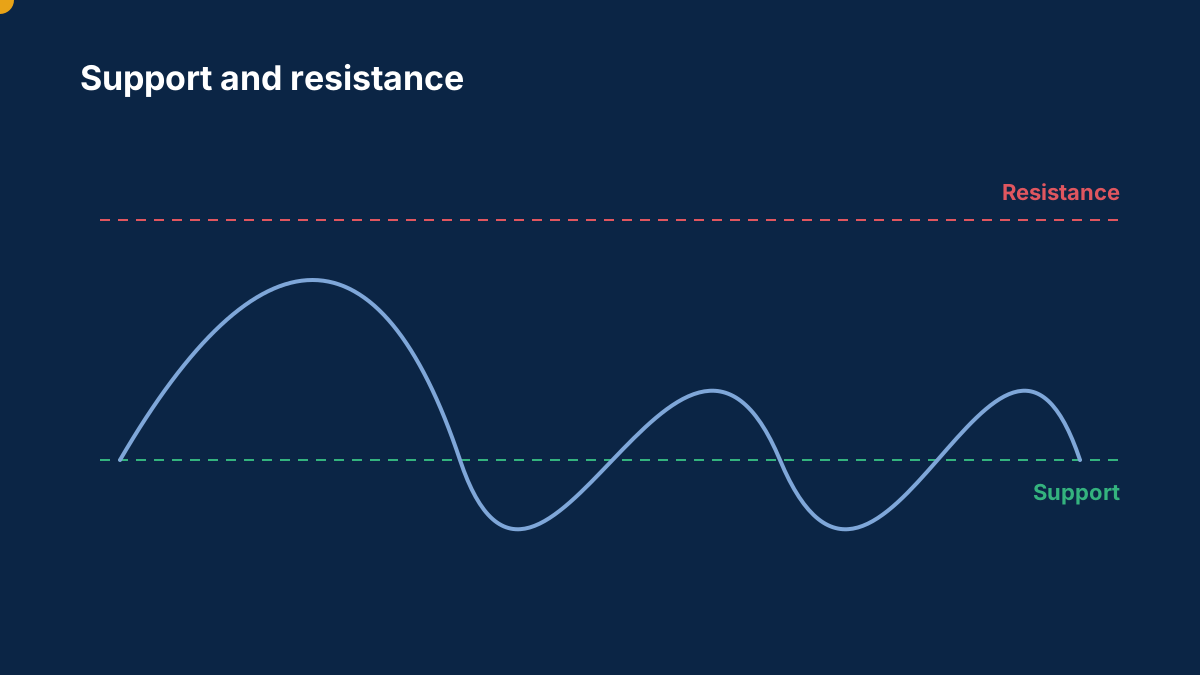
Price is respecting two boundaries — support below and resistance above — with at least two touches at each. A flat moving average on the higher time frame confirms the regime.
What is the best strategy for a ranging market?
Fading the boundaries: buy support on a rejection and sell resistance on a rejection, with the stop beyond the boundary and the opposite side as the target. The range's width gives the trade its risk-reward.
Comments
Log in to join the discussion. Comments follow the community guidelines.
Log in to commentLoading comments…