Trade balance and current account explained: do deficits weaken a currency?
The trade balance compares exports with imports; the current account adds income and transfers. How they're reported, why a deficit doesn't automatically weaken a currency, and what traders watch.
The trade balance is the difference between what a country exports and what it imports. Import more than you export and you run a trade deficit; export more and you run a surplus. The United States has run large deficits for decades, while China, Germany and Norway are known for surpluses.
Goods, services and the current account
- Goods balance: trade in physical products such as cars, oil and machinery.
- Services balance: trade in services such as tourism, finance, software and education.
- Trade balance: goods and services together.
- Current account: the trade balance, plus income earned on investments abroad minus income paid to foreign investors, plus transfers such as money sent home by workers abroad.
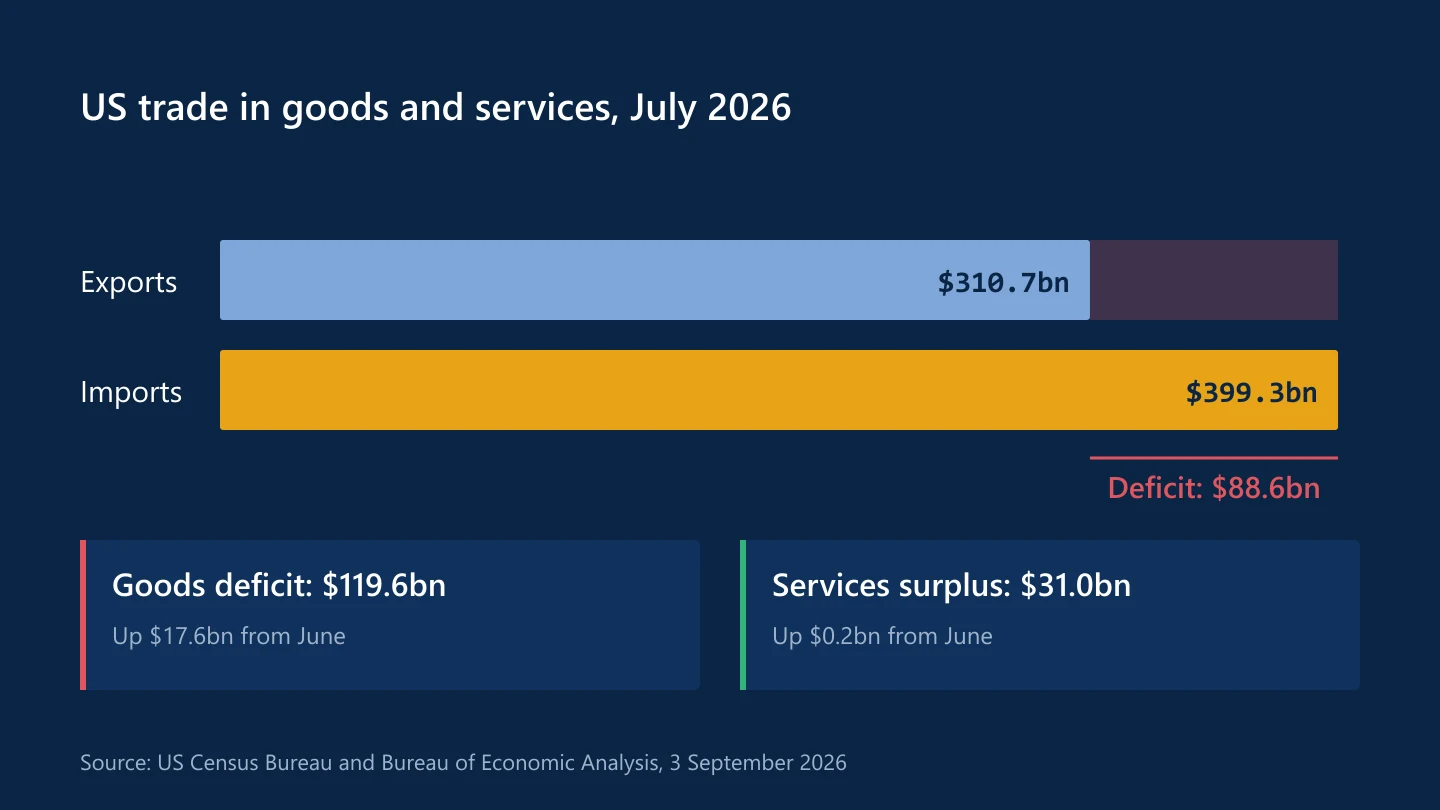
The US shows how the parts combine. In July 2026 it ran a goods deficit of $119.6 billion and a services surplus of $31.0 billion, for an overall trade deficit of $88.6 billion (report).
Every deficit has a financing side
A current account deficit means a country spends more abroad than it earns, and the difference has to be financed: foreigners buy its assets, such as government bonds, shares or property, or lend to it. In the balance of payments, the current account is matched by the capital and financial accounts.
That's why a deficit doesn't automatically weaken a currency. If investors want a country's assets, as they have wanted US Treasury bonds and shares for decades, those inflows can support the currency even while the deficit persists.
When the balance matters for currencies
- When financing gets harder. Countries with large deficits that rely on short-term foreign money are vulnerable if investors pull back, one ingredient of the Asian financial crisis.
- For commodity exporters. Export earnings rise and fall with commodity prices, part of why the Australian and Canadian dollars and the Norwegian krone respond to them.
- Through GDP. Net exports feed straight into GDP: they added 0.9 percentage points to euro area growth in the second quarter of 2026 (report).
- Through politics. Large bilateral deficits can prompt tariffs, which often move currencies more than the trade figures themselves.
How traders use the release
Monthly trade figures rarely cause large moves in major currencies on their own. Traders look at them for trends in exports, for their contribution to GDP, and in economies where trade is a large share of output. For China, where exports rose 25% in August 2026 (report), trade data can move the yuan and the currencies of its trading partners.
Sources
Common questions
What is the difference between the trade balance and the current account?
The trade balance covers exports and imports of goods and services. The current account adds income from investments abroad, minus income paid to foreign investors, and transfers such as remittances.
Does a trade deficit weaken a currency?
Not automatically. A deficit has to be financed by foreign investment or lending, and if investors want the country's assets, those inflows can support its currency.
What was the US trade deficit in July 2026?
$88.6 billion, made up of a $119.6 billion goods deficit and a $31.0 billion services surplus.
This article is for information only and is not financial advice. Trading forex and CFDs carries a high risk of losing money. Read the risk warning. Spotted an error? Tell the editors.
Comments
Log in to join the discussion. Comments follow the community guidelines.
Log in to commentLoading comments…