New Zealand's economy grows 0.2% in the June quarter as construction offsets weaker transport and retail
GDP rose 0.2% after 0.9% in the March quarter, Stats NZ said on 17 September. Higher import prices cut real national disposable income by 0.4%.
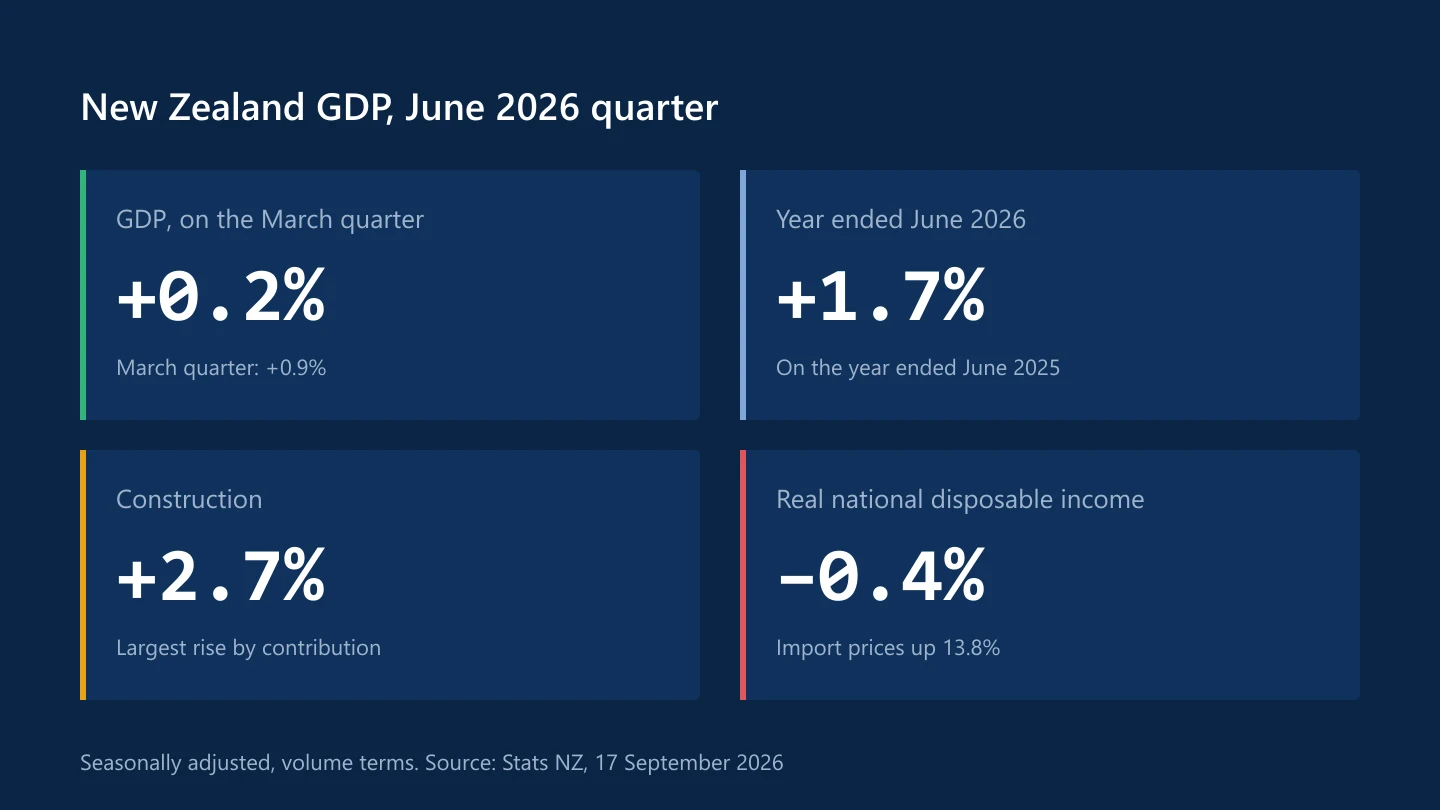
Stats NZ published gross domestic product for the June 2026 quarter at 10:45 a.m. New Zealand time on Thursday 17 September (22:45 UTC on 16 September).
The headline figures
Seasonally adjusted, in volume terms, compared with the March 2026 quarter:
- GDP: up 0.2%, after a 0.9% rise in the March quarter
- Expenditure on GDP: up 0.4%, after 1.1%
- GDP per person: up 0.1%
- Year ended June 2026: GDP 1.7% higher than in the year ended June 2025, and expenditure on GDP 2.2% higher
In current prices, the economy was worth $455 billion over the year to June.
Which industries grew
- Construction: up 2.7%, the largest contribution, led by construction services and residential building
- Public administration and safety: up 2.0%
- Wholesale trade: up 1.3%
- Health care and social assistance: up 0.8%
Falls came in transport, postal and warehousing, down 1.7% because of weaker road transport, and retail trade and accommodation, down 1.0%. Accommodation and food services fell 3.8%, which Stats NZ said may point to a change in discretionary spending.
Spending, trade and the fuel bill
- Exports: up 3.3%
- Investment (gross fixed capital formation): up 1.5%
- Imports: down 0.8%
- Central government spending: down 2.0%
- Household spending on transport: down 1.6%
Fuel prices shaped the quarter. Import prices rose 13.8% while export prices rose 3.5%, so the terms of trade fell and real gross national disposable income, a measure of what the country's income can buy, dropped 0.4%, or 0.6% per person. Imports of processed fuels, including diesel, rose 19.8% in volume but 123.8% in value.
What it means for the RBNZ and the kiwi
The Reserve Bank of New Zealand raised the official cash rate to 2.75% on 2 September, with annual inflation at 4.1% (report). Slower growth and a squeeze on real incomes sit alongside inflation well above its 1–3% target, which is the trade-off the bank has to weigh.
The New Zealand dollar is sensitive to commodity prices and global risk appetite (commodity currencies), and to US rates after the Federal Reserve's increase on 16 September (report). GDP explained covers how traders read growth figures. Live prices: NZD/USD and AUD/USD.
Sources
Common questions
How is the New Zealand economy doing?
GDP grew 0.2% in the June 2026 quarter after 0.9% in the March quarter, and was 1.7% higher over the year ended June 2026. Real gross national disposable income fell 0.4% as import prices rose 13.8%.
How big is New Zealand's economy?
In current prices, New Zealand's GDP was $455 billion (New Zealand dollars) for the year ended June 2026, according to Stats NZ.
This article is for information only and is not financial advice. Trading forex and CFDs carries a high risk of losing money. Read the risk warning. Spotted an error? Tell the editors.

Comments
Log in to join the discussion. Comments follow the community guidelines.
Log in to commentLoading comments…