Trend following or mean reversion: which suits you, and why?
Most methods fall roughly into two camps. Trend followers buy strength and sell weakness, accept lots of small losses and rely on a few large winners. Mean reversion traders fade stretched moves, win more often, and have to keep losses contained when a range breaks.
Neither is better in general, but they feel very different to trade, and many people find one suits their temperament far better than the other.
Tell us:
- which approach you use, and the conditions in which it struggles
- your typical win rate and average win against average loss (in R, if you track it)
- how you tell a trending market from a ranging one before you commit
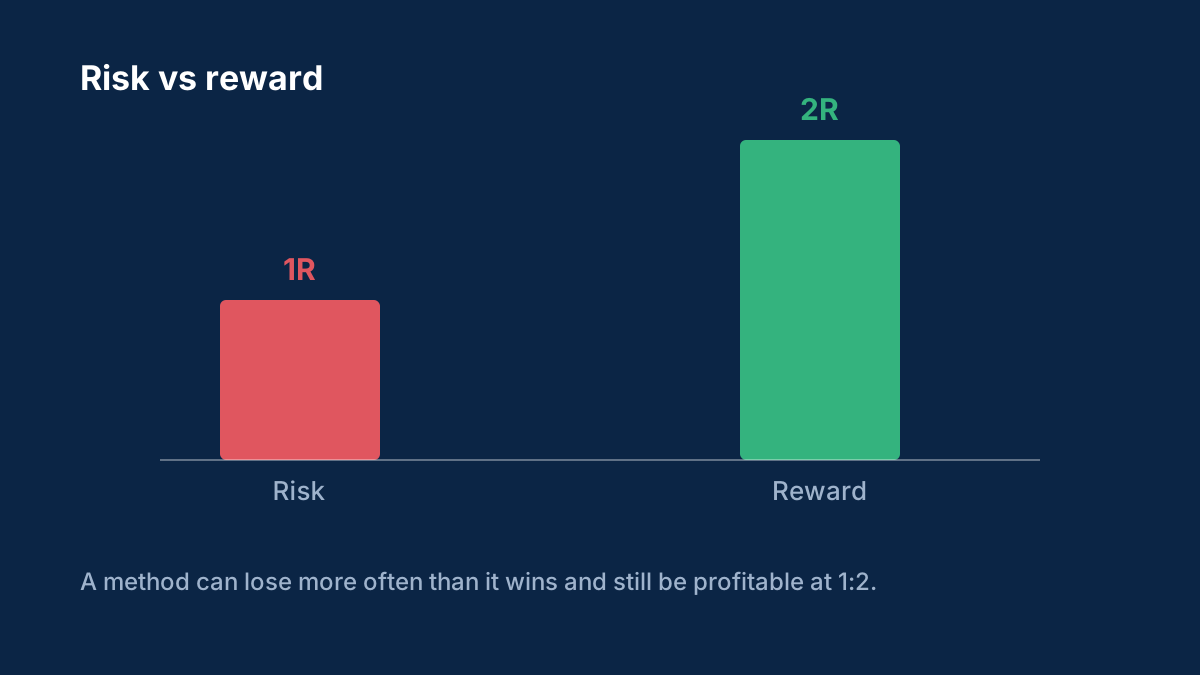
See risk-reward, win rate and expectancy for why win rate alone tells you little.
Comments
Log in to join the discussion. Comments follow the community guidelines.
Log in to commentLoading comments…
A worked comparison, with made-up but typical numbers, of why both approaches can work and why they feel so different.
- Trend following: wins 35% of trades, average win 3R, average loss 1R. Expectancy = 0.35 × 3 − 0.65 × 1 = +0.40R per trade.
- Mean reversion: wins 65% of trades, average win 0.8R, average loss 1R. Expectancy = 0.65 × 0.8 − 0.35 × 1 = +0.17R per trade.
The first has a better expectancy, but its losing streaks are much longer, and most traders find that harder to sit through. The second feels better day to day, but a few losses larger than 1R, for example when a range breaks sharply, can wipe out its edge.
To tell the conditions apart, some traders check whether price is making consistent higher highs and lows on a higher time frame, or whether a measure such as ATR is shrinking, which often happens in ranges.
Background: risk-reward, win rate and expectancy. Members, which one matches your temperament?
0