UK unemployment steady at 4.9% as private sector pay growth edges up to 2.9%
ONS figures for May to July show unemployment at 4.9% and regular pay growth of 3.5%, while payrolled employees fell 145,000 on the year. The Bank of England decides on 17 September.
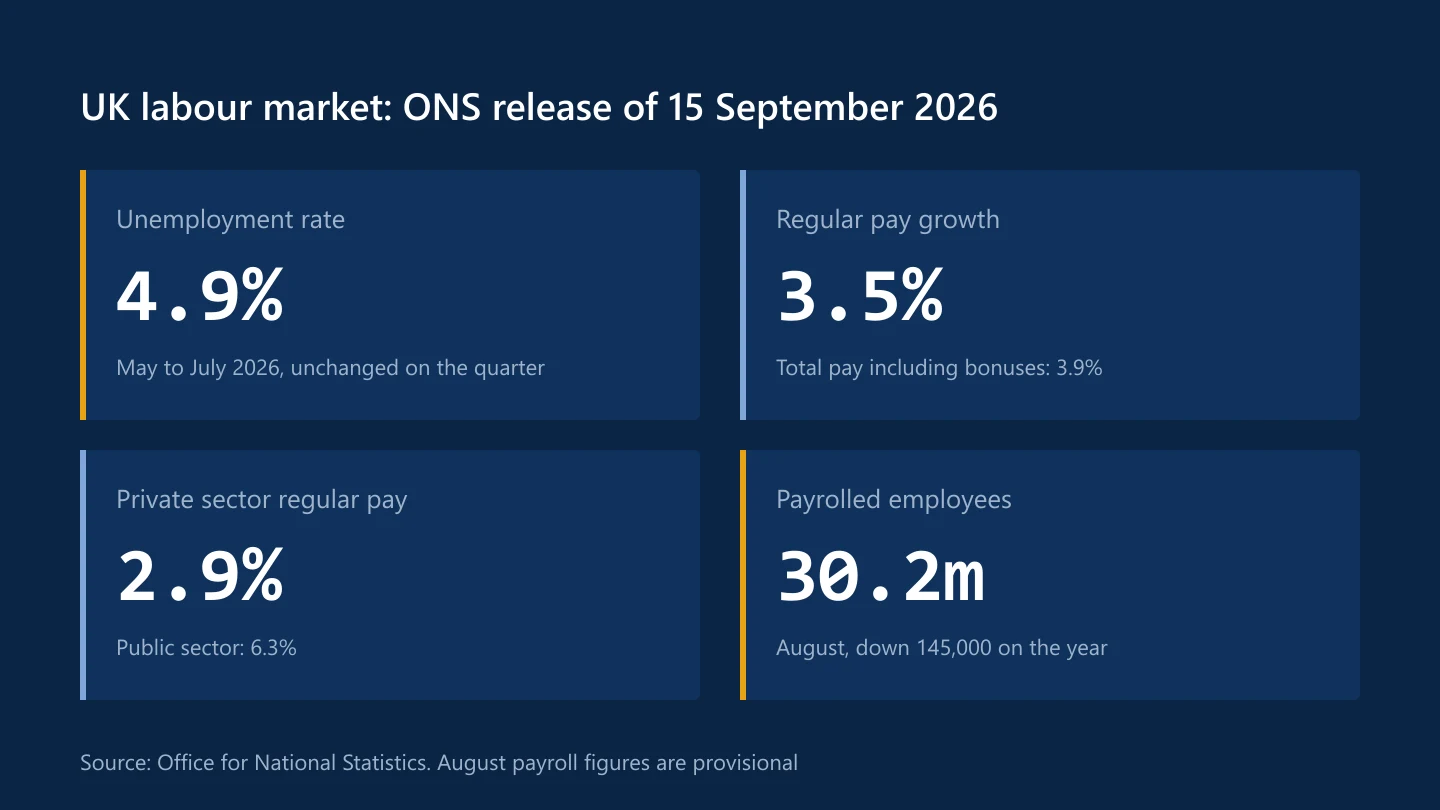
The Office for National Statistics published its latest UK labour market figures on Tuesday 15 September 2026, two days before the Bank of England announces its interest rate decision. This is the release our preview looked ahead to.
The headline figures
For May to July 2026:
- Unemployment rate (ages 16 and over): 4.9%, up 0.2 percentage points on the year and largely unchanged on the quarter
- Employment rate (ages 16 to 64): 75.1%, down 0.1 points on the year and largely unchanged on the quarter
- Economic inactivity rate (ages 16 to 64): 20.9%, down 0.1 points on both the year and the quarter
Payrolls, vacancies and the claimant count
- Payrolled employees: 30.2 million in August, down 145,000 (0.5%) on the year and 26,000 (0.1%) on the month. The ONS says the August figures are provisional and likely to be revised next month.
- Vacancies: 702,000 in June to August, down 8,000 (1.1%) on March to May. The ONS says vacancies have been broadly flat since the start of the year, down 16,000 since January to March.
- Claimant count: 1.692 million in August, up on both the month and the year.
Pay growth
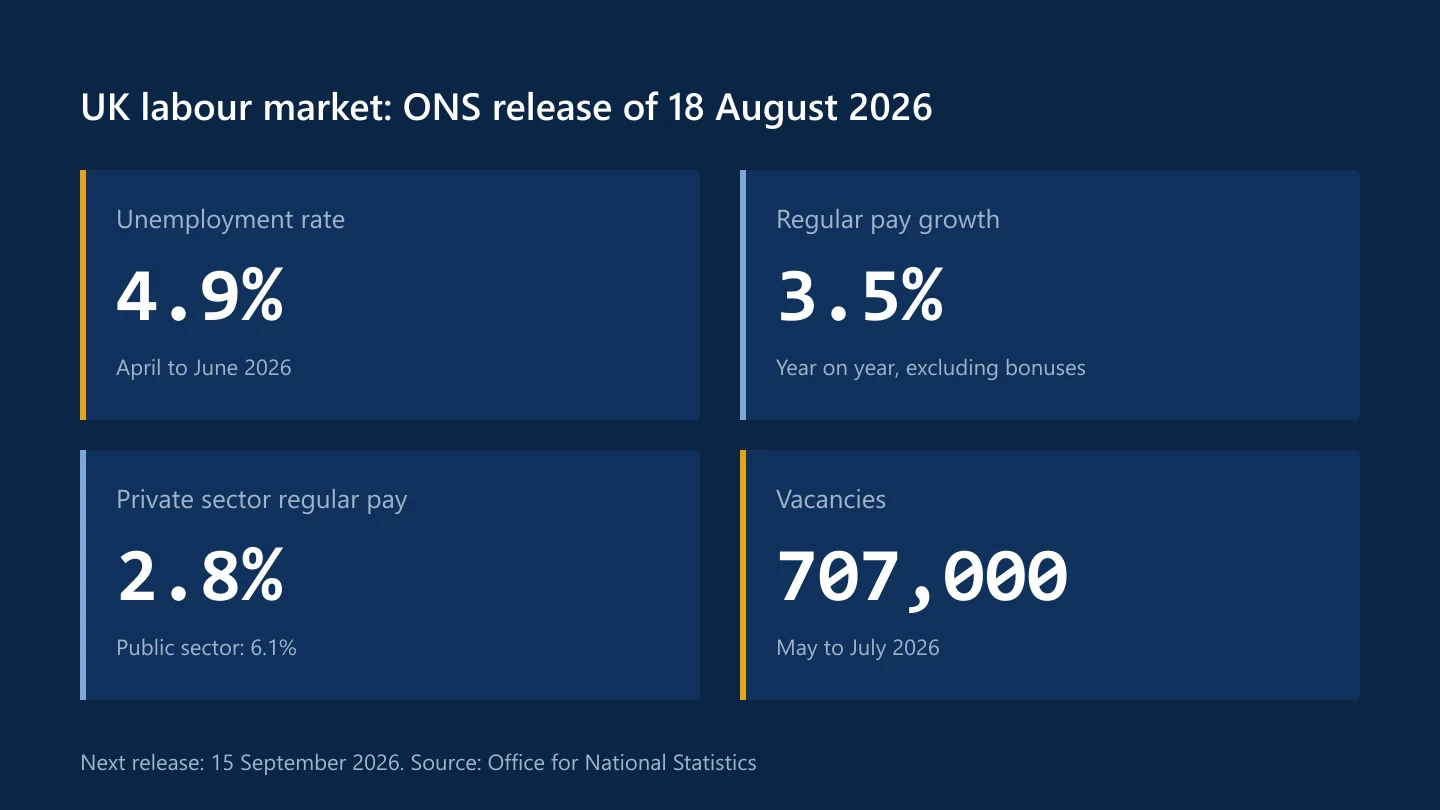
- Regular pay, excluding bonuses: up 3.5% a year, the same rate as in the previous release
- Total pay, including bonuses: up 3.9%, compared with 4.1% in the previous release
- Private sector regular pay: up 2.9%, compared with 2.8% for April to June
- Public sector regular pay: up 6.3%, compared with 6.1%
Adjusted for inflation using CPIH, real regular pay grew 0.6% and real total pay 0.9%. Using CPI instead, the figures were 0.8% and 1.1%.
Handle the survey figures with care
The ONS says some volatility remains in Labour Force Survey estimates despite improved responses, and advises caution when drawing conclusions from short-term changes. An operational issue in May 2026 had a small but noticeable effect on estimates of average hours and total hours worked. Payroll data from tax records and the vacancies survey give a cross-check on the survey.
What it means for the Bank of England
In July, the Monetary Policy Committee held Bank Rate at 3.75%, with three of its nine members voting to raise it to 4% (Bank of England preview). Private sector regular pay growth is one of the measures the committee watches for domestic inflation pressure. In this release it moved up by 0.1 percentage point, unemployment was unchanged and the number of payrolled employees fell again.
The other recent UK data: inflation was 2.9% in July (report) and GDP grew 0.4% in July (report). The decision is announced on Thursday 17 September; times in your time zone are on the economic calendar. Sterling prices: GBP/USD and EUR/GBP.
Sources
Common questions
What is the UK unemployment rate?
4.9% for May to July 2026, according to the Office for National Statistics release of 15 September 2026. That is up 0.2 percentage points on a year earlier and largely unchanged on the previous quarter.
How fast are UK wages growing?
Regular pay grew 3.5% a year and total pay 3.9% in May to July 2026. Private sector regular pay grew 2.9% and public sector regular pay 6.3%.
How many job vacancies are there in the UK?
An estimated 702,000 in June to August 2026, down 8,000 on March to May 2026.
This article is for information only and is not financial advice. Trading forex and CFDs carries a high risk of losing money. Read the risk warning. Spotted an error? Tell the editors.

Comments
Log in to join the discussion. Comments follow the community guidelines.
Log in to commentLoading comments…