Canada's July retail sales are due 24 September after Statistics Canada's early estimate of a 0.8% fall
Statistics Canada's advance estimate points to a 0.8% drop in July after June's 0.6% gain to $74.3 billion. The full report, with detail by type of store, is published on 24 September.

Statistics Canada publishes its detailed retail trade report for July on Thursday 24 September 2026 (week-ahead calendar). The agency has already given an early reading: an advance estimate that sales decreased 0.8% in July. Such estimates are preliminary and are revised as more survey responses arrive.
Where June left off
Retail sales rose 0.6% to $74.3 billion in June, and in volume terms they grew 1.5%. Sales were up in seven of nine subsectors, led by general merchandise retailers. Core retail sales, which exclude gasoline stations and motor vehicle dealers, rose 1.2%, with general merchandise up 2.7% and clothing and accessories up 3.1%. The largest fall was at gasoline stations and fuel vendors, down 4.1%.
What the advance estimate implies
A 0.8% fall in July would follow June's gain, and the split between value and volume will matter. Gasoline stations were the weakest part of June's report, so the breakdown by store type on 24 September will show whether July's drop was concentrated in fuel and vehicles or spread across retailers. The gap between sales in dollars and in volume also shows how much of any change comes from prices rather than from the quantity sold.
The wider picture
- Inflation: Canada's CPI was 3.0% in August, and gasoline was still 22.8% higher than a year earlier (report)
- Housing: national home sales edged down 0.7% in August (report)
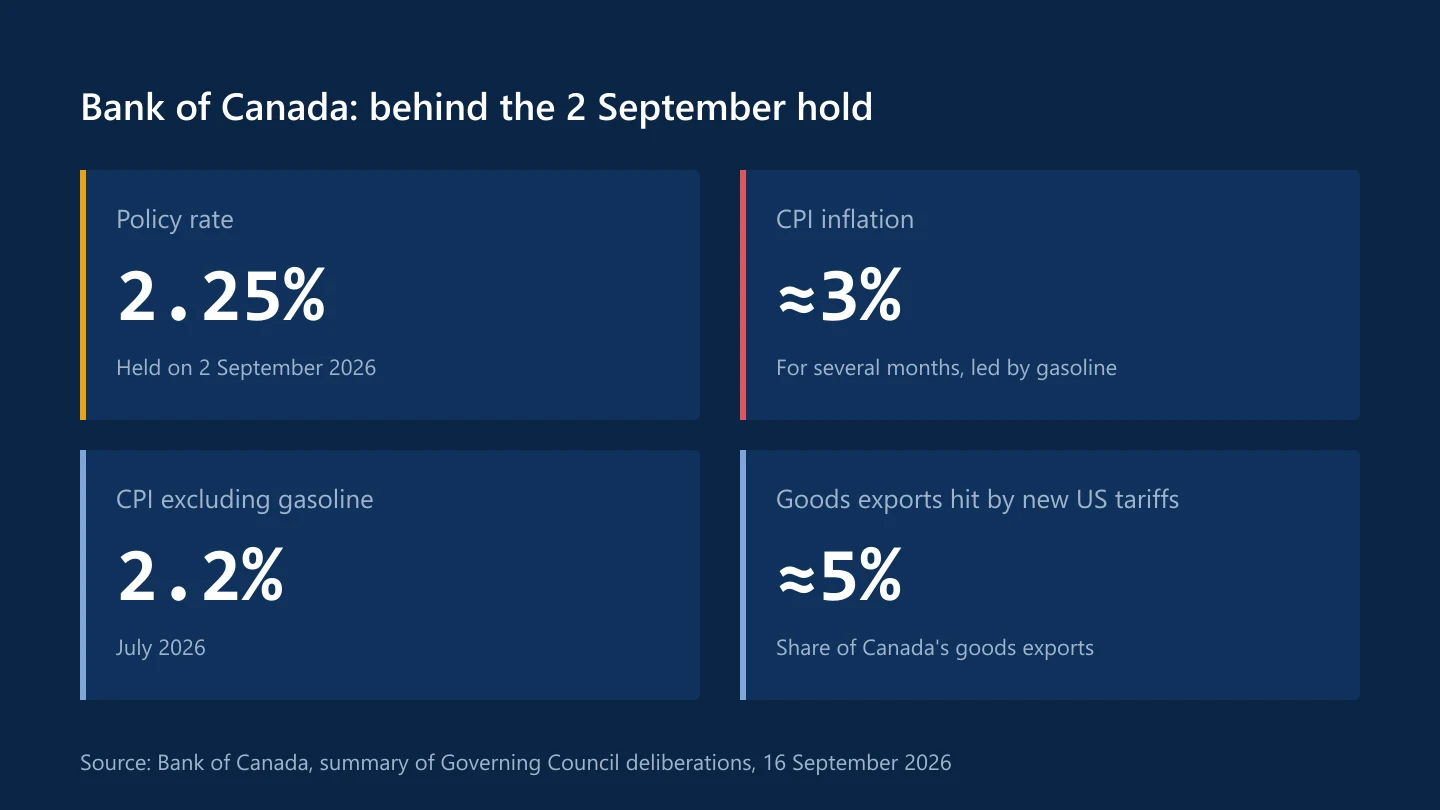
- Interest rates: the Bank of Canada held its policy rate at 2.25% on 2 September for a seventh straight decision, citing the Middle East conflict and the breakdown in trade talks with the United States (report). Its next announcement is on 28 October
What it means for the Canadian dollar
Retail sales feed the Bank of Canada's assessment of household demand, and oil prices move the Canadian dollar through both trade flows and inflation (oil and the Canadian dollar). For USD/CAD, a result far from the early estimate matters more than one in line with it, because the estimate is already known to traders. How to read an economic calendar explains how forecast and previous readings are compared.
Sources
Common questions
When is Canada's July retail sales report released?
Thursday 24 September 2026, when Statistics Canada publishes retail trade for July.
What was Statistics Canada's advance estimate for July retail sales?
The agency's advance estimate was that retail sales decreased 0.8% in July. It is preliminary and will be revised in the full report.
How much were Canadian retail sales in June 2026?
$74.3 billion, up 0.6% from May. In volume terms sales rose 1.5%, and core retail sales, excluding gasoline stations and motor vehicle dealers, rose 1.2%.
What is the Bank of Canada's interest rate?
2.25%. The Bank held its target for the overnight rate on 2 September 2026 for a seventh decision in a row, and its next announcement is on 28 October.
How do Canadian retail sales affect the Canadian dollar?
They inform the Bank of Canada's view of household demand and so of interest rates. A result far from the early estimate moves USD/CAD more than one in line with it.
This article is for information only and is not financial advice. Trading forex and CFDs carries a high risk of losing money. Read the risk warning. Spotted an error? Tell the editors.

Comments
Log in to join the discussion. Comments follow the community guidelines.
Log in to commentLoading comments…